Wearable Ultrasound Patch Noninvasively Reaches Deep Brain Sleep Circuits at Home, Accelerating REM Sleep by 43 Minutes
Researchers from three US institutions have developed NEUSLeeP, a soft wearable patch combining ultrasound neuromodulation with real-time EEG monitoring that noninvasively targets deep brain sleep regions previously accessible only through surgery or pharmacology.
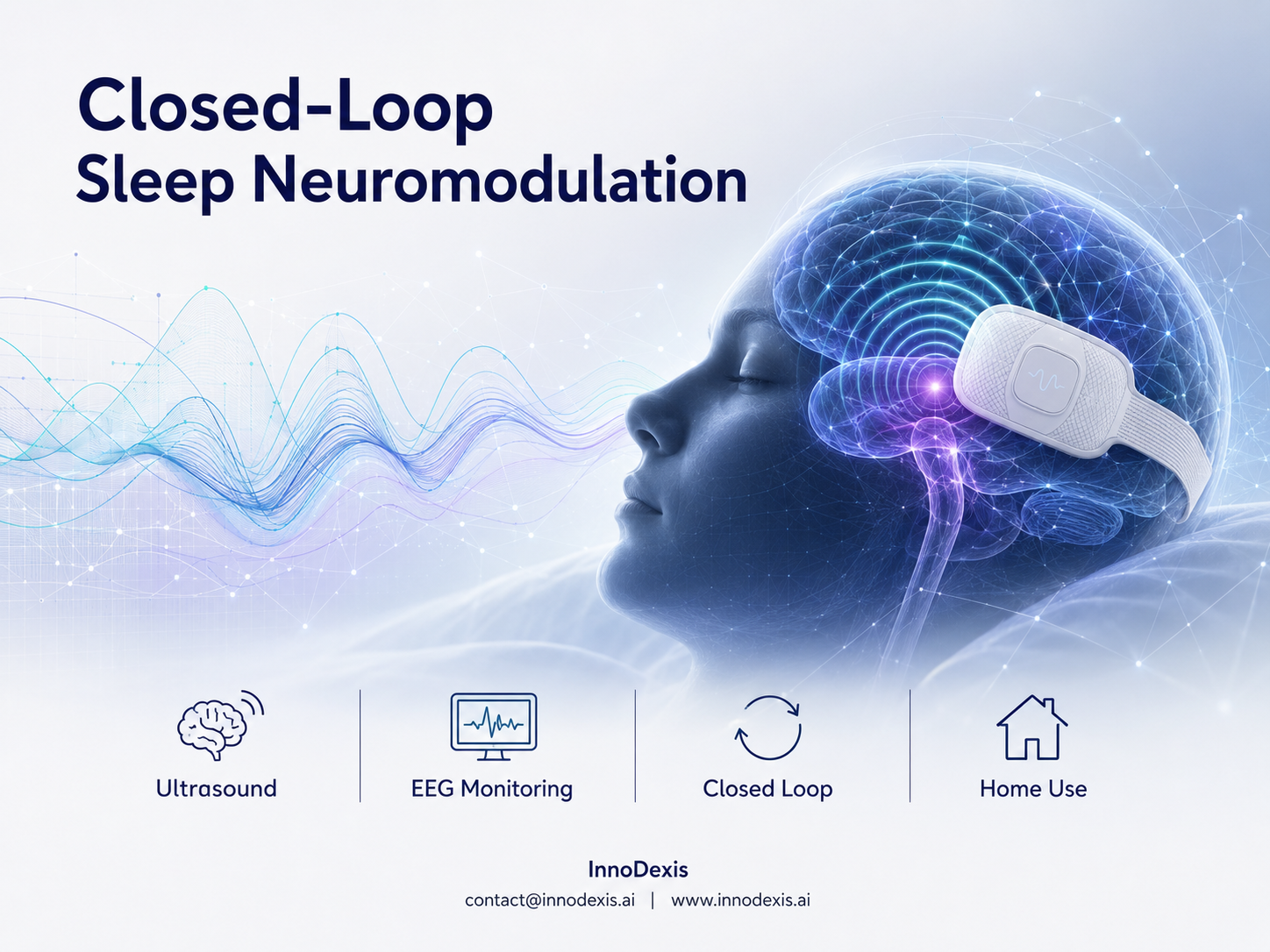
InnoDexis has published its latest Innovation Intelligence Report covering wearable neuromodulation and sleep science, analyzing a high-significance innovation developed across three United States research institutions — UT Austin, Virginia Tech, and UT Health San Antonio. The report reveals that researchers have developed NEUSLeeP, a soft wearable skin patch that combines ultrasound stimulation with real-time EEG monitoring to noninvasively target deep brain sleep circuits at home, demonstrating in a 28-participant study that participants entered REM sleep 43 minutes sooner on average and extended REM sleep duration by approximately 16 minutes per session.
Key Findings
NEUSLeeP represents the first wearable form factor to combine closed-loop ultrasound neuromodulation and real-time EEG monitoring in a single device deployable outside clinical settings. Deep brain sleep circuits were previously accessible only through surgical intervention or pharmacological approaches, both of which carry significant infrastructure requirements or systemic side effects. The patch delivers a structurally different access pathway — noninvasive, drug-free, and operable at home by participants without clinical supervision.
Across 28 participants tested at home, NEUSLeeP stimulation accelerated REM sleep onset by 43 minutes on average. This magnitude of effect on sleep onset timing is significant in the context of conditions where REM sleep disruption is a central pathological feature, including PTSD, depression, and chronic insomnia — conditions for which current pharmacological interventions carry systemic side effects and clinical-setting devices require supervised use.
REM sleep duration was extended by approximately 16 minutes per session under NEUSLeeP stimulation. The combination of faster REM onset and extended REM duration within a single home-use session establishes a dual functional effect that distinguishes this approach from interventions targeting only one dimension of sleep architecture.
The device simultaneously stimulates and records live neural signals in real time, creating a closed-loop system that monitors brain response during active stimulation. This closed-loop capability within a wearable form factor is a methodological advance over open-loop neuromodulation approaches, which deliver stimulation without concurrent neural feedback. The ability to record live EEG response during ultrasound stimulation at home — rather than in a clinical or laboratory setting — extends the operational boundary of closed-loop neuromodulation as a research and therapeutic tool.
NEUSLeeP sits at the boundary between consumer wearables and prescription therapeutics. The home-use deployment across 28 participants demonstrates feasibility outside controlled clinical environments, while the depth of neural targets reached and the clinical relevance of the conditions it addresses — PTSD, depression, chronic insomnia — position it within the regulatory and therapeutic landscape of medical devices rather than consumer health technology.
Strategic Insight and Trend Analysis
The dominant trend this innovation signals is a structural shift in neuromodulation: from interventions that require clinical settings, surgical access, or pharmacological delivery toward closed-loop, home-deployable wearable systems capable of reaching deep brain targets noninvasively. NEUSLeeP is not an incremental improvement within an existing product category — it combines capabilities that have not previously coexisted in a single wearable form factor.
The strategic significance of this combination is threefold. First, ultrasound penetration of deep brain sleep circuits through a skin-attached patch removes the access barrier that has historically defined the boundary between consumer sleep wearables and clinical neuromodulation devices. Second, real-time EEG integration within the same form factor enables closed-loop operation — the device responds to live neural signals rather than delivering fixed stimulation. Third, home deployment across 28 participants demonstrates that this capability does not require a clinical environment to function, which is the prerequisite condition for any pathway toward scaled therapeutic use.
The conditions NEUSLeeP targets — PTSD, depression, and chronic insomnia — represent a substantial and underserved treatment population where pharmacological interventions carry known limitations. A drug-free, home-use alternative that demonstrably modulates the specific brain circuits implicated in these conditions introduces a new category of intervention into a therapeutic space that has seen limited structural innovation. Larger clinical trials, as the researchers note, will determine the regulatory and commercial timeline — but the feasibility data from 28 home-use participants establishes the foundation those trials will build on.
Global and Industry Implications
For corporates and R&D teams in medical devices and digital health, NEUSLeeP identifies a convergence point between ultrasound neuromodulation, wearable EEG, and closed-loop signal processing that warrants strategic monitoring. Organisations operating in sleep technology, psychiatric device development, or bioelectronic medicine will need to assess how home-deployable deep brain neuromodulation affects their product and pipeline positioning, particularly as clinical trial data matures.
For investors and capital allocators, the innovation occupies a high-potential but pre-regulatory stage. The 28-participant home-use study establishes feasibility and initial efficacy signals, but the pathway from university research to regulated therapeutic device requires larger clinical trials and regulatory engagement. The intersection of the psychiatric condition addressable market — PTSD, depression, chronic insomnia — with a drug-free, home-use modality represents a commercially significant opportunity if clinical trial outcomes sustain the initial findings.
For policymakers and national innovation bodies, NEUSLeeP illustrates the translational value of funding research at the intersection of neuroscience, materials science, and wearable engineering. The three-institution US collaboration that produced this innovation reflects the cross-disciplinary infrastructure investment required to advance bioelectronic medicine from laboratory concept to home-deployable prototype.
InnoDexis Statement
"NEUSLeeP redefines the access boundary for deep brain neuromodulation by delivering closed-loop ultrasound stimulation and real-time EEG monitoring through a home-use wearable — collapsing a capability gap that previously required surgery or pharmacology to bridge," noted InnoDexis in its latest intelligence report.
Conclusion
As psychiatric conditions tied to sleep dysregulation represent one of the most challenging therapeutic frontiers in medicine, the emergence of a home-deployable wearable capable of noninvasively targeting deep brain sleep circuits marks a structurally significant development. The progression of NEUSLeeP through larger clinical trials will determine how rapidly this technology moves from university research toward regulated therapeutic deployment. InnoDexis will continue to monitor developments in closed-loop neuromodulation, wearable bioelectronic medicine, and the convergence of consumer and clinical-grade neurotechnology. The complete Wearable Neuromodulation Innovation Intelligence Report is available to InnoDexis subscribers and enterprise clients.
About InnoDexis
InnoDexis is a global Innovation Intelligence platform that tracks, analyzes, and interprets breakthrough innovations, prototypes, and emerging technologies across industries and countries. Its intelligence helps corporates, investors, and policymakers understand the true structure and direction of global innovation. Learn more at innodexis.ai.