United States, Germany, and United Kingdom Capture 65% of Global Genomics Breakthroughs as Deployment Becomes Strategic Differentiator
An analysis of 234 genomics breakthroughs reveals geographic concentration of capability and emerging competition around food security, clinical translation, and sovereign genomic infrastructure
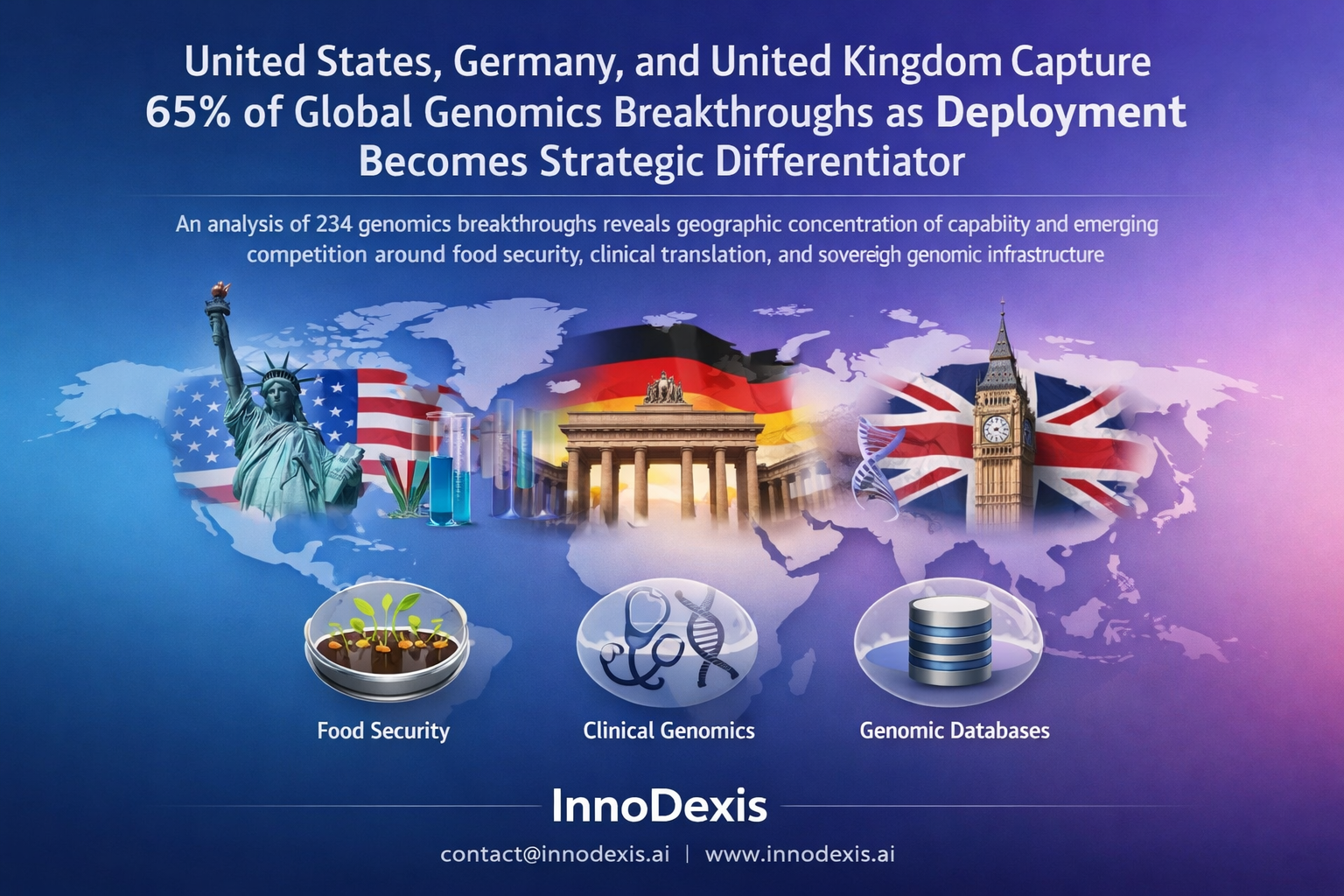
InnoDexis has published its latest Innovation Intelligence Report covering genomics innovation, analyzing 234 breakthroughs across multiple countries between February 1–19, 2026. The report reveals that 65% of documented genomics breakthroughs are concentrated in three countries: the United States, Germany, and the United Kingdom. The findings indicate not only scientific leadership, but a structural concentration of genomics capability that is increasingly shaping national competitiveness in healthcare, agriculture, and data infrastructure.
Key Findings
A total of 234 genomics breakthroughs were tracked during the February 1–19, 2026 analysis window. Of these, 65% originated from the United States, Germany, and the United Kingdom, demonstrating a pronounced geographic clustering of advanced genomics activity within a limited group of nations.
Food security is emerging as a competitive genomics domain. The STR4 resistance gene protecting Cavendish bananas reached commercial deployment in France during the period analyzed, without classification as a genetically modified organism. This development signals the practical application of precision breeding technologies within national agricultural systems.
Clinical genomics continues to advance at the research level, but translation into widespread deployment remains uneven. The Advanced Research Projects Agency for Health (ARPA-H) allocated $8.7 million to the LIGHT programme to validate genomic diagnostic panels, underscoring federal-level support for clinical genomics development while highlighting ongoing regulatory and implementation pathways.
Population-scale genomic databases are consolidating as strategic assets. The UK Biobank has accumulated more than 500,000 genomes, while the All of Us research programme has surpassed 336,000 genomes. These large-scale datasets represent foundational infrastructure supporting research, diagnostics, and public health planning.
Strategic Insight and Trend Analysis
The concentration of 65% of genomics breakthroughs within three countries suggests that genomics innovation is no longer evenly distributed across global research systems. Instead, capability appears to be consolidating within national ecosystems that combine research institutions, funding mechanisms, regulatory frameworks, and data infrastructure.
The commercial deployment of the STR4 resistance gene in France illustrates a transition from laboratory innovation to field-level implementation in agriculture. Precision breeding technologies, particularly those not classified under traditional GMO frameworks, are entering national food systems as instruments of resilience and productivity.
In clinical genomics, the $8.7 million allocation by ARPA-H to the LIGHT programme reflects sustained public investment in diagnostic validation. However, the broader dataset indicates that discovery momentum exceeds the pace of regulatory translation and large-scale deployment. This divergence highlights the importance of regulatory alignment and healthcare system integration in determining which regions convert genomic science into measurable health outcomes.
The scale of genomic databases such as UK Biobank and All of Us reinforces the role of data as strategic infrastructure. Population-scale datasets enable longitudinal research, disease risk modeling, and precision medicine development. As these databases expand, they increasingly shape national competitiveness in biotechnology and health innovation.
Collectively, the findings suggest that the next phase of genomics competition will be defined less by initial discovery and more by the ability to scale, govern, and protect genomic intelligence assets.
Global and Industry Implications
For corporates and R&D teams, the geographic concentration of breakthroughs signals where partnership, licensing, and acquisition opportunities may be most active. Organizations operating in healthcare and agriculture may need to align with ecosystems that demonstrate both research strength and deployment capability.
For investors and capital allocators, the data indicates that scale and infrastructure readiness may differentiate returns more than early-stage discovery. Regions with established genomic databases and regulatory clarity could present comparatively lower translation risk.
For policymakers and national innovation bodies, the findings underscore the strategic importance of genomic data governance, regulatory efficiency, and agricultural biotechnology frameworks. Sovereign genomic infrastructure is emerging as a determinant of long-term competitiveness in both health and food systems.
InnoDexis Statement
“The February 2026 genomics dataset indicates that competitive advantage is shifting from discovery volume to deployment capability and data governance strength,” noted InnoDexis in its latest intelligence report.
Conclusion
The February 1–19, 2026 genomics analysis highlights a concentrated innovation landscape led by the United States, Germany, and the United Kingdom. Food security applications, clinical diagnostic validation, and population-scale genomic databases are defining the current strategic frontier. As genomics moves further into agricultural systems and healthcare infrastructure, regional deployment capacity is likely to shape long-term outcomes. The complete February 2026 Genomics Innovation Intelligence Report is available to InnoDexis subscribers and enterprise clients.
About InnoDexis
InnoDexis is a global Innovation Intelligence platform that tracks, analyzes, and interprets breakthrough innovations, prototypes, and emerging technologies across industries and countries. Its intelligence helps corporates, investors, and policymakers understand the true structure and direction of global innovation. Learn more at innodexis.ai.