United States Commits $1 Billion to Largest Modern Hypersonic Ground-Testing Complex as Infrastructure Gap Constrains National Aerospace Programmes
A $1 billion+ integrated physical-digital hypersonic research and testing complex in Rosemount, Minnesota addresses a federally validated infrastructure deficiency that has left U.S. hypersonic ground-testing capacity behind programme demand.
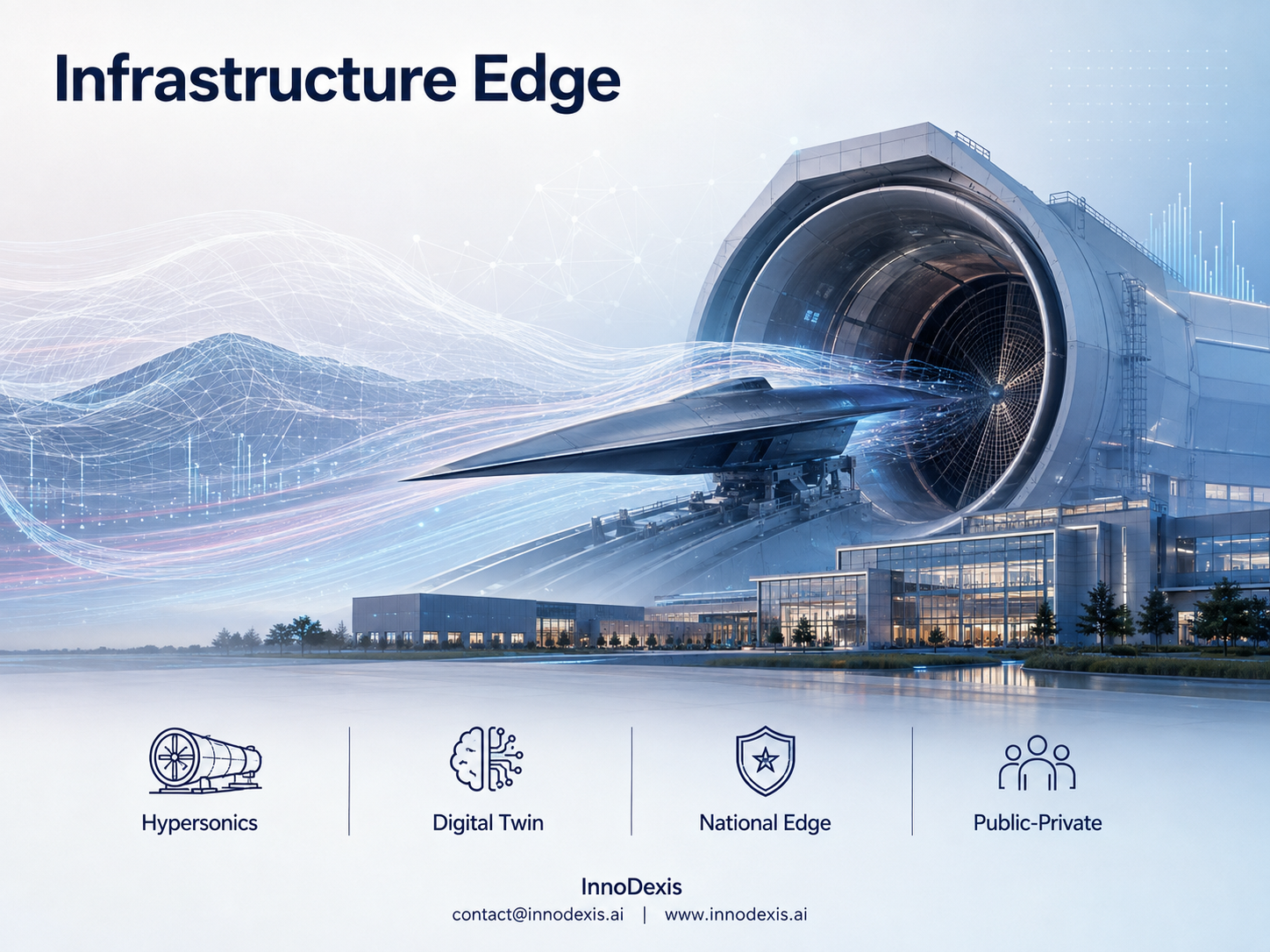
InnoDexis has published its latest Innovation Intelligence Report covering hypersonic research and testing infrastructure, analyzing a landmark capital investment in the United States. The report reveals that North Wind, the University of Minnesota, and the Department of Defense Test Resource Management Center are jointly developing a $1 billion+ hypersonic research and testing complex spanning 60 acres in Rosemount, Minnesota. The facility integrates physical wind-tunnel testing with AI-enabled digital engineering ecosystems and directly addresses a ground-testing capability gap formally validated by the Government Accountability Office — representing the largest modern upgrade to U.S. hypersonic testing infrastructure.
Key Findings
The Rosemount complex represents a capital commitment exceeding $1 billion across a 60-acre research and testing site — the largest modern investment in U.S. hypersonic ground-testing infrastructure. The scale of investment reflects the structural nature of the capability gap it addresses: existing U.S. hypersonic ground-testing infrastructure was not keeping pace with the demands of active hypersonic development programmes, a deficiency that compounds cost and schedule risk across the national aerospace portfolio.
The Government Accountability Office formally validated the ground-testing deficiency before private capital responded to the gap. This sequence — federal acknowledgement preceding infrastructure investment — is significant because it establishes the facility's strategic rationale on public record, reducing the ambiguity typically associated with large-scale defence infrastructure commitments and providing a documented basis for the investment that extends beyond individual programme requirements.
The facility is designed to integrate physical wind-tunnel testing with AI-enabled digital engineering ecosystems. This physical-digital integration is the core methodological advance of the complex: AI-driven digital models operating alongside physical wind tunnels are designed to identify design risks before they surface in late-stage flight tests, front-loading risk identification into earlier and less costly phases of the development cycle.
The facility's design philosophy directly targets the cost structure of hypersonic development failures. Deficiencies that currently surface only during flight testing carry significantly higher remediation costs than those identified during ground-test phases. By compressing the risk identification timeline through integrated physical-digital testing, the complex is structured to reduce the incidence of late-stage programme failures across hypersonic development portfolios.
The consortium structure — combining North Wind as the facility developer, the University of Minnesota as the academic research anchor, and the DoD Test Resource Management Center as the federal programme body — reflects a deliberate public-private architecture. This structure positions the complex to serve both national defence hypersonic programmes and broader aerospace research requirements, extending its utility beyond any single procurement programme.
Strategic Insight and Trend Analysis
The dominant strategic signal from this dataset is a reframing of the binding constraint in U.S. hypersonic development. The prevailing discourse around hypersonic competition has focused predominantly on technology — propulsion systems, thermal protection materials, guidance and control. This investment shifts the analytical focus toward infrastructure as an equally significant constraint: if ground-testing capacity cannot keep pace with programme demand, technology advances cannot be validated and fielded at the required rate regardless of their technical merit.
The GAO's prior formal documentation of the deficiency is strategically important beyond its administrative function. It establishes that the infrastructure gap was not a matter of industry perception but of federal record — a distinction that carries weight for programme planning, budget justification, and allied confidence in U.S. hypersonic development timelines. The investment that followed represents a structural response to a structurally documented problem.
The integration of AI-enabled digital engineering with physical wind-tunnel infrastructure signals a broader shift in how high-consequence aerospace testing is being conceived. Rather than treating physical testing and computational modelling as sequential or parallel activities, the Rosemount complex embeds them as a unified ecosystem. This architecture reflects lessons from programmes where late-stage flight test failures have demonstrated the cost of inadequate early-phase ground validation.
The 60-acre scale and $1 billion+ capital commitment also signal that the infrastructure rebuild is intended to serve a generational timeframe rather than a single programme cycle — positioning Rosemount as a durable national asset rather than a project-specific facility.
Global and Industry Implications
For corporates and R&D teams in aerospace and defence, the Rosemount complex expands available ground-testing capacity for hypersonic programme validation in the United States. Organisations developing hypersonic vehicles, propulsion systems, and thermal protection technologies will have access to a facility specifically designed to integrate physical test data with AI-driven digital models — compressing development timelines and reducing late-stage failure risk across the portfolio.
For investors and capital allocators, the $1 billion+ commitment anchored by a DoD-affiliated consortium and validated by a GAO-documented capability gap represents a lower-ambiguity infrastructure investment than is typical in early-stage defence technology. The public-private structure and federal acknowledgement of the underlying deficiency provide a documented strategic rationale that supports long-term programme continuity assessments.
For policymakers and national innovation bodies, the investment illustrates that sustaining aerospace leadership requires parallel commitment to testing infrastructure alongside technology development. The GAO-to-investment sequence demonstrated here — formal deficiency documentation followed by structured capital response — offers a replicable model for addressing infrastructure gaps in other high-consequence national technology domains.
InnoDexis Statement
"The Rosemount hypersonic complex signals that the binding constraint in advanced aerospace development is increasingly infrastructure rather than technology alone — and that rebuilding ground-testing capacity is a prerequisite for translating hypersonic advances into fielded capability," noted InnoDexis in its latest intelligence report.
Conclusion
As hypersonic development programmes intensify across national aerospace portfolios, the availability of integrated physical-digital ground-testing infrastructure will increasingly determine which programmes can validate designs efficiently and which face avoidable late-stage failure costs. The Rosemount complex establishes a new baseline for U.S. hypersonic testing capacity and signals a structural commitment to rebuilding the infrastructure layer underpinning national aerospace advantage. InnoDexis will continue to monitor developments in hypersonic testing infrastructure, AI-enabled digital engineering ecosystems, and the evolving public-private architecture of defence technology investment. The complete Hypersonic Infrastructure Innovation Intelligence Report is available to InnoDexis subscribers and enterprise clients.
About InnoDexis
InnoDexis is a global Innovation Intelligence platform that tracks, analyzes, and interprets breakthrough innovations, prototypes, and emerging technologies across industries and countries. Its intelligence helps corporates, investors, and policymakers understand the true structure and direction of global innovation. Learn more at innodexis.ai.