United States and Germany Drive 62% of Global Agentic AI Innovation as Autonomous Systems Converge on a Shared Foundation-Model Substrate
An analysis of 349 validated innovations across 27 countries finds that software-agentic deployment is accelerating toward commercial scale while governance and interoperability remain the field's most structurally under-built layer.
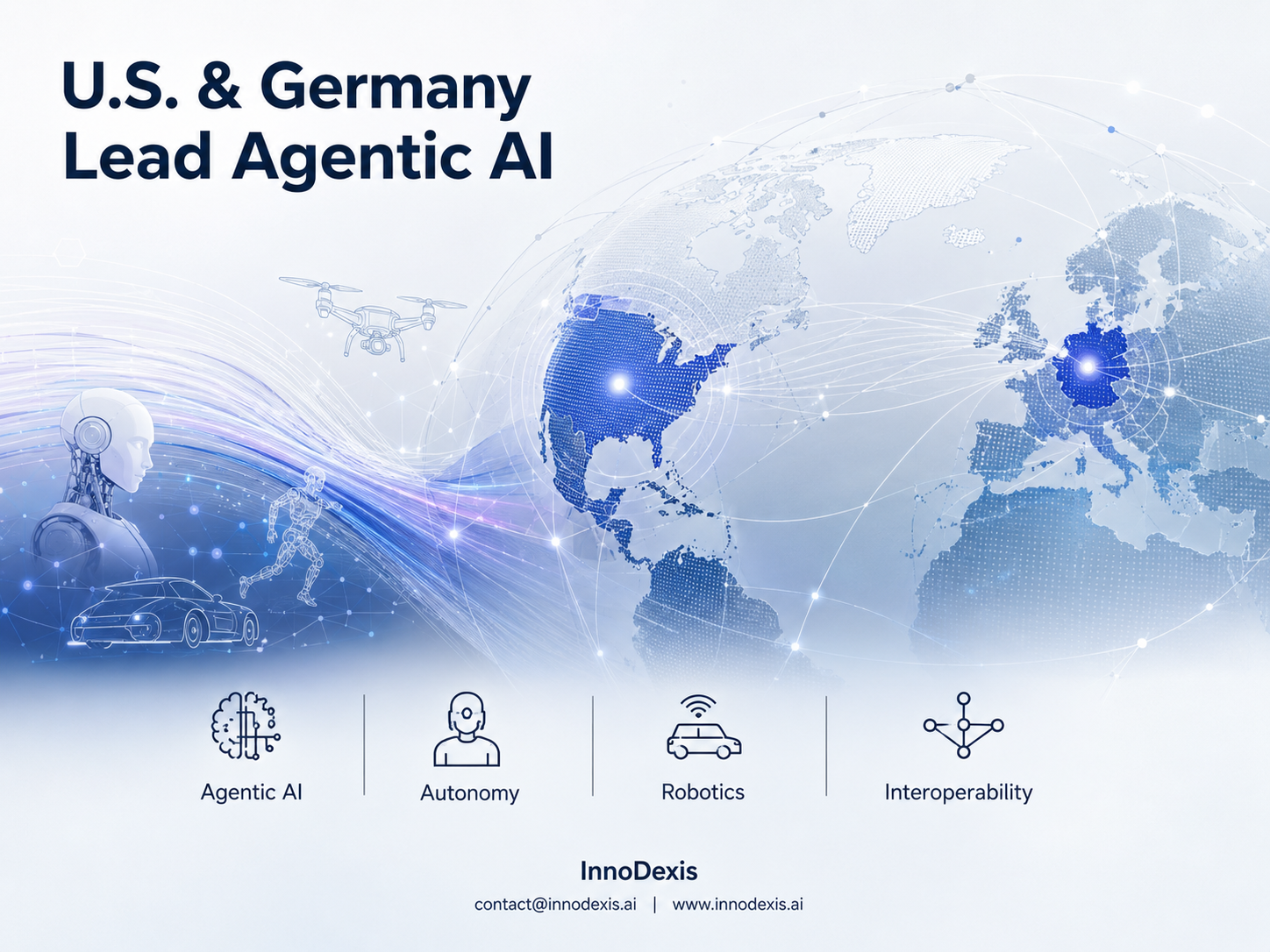
InnoDexis has published its latest Innovation Intelligence Report covering agentic AI and autonomous systems, analyzing 349 validated innovations across 27 countries and 199 institutions during the period from January to May 2026. The report reveals that the transition from generative to agentic artificial intelligence is the defining technological inflection of 2026, producing systems that pursue goals, plan actions, and operate with diminishing human supervision. The United States and Germany together account for 62% of all qualifying disclosures — the most concentrated two-country footprint recorded in any InnoDexis technology track this year.
Key Findings
Agentic Architectures constitute the single largest innovation cluster, accounting for 108 of the 349 validated innovations, or 30.9% of the corpus. The cluster spans agent planning, memory systems, and general-purpose agent frameworks being embedded in enterprise software, reflecting the scale of activity as the field moves from isolated model capability toward goal-directed autonomous operation.
Physical autonomy clusters collectively account for nearly 45% of the corpus. Autonomous Vehicles and ADAS represent 66 innovations (18.9%), Humanoid and Mobile Robotics 52 (14.9%), Drones, Swarms and Aerial Autonomy 39 (11.2%), and Embodied AI and Robot Foundation Models 25 (7.2%), confirming that hardware-intensive research remains a substantial center of gravity alongside software-agentic work.
Geographic concentration is pronounced. The United States leads with 123 innovations (35.2%), followed by Germany at 94 (26.9%) — the highest non-US share InnoDexis has recorded in any 2026 technology track. The United Kingdom follows at 29 innovations (8.3%), with Spain, Portugal, China, Canada, Japan, Australia, and the Netherlands forming the remaining mid-tier across 27 contributing countries.
A small number of commercialization breakouts mark the frontier. Stuttgart-based sereact, a University of Stuttgart spin-off, secured USD 110 million for Cortex 2.0, a robot world model trained on over one billion real-world motion data points. Chinese manufacturer AGIBOT reached mass production of its 5,000th general-purpose embodied robot. Hong Kong-based Insilico Medicine launched PandaClaw, an agentic platform automating multi-omics biological analyses for therapeutic discovery without requiring computational expertise from end users.
Government grants and strategic partnerships dominate capital formation. Grants appear in 127 innovations and strategic partnerships in 110, against nine explicit venture-capital disclosures and nine patent applications. This pattern confirms that institutional partnerships and grant-funded spin-outs remain the primary commercialization mechanisms, with a visible but thin venture layer concentrated in embodied-AI ventures combining proprietary data assets with world-model architectures.
Technology readiness is heavily upstream. Among 25 innovations disclosing formal TRL scores, 15 sit at TRL 1–4, seven at TRL 5–7, and three at TRL 8–9. The Multi-Agent Systems and Orchestration cluster shows zero commercial innovations in the disclosed research record. Agentic Architectures carry the largest commercial band, reflecting software's shorter path from prototype to deployment relative to hardware-constrained physical systems.
Strategic Insight and Trend Analysis
The most consequential structural finding is the convergence of the field's two halves. Software-agentic systems and physically embodied autonomous systems are increasingly built on a shared substrate of foundation models repurposed as action policies. Robot world models emerging from embodied AI research and reasoning models emerging from agentic software research are conceptually identical objects — internal predictive models of how actions change state. This convergence is reshaping the field's architecture and investment logic simultaneously.
Migration velocity is governed by physics as much as by science. Software-agentic capability already sits partly in the commercial band and faces no manufacturing constraint, meaning the autonomous-enterprise market will mature ahead of physical autonomy. The Experian–ServiceNow partnership — connecting autonomous agents to trusted enterprise data and decisioning systems — is the corpus's clearest articulation of near-term value capture: located not in more capable models in isolation, but in integrating those models with authoritative institutional data and workflows.
The most strategically significant under-represented signal is the formation of an interoperability layer. The Agentic Workflows, Tool Use and Interoperability cluster contains only eight innovations, yet points toward winner-take-most dynamics in which standardized agent-to-agent and agent-to-tool protocols will underpin the entire ecosystem. This layer is being constructed largely inside corporate platforms and standards bodies rather than academic channels — which is why it registers as a weak signal in the research record despite its outsized structural importance.
Governance represents the field's most material structural risk. Capability research vastly outweighs safety, alignment, and accountability research across the corpus. The most significant near-term threat is not that technology fails to advance, but that capability outpaces the trust infrastructure required for responsible deployment at scale.
Global and Industry Implications
For corporates and R&D teams, the findings identify two near-term opportunity zones: vertical digital-worker platforms automating expert workflows end-to-end, and industrial logistics autonomy where learning-based coordination is delivering measurable throughput gains. Germany's concentration in physical autonomy and the United States' broad-based output across both software and hardware clusters identify the primary geographies for partnership and talent sourcing.
For investors and capital allocators, the dataset signals a structural gap. Multi-agent orchestration, interoperability, and reasoning attract limited disclosed capital despite representing the layer where near-term enterprise value is accumulating. Germany's physical-autonomy research base is also comparatively under-capitalized relative to the United States, presenting a sourcing opportunity for investors operating within the European applied-research ecosystem.
For policymakers and national innovation bodies, the concentration of 62% of global activity within two countries underscores the strategic importance of applied-research infrastructure and university-industry partnership mechanisms. The governance gap — where capability research vastly outweighs accountability and safety research — represents a systemic risk requiring coordinated policy response before deployment pressure produces irreversible outcomes.
InnoDexis Statement
"The defining contest of agentic AI and autonomous systems in 2026 is no longer whether machines can act autonomously, but whether the interoperability standards, governance frameworks, and trust infrastructure required for deployment at scale can be constructed at the pace capability itself is advancing," noted InnoDexis in its latest intelligence report.
Conclusion
Agentic AI and autonomous systems in 2026 represent a field at the moment of capability accumulation that precedes mass deployment. Across 349 validated innovations from 199 institutions in 27 countries, the evidence points to a landscape where goal-directed autonomous behaviour is advancing rapidly while the commercial, governance, and interoperability scaffolding required to deploy it at scale is only beginning to form. As software-agentic platforms convert capability into enterprise value and embodied world models pull physical autonomy toward the scale-up threshold, organizations with early visibility into each transition will hold meaningful strategic advantage. The complete Agentic AI & Autonomous Systems Innovation Intelligence Report H1 2026 is available to InnoDexis subscribers and enterprise clients.
About InnoDexis
InnoDexis is a global Innovation Intelligence platform that tracks, analyzes, and interprets breakthrough innovations, prototypes, and emerging technologies across industries and countries. Its intelligence helps corporates, investors, and policymakers understand the true structure and direction of global innovation. Learn more at innodexis.ai.