United States Advances Autonomous Space Computing as Radiation-Hardened AI Processors Push Deep-Space Systems Toward Real-Time Decision-Making
NASA and Microchip Technology are developing a radiation-hardened AI processor capable of significantly outperforming current spaceflight computers, signaling a broader shift toward autonomous spacecraft operations.
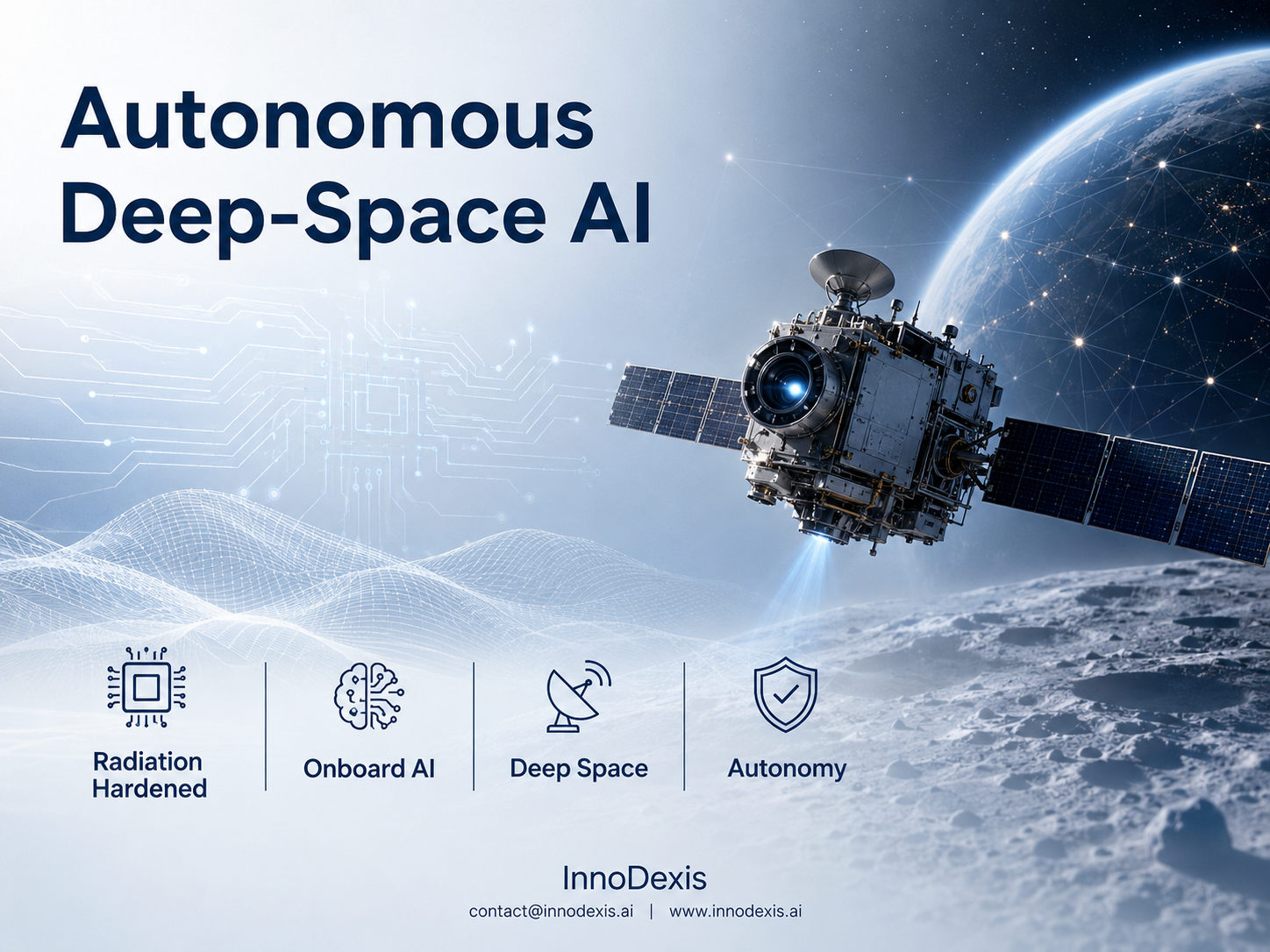
InnoDexis has published its latest Innovation Intelligence Report covering space-based AI computing, autonomous spacecraft systems, and radiation-hardened semiconductor technologies. The report analyzes emerging developments in onboard artificial intelligence architectures designed for deep-space environments. The report reveals that NASA and Microchip Technology are developing a new radiation-hardened system-on-a-chip processor capable of operating at roughly 500 times the performance of current spaceflight computing systems. The findings indicate that future spacecraft may increasingly perform real-time navigation, scientific analysis, and operational decision-making independently from Earth-based control systems.
Key Findings
The report identifies a substantial projected increase in onboard computing capability as one of the most important developments in current space technology infrastructure. Early testing showed approximately 500 times higher performance compared with existing space-grade processors. This level of computational improvement could significantly expand the ability of spacecraft to process scientific, environmental, and navigational data locally rather than relying heavily on delayed communication with Earth.
Another major finding concerns the integration of multiple computing functions into a unified system-on-a-chip architecture. The processor combines CPUs, networking capabilities, memory, and AI acceleration within a single platform. This consolidation may reduce system complexity while improving efficiency, reliability, and real-time operational responsiveness inside space environments where hardware redundancy and performance stability remain critical.
The report also highlights NASA’s ongoing testing of the processor under extreme radiation, thermal, vibration, and shock conditions. Unlike conventional terrestrial AI hardware, space-grade processors must maintain operational integrity under prolonged exposure to harsh environmental stressors. The ability to combine advanced AI performance with radiation hardening represents an important engineering milestone for long-duration missions.
Another key finding is the broad mission applicability being considered for the technology. NASA is evaluating the processor for use across rovers, orbiters, crewed habitats, lunar systems, and future Mars exploration missions. This suggests that autonomous onboard computing may become a foundational infrastructure layer across multiple generations of exploration systems rather than a mission-specific capability.
The findings further indicate a growing shift from remotely managed spacecraft toward increasingly autonomous operational systems. Current deep-space missions often face communication delays that limit rapid response capability. More advanced onboard AI systems may allow spacecraft to identify hazards, analyze environmental changes, optimize navigation paths, and support astronaut operations without waiting for instructions from Earth-based teams.
Strategic Insight and Trend Analysis
The report suggests that space exploration infrastructure is entering a new computational phase driven by the convergence of artificial intelligence, semiconductor miniaturization, and autonomous systems engineering. Historically, spacecraft computing architectures prioritized reliability and survivability over computational performance due to radiation constraints and hardware limitations. The emergence of high-performance radiation-hardened AI processors may significantly alter this balance.
The broader trend points toward spacecraft functioning less as remotely operated instruments and more as semi-independent intelligent systems capable of adaptive operational behavior. As exploration missions extend farther into deep space, communication latency increasingly limits centralized mission control models. Autonomous onboard decision-making may therefore become operationally necessary rather than technologically optional.
The integration of AI acceleration directly into hardened space-grade processors also reflects a wider infrastructure shift occurring across advanced computing sectors. Rather than separating sensing, processing, and decision-making functions, future systems are increasingly being designed around tightly integrated architectures capable of handling real-time environmental interpretation locally. In space environments, this capability may prove essential for navigation, scientific prioritization, system maintenance, and crew support operations.
The report further indicates that autonomous computing capability may become an important dimension of geopolitical and industrial competition in the space sector. Future leadership in deep-space exploration may depend not only on launch systems or propulsion technologies, but also on the ability to deploy resilient AI-enabled computational infrastructure capable of operating independently millions of miles from Earth.
The implications may extend beyond aerospace. Technologies developed for autonomous space systems often influence aviation, defense systems, advanced robotics, and high-reliability industrial automation. Radiation-hardened AI computing platforms may therefore contribute to broader extreme-environment operational technologies across multiple industries.
Global and Industry Implications
For corporates and R&D teams, the findings highlight increasing strategic importance for autonomous edge computing, radiation-hardened semiconductors, and AI-enabled embedded systems. Aerospace manufacturers, semiconductor companies, and advanced robotics developers may increasingly prioritize resilient onboard intelligence architectures capable of operating under extreme environmental conditions.
For investors and capital allocators, the report signals growing momentum around space-computing infrastructure and specialized AI hardware markets. As governments and private-sector organizations expand lunar and deep-space programs, enabling technologies that support autonomous mission operations may become increasingly valuable components of the broader space economy.
For policymakers and national innovation bodies, the findings reinforce the importance of semiconductor sovereignty, advanced AI infrastructure, and space technology investment strategies. Nations seeking long-term competitiveness in deep-space exploration may increasingly view autonomous computing systems as strategic infrastructure with implications for scientific leadership, national security, and industrial capability development.
InnoDexis Statement
“The convergence of high-performance AI computing and radiation-hardened semiconductor engineering may fundamentally reshape how future exploration systems operate beyond Earth,” noted InnoDexis in its latest intelligence report.
Conclusion
The development of advanced radiation-hardened AI processors suggests that future spacecraft may operate with significantly greater autonomy, adaptability, and computational independence than previous generations of exploration systems. As missions expand toward long-duration lunar operations and eventual Mars exploration, onboard intelligence capability may become increasingly central to mission safety, navigation, and scientific productivity. The broader transition toward autonomous space systems could also influence multiple adjacent industries where resilient real-time decision-making is critical. InnoDexis will continue tracking developments in AI hardware, autonomous aerospace infrastructure, and next-generation space computing systems shaping the future of exploration technologies. The complete Autonomous Space Computing and Radiation-Hardened AI Systems Intelligence Report is available to InnoDexis subscribers and enterprise clients.
About InnoDexis
InnoDexis is a global Innovation Intelligence platform that tracks, analyzes, and interprets breakthrough innovations, prototypes, and emerging technologies across industries and countries. Its intelligence helps corporates, investors, and policymakers understand the true structure and direction of global innovation. Learn more at innodexis.ai.