United Kingdom Energy Policy Cycles Persist Without Structural Reform as Crisis-Response Model Repeats Over Five Decades
A long-term analysis indicates that recurring energy crises are driven by systemic policy design, with delayed preventive measures and short-term interventions dominating decision-making.
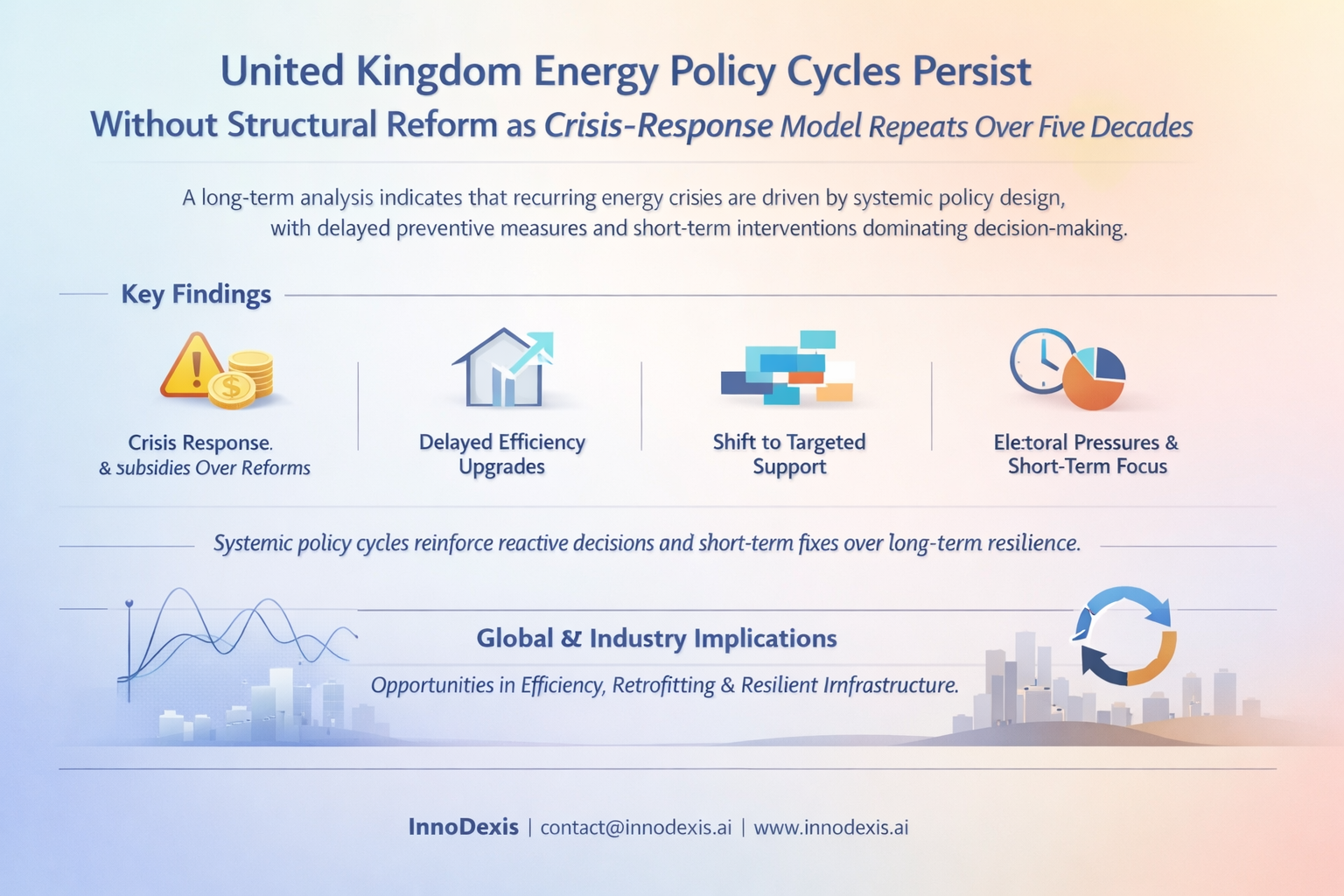
InnoDexis has published its latest Innovation Intelligence Report covering energy policy and system resilience, analyzing multi-decade policy patterns in the United Kingdom over a 50-year period. The report reveals that energy crises are not isolated shocks but are structurally embedded within the policy framework, where recurring cycles of crisis response, subsidy allocation, and limited structural reform have persisted. The findings highlight a consistent delay in preventive interventions, reinforcing a reactive system that addresses symptoms rather than underlying vulnerabilities.
Key Findings
The analysis identifies a recurring policy cycle in the United Kingdom characterized by crisis onset, followed by subsidy-driven relief measures, with limited implementation of structural reforms before the next crisis emerges. This repeated pattern has been observed consistently over a 50-year timeframe, indicating systemic continuity rather than episodic disruption.
Preventive measures such as insulation improvements and energy efficiency upgrades have been repeatedly delayed or deprioritized. The absence of early-stage intervention has contributed to higher system costs over time, as responses are initiated only after pressures have escalated.
Policy focus has shifted from universal energy solutions toward more fragmented and targeted support mechanisms. This transition reflects a move away from system-wide structural interventions toward narrower relief strategies, which address immediate affordability concerns without altering underlying system dynamics.
Electoral cycles have influenced policy design, with visible short-term relief measures receiving priority over long-term infrastructure and efficiency investments. This dynamic reinforces a decision-making environment where immediate political responsiveness outweighs sustained system resilience.
The system consistently reacts after cost escalation has already occurred. This delayed response pattern increases both economic and social burden, as interventions are deployed at a stage when mitigation options are more constrained and expensive.
Strategic Insight and Trend Analysis
The findings indicate that the United Kingdom’s energy challenges are not solely the result of external shocks but are embedded within a structural governance loop. The persistence of a crisis-response model over five decades suggests that policy design mechanisms systematically favor reactive interventions over preventive strategies.
The repeated deferral of insulation, retrofitting, and efficiency measures points to an institutional bias toward short-term affordability management rather than long-term system optimization. This dynamic creates a feedback loop in which each crisis reinforces the conditions for the next, rather than breaking the cycle through structural correction.
The shift from universal solutions to targeted support mechanisms further fragments the system. While targeted interventions may address immediate needs, they do not scale to deliver systemic transformation. As a result, the underlying infrastructure and energy efficiency gaps remain unresolved.
A transition in policy framing is emerging, with increasing attention on risk prevention rather than cost relief. This shift reflects a growing recognition that resilience requires anticipatory investment rather than reactive expenditure. The concept of treating energy affordability as a structural component of system design, rather than a temporary policy response, signals a potential reorientation in how energy systems are governed.
Collectively, the data suggests that the next phase of energy policy evolution will depend on whether governments can transition from managing crises to structurally preventing them.
Global and Industry Implications
For corporates and R&D teams, the findings highlight the need to align innovation with long-term system efficiency, including insulation technologies, retrofit solutions, and low-carbon heating systems. The persistence of delayed adoption suggests potential demand acceleration if policy priorities shift toward preventive infrastructure.
For investors and capital allocators, the structural gap between reactive spending and preventive investment indicates an opportunity landscape in energy efficiency and system resilience solutions. Capital deployment aligned with long-term infrastructure transformation may benefit from policy realignment toward risk mitigation.
For policymakers and national innovation bodies, the analysis underscores the importance of shifting from short-term relief frameworks to structural interventions. Embedding efficiency, retrofitting, and affordability within system design could reduce long-term fiscal pressure and improve resilience against future crises.
InnoDexis Statement
“The persistence of crisis-response cycles over multiple decades indicates that energy system vulnerabilities are structurally embedded, and that meaningful resilience will depend on the prioritization of preventive investment over reactive policy intervention,” noted InnoDexis in its latest intelligence report.
Conclusion
The United Kingdom’s energy policy trajectory over the past 50 years reflects a system that has consistently prioritized short-term response over long-term structural reform. As pressures on affordability and system resilience continue to increase, the effectiveness of future policy will depend on the ability to implement preventive measures at scale. The emerging shift toward risk-based policy framing suggests a potential inflection point, but its impact will depend on execution. The complete United Kingdom Energy Policy and System Resilience Report is available to InnoDexis subscribers and enterprise clients.
About InnoDexis
InnoDexis is a global Innovation Intelligence platform that tracks, analyzes, and interprets breakthrough innovations, prototypes, and emerging technologies across industries and countries. Its intelligence helps corporates, investors, and policymakers understand the true structure and direction of global innovation. Learn more at innodexis.ai.