Thermal Stress Identified as Cause of Up to 60% Efficiency Loss in Perovskite Solar Cells
Research from the Technical University of Munich demonstrates how thermal cycling drives early degradation in perovskites and introduces a molecular stabilization approach to improve durability.
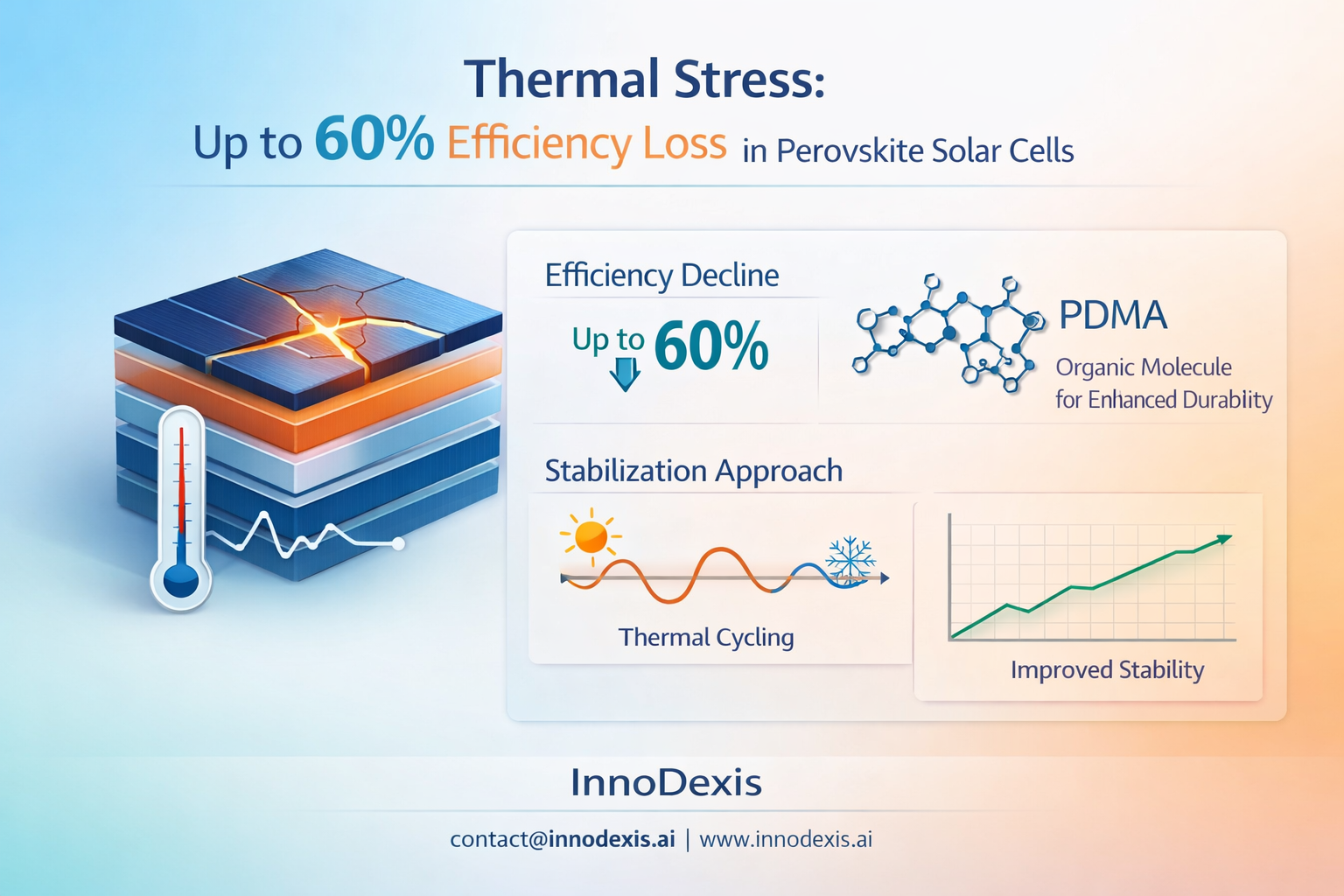
InnoDexis has published its latest Innovation Intelligence Report covering perovskite solar cell durability, analyzing material-level degradation mechanisms affecting early-stage performance. The report reveals that thermal cycling—caused by daily temperature fluctuations—can lead to up to 60% efficiency loss during the initial “burn-in” phase of perovskite solar cells. Researchers at the Technical University of Munich identified thermal stress as the root cause of structural degradation and introduced a stabilization strategy using a bulky organic molecule (PDMA). The findings highlight a potential pathway to improving the structural integrity and long-term performance of perovskite-based solar technologies.
Key Findings
Perovskite solar cells experience significant efficiency loss during early operational stages, with up to 60% performance reduction observed before full deployment. This degradation occurs during the “burn-in” phase, representing a major limitation in transitioning these materials from laboratory performance to real-world applications.
The primary driver of this early degradation has been identified as thermal cycling. Daily temperature variations generate internal stress within the perovskite material, leading to structural instability at the microscopic level and impacting overall device performance.
High-resolution X-ray analysis conducted by researchers at the Technical University of Munich revealed lattice-level structural changes associated with thermal stress. These observations provide direct evidence linking temperature-induced mechanical strain to material degradation pathways.
To address this issue, the research introduced PDMA, a bulky organic molecule, as a stabilizing component within the perovskite structure. The molecule functions as an anchoring element, helping to maintain lattice integrity under thermal stress conditions.
The incorporation of PDMA resulted in measurable improvements in both structural stability and performance consistency. This suggests that targeted material design strategies can mitigate early-stage degradation and extend the operational reliability of perovskite solar cells.
Strategic Insight and Trend Analysis
The identification of thermal stress as a primary degradation mechanism reframes a central challenge in perovskite solar technology. While perovskites have demonstrated high efficiency in controlled laboratory environments, durability under real-world conditions has remained a limiting factor for commercialization.
The findings from the Technical University of Munich indicate that the transition from laboratory-scale performance to deployable infrastructure depends on addressing material stability at the microscopic level. Daily environmental conditions, particularly temperature fluctuations, introduce dynamic stresses that conventional material configurations have not been able to withstand effectively.
The use of PDMA as a stabilizing anchor reflects a broader trend in advanced materials research, where molecular-level engineering is applied to improve macroscopic device performance. By reinforcing lattice structures, such approaches aim to reduce degradation pathways that emerge under operational stress.
This development also signals a potential shift in how perovskite innovation is evaluated. The focus is moving from peak efficiency metrics toward durability and long-term stability. As perovskite materials approach practical deployment thresholds, performance consistency over time becomes a defining parameter for scalability.
The evolution from high-efficiency prototypes to durable, deployable systems suggests that perovskite-based tandem solar cells may become more viable for large-scale energy applications if stability constraints are effectively addressed.
Global and Industry Implications
For corporates and R&D teams in the solar and energy sectors, improving perovskite durability could enable the integration of these materials into commercial photovoltaic systems. Addressing early-stage efficiency loss may reduce performance variability and support more reliable energy generation.
For investors and capital allocators, the resolution of durability challenges may shift the risk profile of perovskite technologies. As stability improves, the pathway from experimental validation to scalable deployment may become more clearly defined within the renewable energy market.
For policymakers and national innovation bodies, advancements in perovskite stability could support broader renewable energy adoption strategies. More efficient and durable solar technologies may contribute to long-term energy transition goals and infrastructure development.
InnoDexis Statement
“The findings indicate that resolving material stability challenges, rather than efficiency limitations, may define the next phase of perovskite solar technology deployment,” noted InnoDexis in its latest intelligence report.
Conclusion
The identification of thermal stress as a key driver of early efficiency loss in perovskite solar cells provides a clearer understanding of the barriers to real-world deployment. By introducing molecular stabilization strategies such as PDMA, researchers have demonstrated a pathway toward improving both structural integrity and performance consistency. As durability becomes a central focus, perovskite technologies may move closer to large-scale adoption in solar energy systems. The complete Perovskite Solar Materials Intelligence Report is available to InnoDexis subscribers and enterprise clients.
About InnoDexis
InnoDexis is a global Innovation Intelligence platform that tracks, analyzes, and interprets breakthrough innovations, prototypes, and emerging technologies across industries and countries. Its intelligence helps corporates, investors, and policymakers understand the true structure and direction of global innovation. Learn more at innodexis.ai.