Thermal Energy Storage Surpasses Battery Chemistries as 1,235 Global Innovations Redefine the Energy Storage Landscape
A global review of 1,235 energy storage innovations across 39 countries reveals that thermal storage, hydrogen systems, and grid integration technologies are emerging as the dominant drivers of next-generation energy infrastructure.
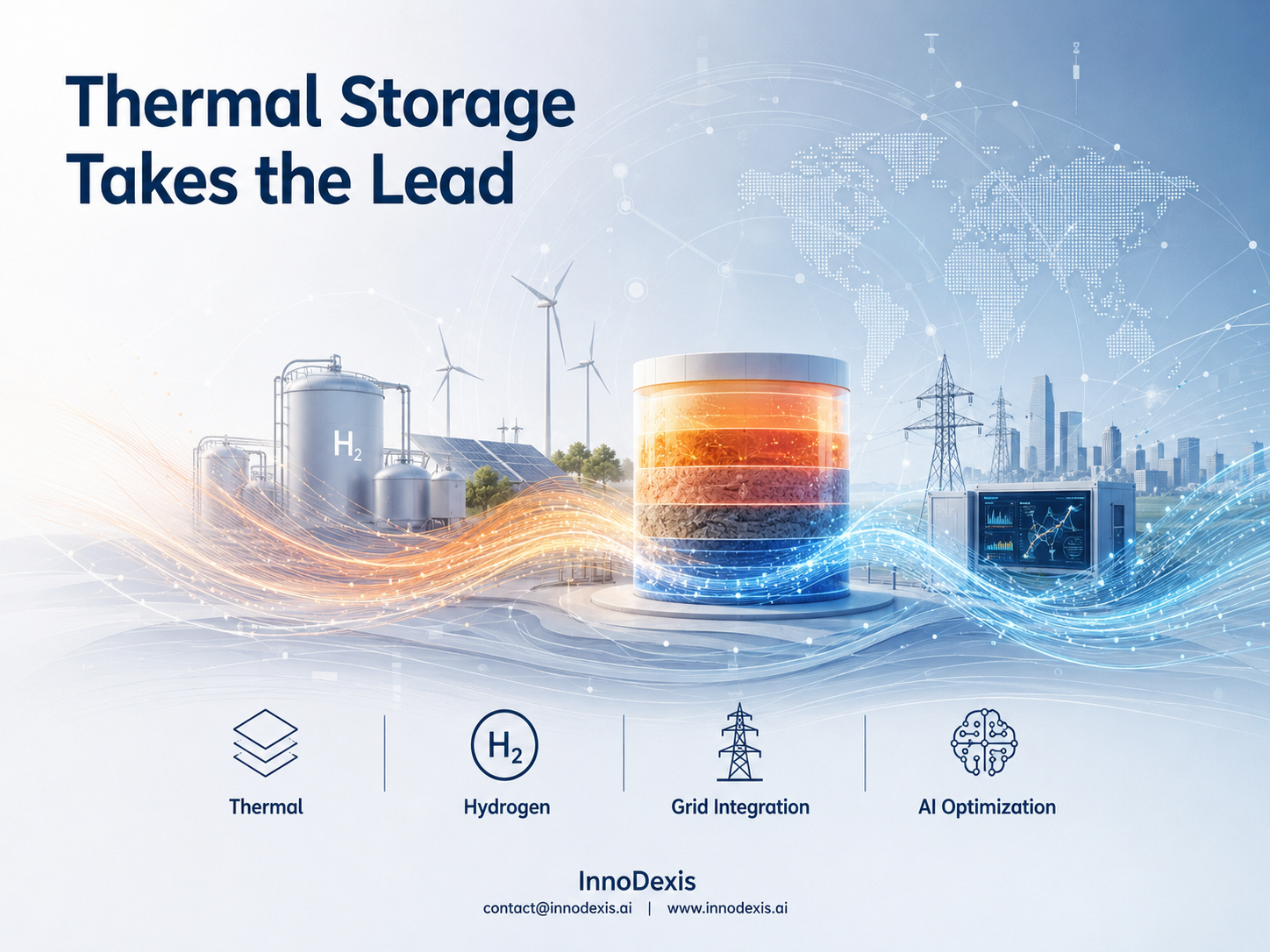
InnoDexis has published its latest Innovation Intelligence Report covering the global energy storage sector, analyzing 1,235 validated innovations across 39 countries and 17 technology clusters during the period from January to May 2026. The report reveals that the center of innovation in energy storage is shifting beyond conventional battery technologies toward thermal energy storage, hydrogen-based systems, and grid integration platforms. While batteries remain an important component of the innovation landscape, the data indicates that future energy storage systems are increasingly being developed as integrated infrastructure platforms that combine multiple storage modalities, software orchestration, and grid optimization capabilities.
Key Findings
The largest technology cluster identified in the analysis is thermal energy storage, accounting for 299 innovations or 24.2% of the global dataset. This exceeds the combined innovation volume of all major battery chemistry categories, demonstrating a significant shift in research and development priorities toward long-duration heat storage, industrial process heat applications, and molecular solar thermal systems.
Hydrogen and chemical storage technologies emerged as the third-largest cluster, representing 103 innovations or 8.3% of the dataset. Research activity is concentrated around green hydrogen production, hydrogen carriers, ammonia cracking, and chemical storage systems designed to support industrial decarbonization and long-duration energy storage.
Grid Integration and Battery Energy Storage Systems account for 77 innovations, reflecting growing emphasis on grid orchestration, virtual power plants, grid-forming inverters, and software-driven optimization. The findings suggest that storage value creation is increasingly tied to system integration rather than standalone hardware performance.
Geographically, Germany leads the global innovation landscape with 434 innovations, representing 35.1% of all activity analyzed. The United States follows with 239 innovations, while the United Kingdom, China, and Japan complete the top five countries. This distribution indicates that Europe, particularly Germany, has become the primary center of disclosed energy storage innovation activity.
The report also highlights a substantial commercialization gap. Only 7.9% of innovations disclose Technology Readiness Levels, while 16.1% provide explicit commercial readiness indicators. Government grants are mentioned in 43.6% of innovations, compared with only 1.2% referencing venture capital funding, demonstrating the sector's continued reliance on public-sector support.
Strategic Insight and Trend Analysis
The findings collectively indicate that energy storage is undergoing a structural transition from a battery-centric market narrative toward a diversified infrastructure ecosystem. While public discourse often frames energy storage as a competition between lithium-ion and solid-state batteries, the innovation data presents a far broader landscape that includes thermal storage, hydrogen systems, flow batteries, gravity storage, compressed air systems, supercapacitors, and AI-enabled grid platforms.
One of the most significant trends is the rise of thermal energy storage as a major innovation category. The scale of activity in molten salt systems, phase-change materials, thermochemical storage, and molecular solar thermal technologies suggests increasing recognition that future energy systems will require solutions optimized for industrial heat, district heating, and seasonal storage applications.
A second trend is the growing convergence between storage technologies and software intelligence. Grid orchestration platforms, virtual power plants, and AI-enabled optimization systems are becoming critical components of storage deployments. As storage becomes embedded within broader energy networks, competitive advantage increasingly depends on software-driven coordination rather than hardware specifications alone.
The data also highlights the expanding diversity of storage chemistries. Activity in sodium-ion batteries, flow batteries, hydrogen carriers, and alternative storage materials suggests that the industry is pursuing multiple parallel pathways rather than converging around a single dominant technology. This diversification reduces dependence on specific material supply chains and increases resilience across the broader energy ecosystem.
Collectively, these trends indicate that future energy storage leadership will likely be determined by the ability to integrate multiple technologies into coherent energy systems rather than by advances in a single storage chemistry.
Global and Industry Implications
For corporates and R&D teams, the findings underscore the importance of broadening technology scouting efforts beyond conventional battery platforms. Thermal storage, hydrogen systems, and grid optimization technologies are emerging as critical areas for partnership, investment, and capability development.
For investors and capital allocators, the report highlights opportunities in technology clusters that appear underrepresented in private capital flows relative to their scientific activity. Thermal energy storage, sodium-ion batteries, and grid orchestration software demonstrate strong innovation momentum despite limited venture capital visibility.
For policymakers and national innovation bodies, the analysis reinforces the strategic importance of public funding in advancing energy storage technologies. Continued support for pilot-scale demonstrations, infrastructure development, and industrial transfer programs will be essential to bridge the gap between laboratory breakthroughs and commercial deployment.
InnoDexis Statement
“The global energy storage landscape is evolving from a battery-centered industry into a diversified infrastructure ecosystem where thermal storage, hydrogen systems, and intelligent grid integration play increasingly central roles,” noted InnoDexis in its latest intelligence report.
Conclusion
The Global Energy Storage Innovation Landscape 2026 reveals an industry expanding beyond traditional assumptions about storage technologies. The emergence of thermal energy storage, hydrogen-based systems, and software-driven grid integration reflects a broader transformation in how energy resilience, flexibility, and decarbonization are being approached worldwide.
As deployment accelerates and commercialization pathways mature, the most influential innovations may emerge not from a single technology category but from the integration of multiple storage modalities into unified energy systems. Monitoring these developments will remain essential for organizations seeking to understand the future direction of global energy infrastructure.
The complete Global Energy Storage Innovation Landscape 2026 Report is available to InnoDexis subscribers and enterprise clients.
About Innodexis
InnoDexis is a global Innovation Intelligence platform that tracks, analyzes, and interprets breakthrough innovations, prototypes, and emerging technologies across industries and countries. Its intelligence helps corporates, investors, and policymakers understand the true structure and direction of global innovation. Learn more at innodexis.ai.