Teleoperated Humanoid Robots Complete Live Surgery in World-First Preclinical Trial as Mobile Surgical Robotics Challenges Existing Infrastructure Model
A UC San Diego preclinical trial has validated teleoperated humanoid robots performing live surgical procedures including gallbladder removal at precision comparable to existing specialised systems, at a fraction of the weight and cost profile.
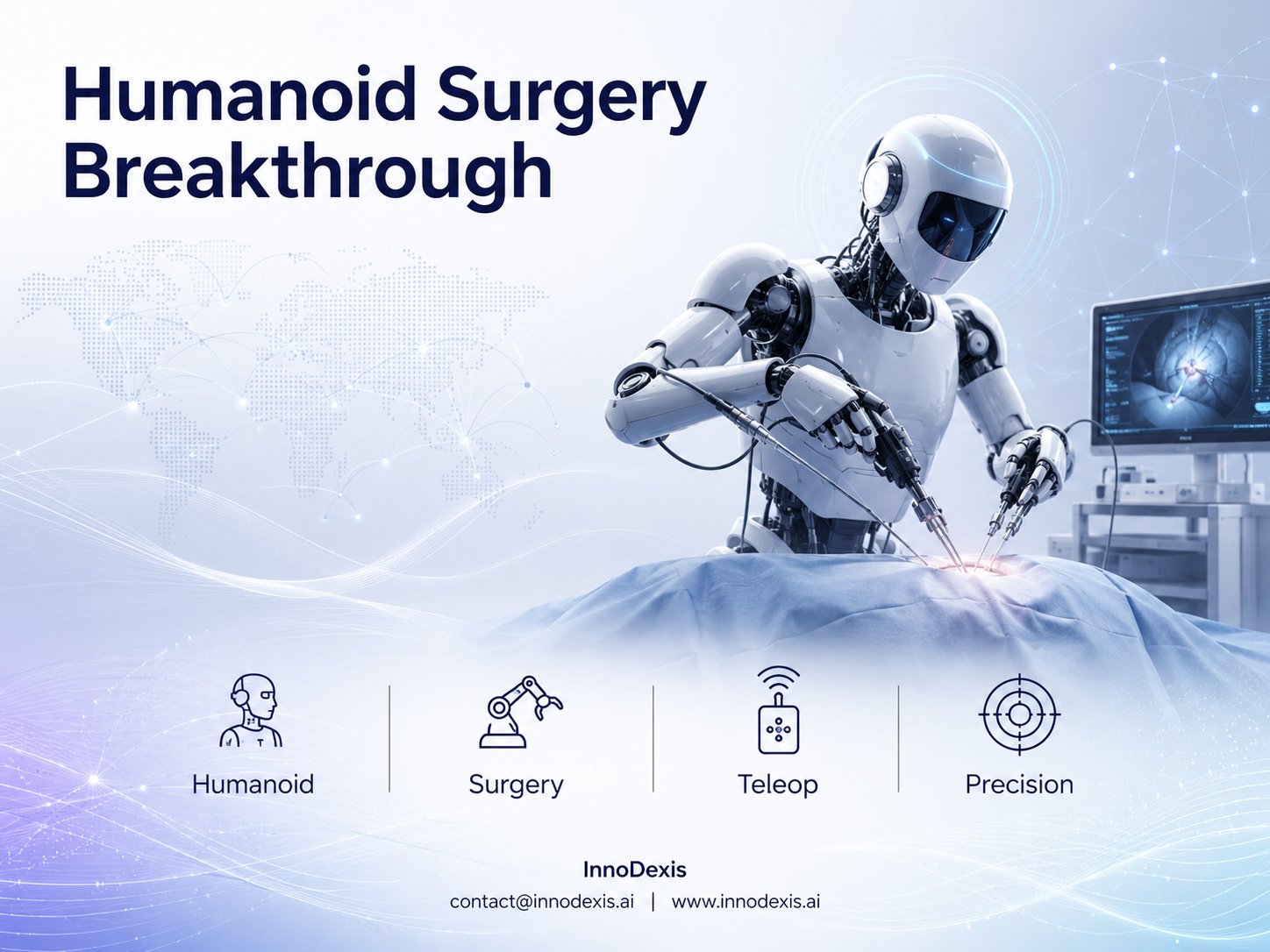
InnoDexis has published its latest Innovation Intelligence Report covering humanoid surgical robotics, analyzing a landmark preclinical innovation developed at the University of California, San Diego. The report reveals that a collaborative team of engineers and surgeons completed the world's first preclinical trial of teleoperated humanoid robots performing live surgeries — including a gallbladder removal executed by a human-robot team and a second procedure completed by two robots operating side by side. The findings introduce a fundamentally different form factor into a surgical robotics market historically defined by large, fixed, single-purpose systems.
Key Findings
The world's first live surgeries performed by teleoperated humanoid robots were completed in a preclinical trial at UC San Diego, validating two distinct operational configurations: a human-robot team and a robot-robot team operating simultaneously. The successful demonstration of both configurations establishes that humanoid robots can function within the procedural and spatial demands of real surgical environments without requiring dedicated infrastructure modifications.
The humanoid surgical robot weighs 60 pounds, compared to approximately 1,800 pounds for conventional specialised surgical systems. This 30-fold reduction in weight is not an incremental engineering refinement — it is a form factor shift that directly determines where surgical robotics can be deployed. Systems weighing 1,800 pounds require purpose-built facilities; a 60-pound system fits existing operating rooms without modification.
Precision delivered by the humanoid robot was reported as comparable to existing teleoperated surgical robotic systems. This is the critical performance threshold for clinical credibility — not that the humanoid system exceeded specialised platforms, but that it matched them under live surgical conditions, establishing a minimum viable performance baseline for a fundamentally different hardware architecture.
A gallbladder removal was among the procedures completed during the trial, demonstrating that the system is capable of performing a defined, clinically recognised surgical procedure rather than performing only simulated or simplified tasks. The completion of a recognised surgical procedure in a preclinical setting materially advances the credibility of the humanoid surgical robotics pathway.
The dataset identifies latency and recalibration as the remaining technical challenges for the system. The explicit acknowledgement of these constraints within the research signals scientific rigour and defines the specific engineering problems that, if resolved, would clear the pathway for broader clinical deployment of humanoid surgical platforms.
Strategic Insight and Trend Analysis
The dominant strategic signal from this dataset is a structural reframing of the surgical robotics market — from a model built around large, expensive, fixed infrastructure toward one where surgical capability becomes a mobile, deployable asset.
The surgical robotics market has been shaped for decades by the economics and engineering of single-purpose systems. These systems deliver high precision but at a cost — in capital, in infrastructure requirements, and in geographic reach — that has concentrated robotic surgery within well-resourced healthcare facilities in high-income settings. The UC San Diego preclinical findings do not incrementally improve on this model; they introduce a physically distinct alternative operating on different assumptions about weight, portability, and deployment context.
The significance of the 60-pound form factor extends beyond engineering specifications. It changes the question from whether a facility can afford a surgical robot to whether a surgical robot can reach the facility. Mobile humanoid platforms are deployable in settings — field hospitals, rural facilities, disaster response environments, low-infrastructure healthcare systems — where no specialised surgical system has ever operated. The bottleneck in global surgical access has not been exclusively surgeon availability; it has been the infrastructure required to support surgical systems. A 60-pound robot that fits existing operating rooms without modification addresses that bottleneck directly.
The two-configuration validation — human-robot and robot-robot — further expands the strategic optionality. Each configuration implies a different deployment model, a different regulatory pathway, and a different economic structure for the organisations that will ultimately commercialise this technology.
Global and Industry Implications
For corporates and R&D teams in medical technology and robotics, the UC San Diego findings define a new competitive surface within surgical robotics. Organisations invested in large, fixed surgical platforms must assess how mobile humanoid alternatives will affect market positioning as the technology matures. For hardware and software teams, latency reduction and recalibration reliability represent the most immediate engineering investment priorities.
For investors and capital allocators, the preclinical stage of this innovation places it early in the commercialisation timeline, but the form factor differentiation is sufficiently distinct to warrant early-stage monitoring. The addressable market expands materially if humanoid surgical platforms can reach settings currently excluded from the surgical robotics market — a population representing the majority of the world's surgical need.
For policymakers and national healthcare bodies, the findings introduce a new variable into surgical access planning. Regulatory frameworks designed for fixed, single-purpose surgical systems will require adaptation to address mobile humanoid platforms operating in non-specialist environments. Nations with significant rural or low-infrastructure healthcare populations have the most immediate policy interest in accelerating that regulatory development.
InnoDexis Statement
"The humanoid surgical robot reframes the deployment question for surgical robotics — shifting from which facilities can support a surgical system to which environments a surgical system can reach," noted InnoDexis in its latest intelligence report.
Conclusion
The UC San Diego preclinical trial establishes a credible proof of concept for humanoid robots as surgical platforms — not as a replacement for specialised systems in existing facilities, but as a distinct deployment model for environments those systems cannot reach. As latency and recalibration challenges are addressed, the pathway from preclinical validation to clinical deployment will become the central question for the surgical robotics field. InnoDexis will continue to monitor humanoid surgical robotics development, regulatory progress, and commercialisation activity in this emerging domain. The complete Humanoid Surgical Robotics Innovation Intelligence Report is available to InnoDexis subscribers and enterprise clients.
About InnoDexis
InnoDexis is a global Innovation Intelligence platform that tracks, analyzes, and interprets breakthrough innovations, prototypes, and emerging technologies across industries and countries. Its intelligence helps corporates, investors, and policymakers understand the true structure and direction of global innovation. Learn more at innodexis.ai.