Swallowable Capsule Achieves Active Tissue Sampling via Magnetic Brush Control, Enabling 16S rRNA Sequencing
Researchers at the University of Tokyo have built a magnetically controlled capsule that extends a brush to physically sample small intestine tissue, producing samples suitable for 16S rRNA gene sequencing and moving capsule endoscopy beyond passive imaging.
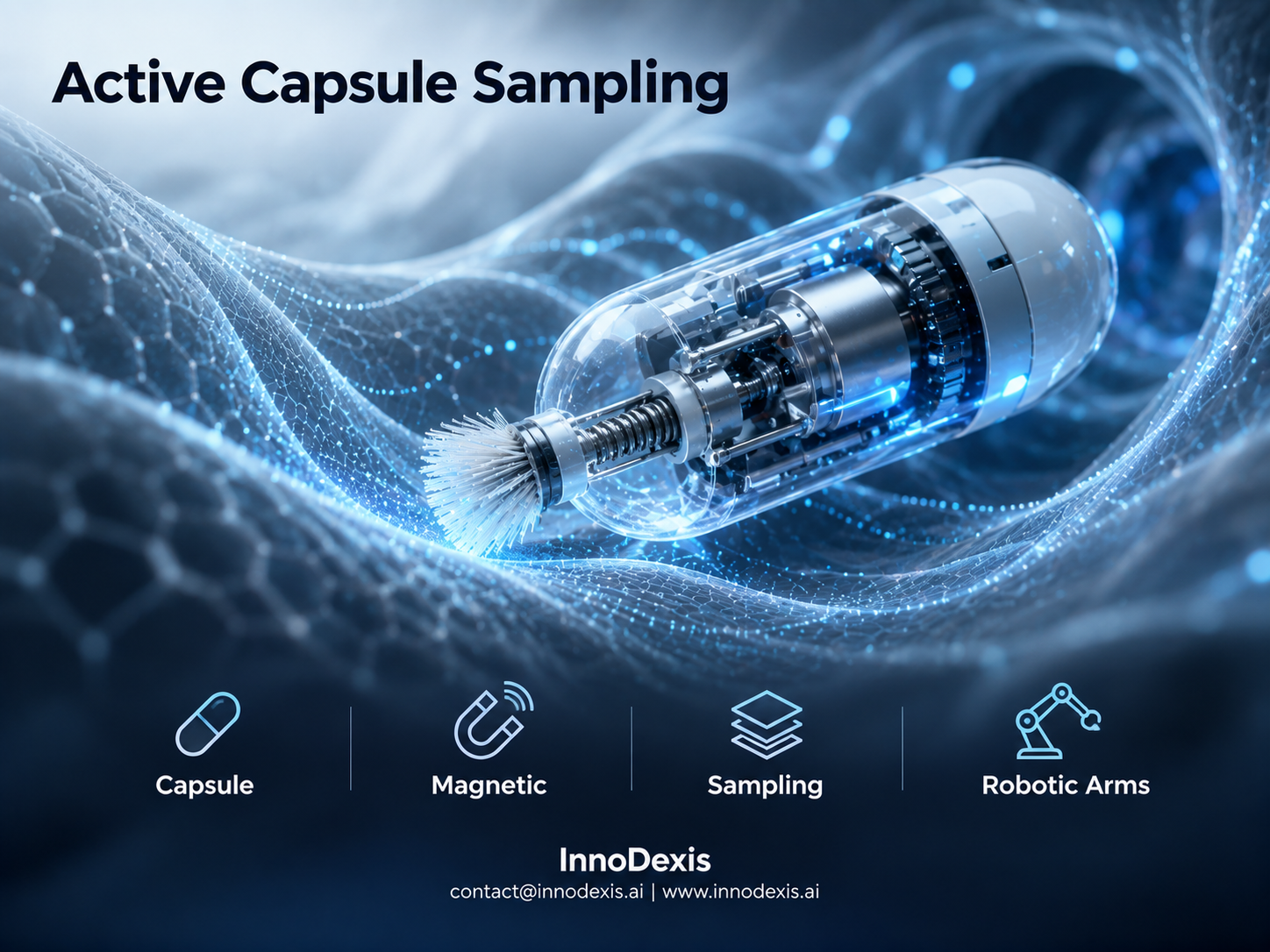
InnoDexis has published its latest Innovation Intelligence Report covering medical robotics and gastrointestinal diagnostics, analyzing a device innovation developed at the University of Tokyo, led by Yuguo Dai and Fumihito Arai. The report reveals that the research team has built a pill-shaped capsule capable of actively sampling small intestine tissue using an internal screw mechanism and external magnetic actuation, successfully tested on ex vivo pig intestines, with collected samples proving suitable for 16S rRNA gene sequencing.
Key Findings
Samples collected by the capsule proved suitable for 16S rRNA gene sequencing, establishing that the device can produce lab-ready microbiome data rather than imaging data alone. This directly distinguishes the device from conventional capsule endoscopy, which has historically been limited to passive visual inspection.
The capsule was tested successfully on ex vivo pig intestines, providing a validated proof of concept for the sampling mechanism under conditions approximating the small intestine environment prior to any in vivo or human testing.
An internal screw mechanism drives the brush extension and retraction, allowing the device to physically contact and collect tissue samples from the intestinal lining rather than relying solely on visual capture through onboard imaging.
Dual external robotic arms provide magnetic actuation control, enabling the capsule's position and sampling action to be directed from outside the body. This external control mechanism is what allows the capsule to decide where to sample tissue, rather than passively following gastrointestinal transit.
The device establishes a new category of diagnostic collection positioned between imaging-only capsules and invasive endoscopic sampling, combining the non-invasive delivery method of capsule endoscopy with the physical tissue-sampling capability previously requiring invasive instrumentation.
Strategic Insight and Trend Analysis
The dominant trend emerging from this innovation is the convergence of two previously separate diagnostic categories: non-invasive capsule-based imaging and invasive tissue-sampling endoscopy. For years, these have existed as distinct modalities with a clear tradeoff — capsule endoscopy offered patient comfort and non-invasiveness but no physical sampling capability, while traditional endoscopy enabled tissue sampling only through more invasive instrumentation. This device demonstrates that the tradeoff is not fundamental to the underlying diagnostic goal, but a function of mechanical design limitations that can be engineered around.
The significance of this convergence extends beyond a single device. By combining an internal screw-driven brush mechanism with external dual-arm magnetic actuation, the research team has shown that active, directed tissue sampling can be achieved without abandoning the non-invasive delivery format that makes capsule endoscopy preferable to patients in the first place. This positions the underlying platform architecture — magnetically controlled internal mechanisms within a swallowable capsule — as a template that could extend beyond microbiome sampling to other forms of targeted intestinal diagnostics.
The validation that collected samples are suitable for 16S rRNA gene sequencing is a structurally important detail, as it confirms the samples meet the quality threshold required for genomic analysis, not merely visual or qualitative inspection. This elevates the device from a sampling mechanism demonstration to a potential source of lab-ready diagnostic data.
Because the device remains at the ex vivo pig intestine validation stage, the primary unresolved question is translation to in vivo and eventually human clinical use, which will determine how quickly this new diagnostic category can move toward practical deployment.
Global and Industry Implications
For corporates and R&D teams in medical device development, this innovation demonstrates a viable mechanical approach — internal screw-driven sampling combined with external magnetic actuation — for achieving active tissue collection within a swallowable form factor, offering a design reference point for future diagnostic capsule development.
For investors and capital allocators, the device represents an early-stage but structurally differentiated opportunity within gastrointestinal diagnostics, positioned in a new category between imaging-only capsules and invasive endoscopy, with the ex vivo validation stage indicating meaningful technical progress toward a defined clinical translation pathway.
For policymakers and national innovation bodies, the work illustrates the kind of cross-disciplinary bioengineering and robotics research that can expand non-invasive diagnostic capabilities, with downstream relevance for healthcare systems seeking lower-burden methods of collecting microbiome and tissue data from patients.
InnoDexis Statement
"This capsule shows that active, directed tissue sampling and non-invasive delivery are no longer mutually exclusive, establishing a new diagnostic category between imaging-only capsules and invasive endoscopy," noted InnoDexis in its latest intelligence report.
Conclusion
As capsule-based diagnostics move from passive imaging toward active tissue sampling, the central question for this device is how quickly ex vivo validation can translate into in vivo and human clinical testing. If miniaturization and in vivo validation proceed successfully, the underlying platform could enable spatial microbiome mapping across regions of the gastrointestinal tract currently difficult to access non-invasively. InnoDexis will continue to track developments in capsule-based medical robotics, microbiome diagnostics, and the clinical translation pathway for magnetically actuated sampling devices. The complete Medical Robotics and Diagnostics Innovation Intelligence Report is available to InnoDexis subscribers and enterprise clients.
About InnoDexis
InnoDexis is a global Innovation Intelligence platform that tracks, analyzes, and interprets breakthrough innovations, prototypes, and emerging technologies across industries and countries. Its intelligence helps corporates, investors, and policymakers understand the true structure and direction of global innovation. Learn more at innodexis.ai.