Storage Appears in 35 of 64 Everything-to-Grid Records as the Vehicle–Building Interface Produces Only Five Coupled Records Against a Decade of Consumer Promises
A dual-stream analysis of 64 innovation records across 18 countries finds that convergence language is near-universal while genuine multi-domain engineering remains rare, that the buildings cluster runs 17 research records to one corporate, and that the single largest funding event in the corpus was paid by a load-side customer avoiding the interconnection queue.
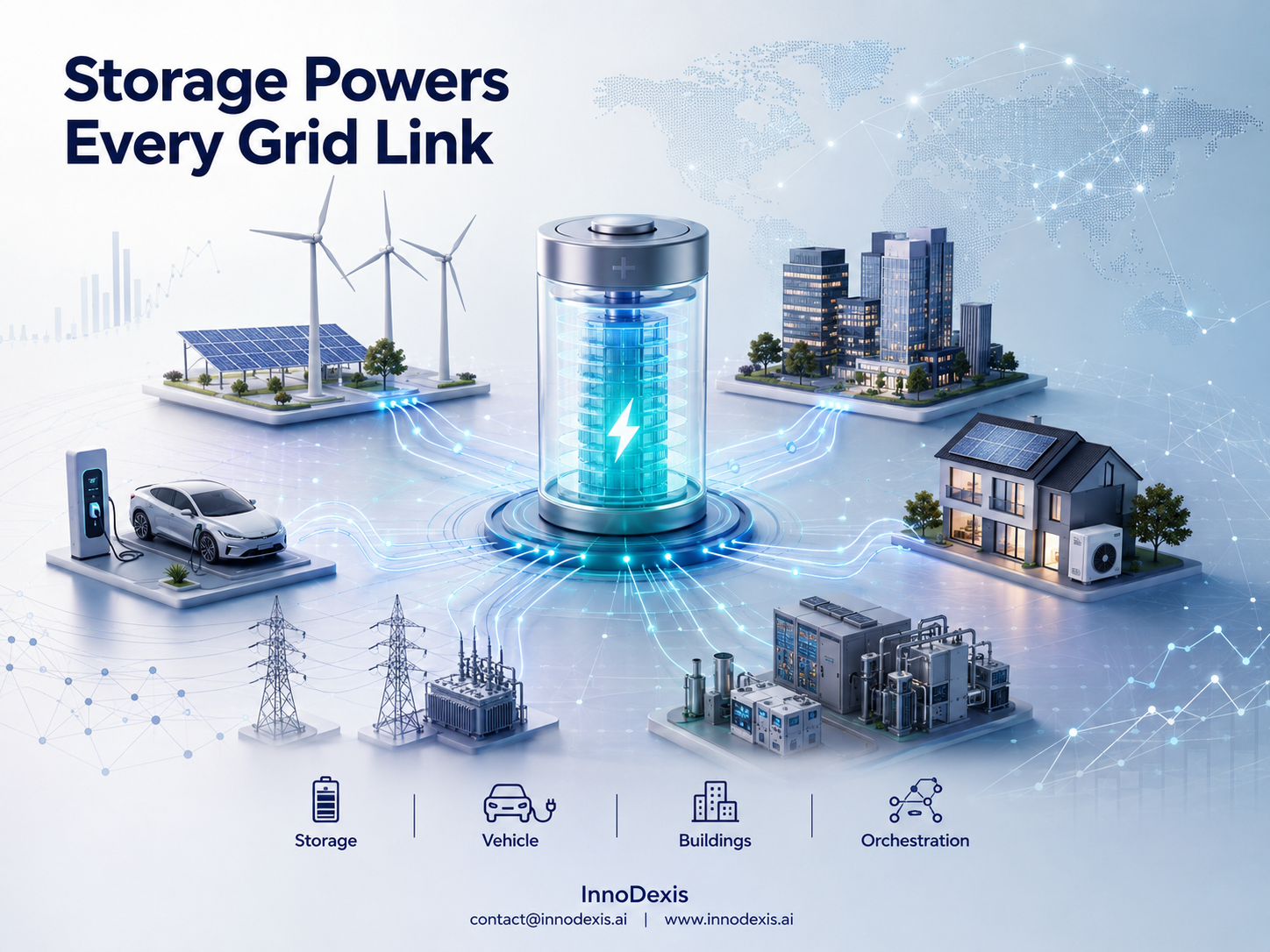
InnoDexis has published its latest Innovation Intelligence Report covering everything-to-grid energy integration, analyzing 64 innovation records — 38 research and 26 corporate — across 18 countries during the period from January to August 2026. The report reveals that grid context appears in 62 of 64 records, confirming convergence as the universal assumed backdrop, while only 13 records couple three or more asset domains and only 5 records couple vehicles and buildings simultaneously. Storage appears in 35 records and functions as the system's primary adapter, co-occurring with generation in 18 records, buildings in 16, and vehicles in 10 — touching every other domain at a frequency no other component approaches.
Key Findings
Storage is not one converging domain among several — it is the adapter through which every other domain currently reaches the network. The interface matrix across 64 records shows storage co-occurring with generation 18 times, buildings 16 times, and vehicles 10 times, while vehicles and buildings — the consumer-facing promise of the car as home battery — appear together in only five records. Eleven of the 13 records in the storage and power-electronics cluster are corporate, carrying capital, certification, or commissioning news. The battery is absorbing the coordination problem that no software layer has yet taken over, and sixteen of the 35 storage records carry no orchestration signal at all — describing an asset, not a system.
The buildings cluster is the largest in the corpus at 18 records and the most lopsided: 17 research against one corporate. Research is working on heat pump connection sizing, thermal storage in building foundations, building automation for energy communities, and retrofit strategy for social housing — the Norwegian Geotechnical Institute documenting a reference installation that covered 95% of a headquarters building's cooling demand and 100% of its heating demand at a coefficient of performance between four and five. Corporate capital has not followed. Heat generates approximately 40% of German CO₂ emissions and consumes roughly 56% of final energy, yet the entire commercial record in this corpus for thermal flexibility amounts to a single announcement.
Orchestration logic — aggregation, dispatch, optimisation, market participation, forecasting, or multi-agent coordination — appears in 38 of 64 records, with 26 of those 38 in the research stream against 12 in the corporate stream. The enabling innovations in the coordination layer are frequently not technologies. A German legal change effective 1 June 2026 permits households, municipalities, and energy cooperatives to share locally produced electricity, converting a regulatory prohibition into a market. A liaison agreement between two standards bodies creates an end-to-end pathway from a grid demand-response signal to a domestic appliance without bespoke integration. A consulting framework helps industrial companies implement flexible connection agreements, trading firm capacity for faster and cheaper grid access — none of these require new hardware.
Utilidata raised a USD 100 million Series C — the largest single disclosed company funding event in the corpus — for a dynamic power orchestration platform co-developed with a chip vendor and aimed at unlocking additional compute capacity from existing data centre grid connections, explicitly framing the commercial case as months-to-capacity against five to seven years for a new grid connection. The buyer is not a utility. The first large-scale orchestration software funding event in this corpus was paid by a load-side customer avoiding a queue, not by a grid operator seeking flexibility. A separate analysis found that shifting more than 20% of data centre energy use to off-peak hours reduces system-wide grid costs by up to 5%, but with regionally divergent emissions outcomes — CO₂ in Texas falling by as much as 40% under flexible operation while the Mid-Atlantic sees a 3% increase.
Vehicles are the most promised and least connected domain. Thirteen records address vehicle–grid integration, and the barrier identified across the corpus is never the battery — it is the absence of a settled commercial arrangement between utilities, automakers, and charging providers. A German bidirectional charging field test with 20 customers establishes annual bonus payments of up to €720 on a vehicle-to-grid tariff — a real number that is unlikely to reorganise consumer behaviour on its own. Where genuine progress is documented, the vehicle and the grid connection share the same owner: a heavy-truck manufacturer demonstrating vehicle-to-grid as depot energy management, and a megawatt charging system integrating a second-life battery buffer to deliver over 1 MW of charging power from a 500 kW grid connection, with DC/DC converter efficiency of 99.26% at a power density of 9 kW per litre.
Germany accounts for 27 of 64 records — more than double the next contributor — and should be read as a genuine signal wrapped in a sampling caveat. The Fraunhofer network alone contributes eight records, and the corpus reflects strong German institutional coverage. The substantive signal is that Germany is furthest into the integration problem: the energy-sharing law, the flexible connection frameworks, the grid-forming readiness concept, the sub-100 kW redispatch demonstration, the heat pump connection sizing dispute, and price-zone restructuring proposals all originate in a system contending with the constraints this corpus describes.
Strategic Insight and Trend Analysis
The most consequential structural finding of the everything-to-grid report is the asymmetry between where corporate capital is flowing and where the coordination problem is accumulating fastest. Storage is being underwritten by infrastructure capital at scale — hybrid projects in Kazakhstan at 1 GW, Egypt at 1.1 GWp solar plus 100 MW/200 MWh storage, Italy at 290 MWp solar with 350 MW of storage, and Chile at 141 MW/677 MWh alongside a solar portfolio — because storage revenue mechanisms are known and priceable. The buildings cluster, the orchestration cluster, and the vehicle–building interface each carry the coordination problem the system has not yet solved, and none of them has a known revenue mechanism that does not depend on regulatory change.
This asymmetry is self-reinforcing. Investors can underwrite a 51.75 MW battery in Italy against known Italian market mechanisms. Underwriting a coordination platform requires a view on how market rules will look in five years. The resulting concentration of capital in storage means the system is paying with capital for translation work that could eventually be done in software — and that dynamic is precisely what makes the Utilidata funding event strategically significant. It is the first evidence in this corpus that the coordination layer is investable when attached to a customer with acute pain and deep capital — and that customer is a load-side operator, not a utility.
The regional emissions divergence finding is the most operationally important result in the corpus for policy and commercial purposes simultaneously, because it breaks the assumption underlying most demand-response advocacy. Flexibility is only as clean as the marginal generator it dispatches into. An unqualified carbon claim for load flexibility is not supportable from this corpus, and any flexibility product sold on a carbon basis requires a locational marginal emissions story that the corpus's existing records do not supply.
Global and Industry Implications
For corporates and R&D teams, the buildings and heat cluster contains 17 research records and one corporate record — a ratio that represents either an opportunity or a threat depending on existing position. The enabling work — connection sizing standards, efficiency test regimes, thermal storage in structures, energy-sharing rules — is being completed now in the public domain. Incumbent HVAC, building-controls, and utility-retail organisations that hold the customer relationship when that work lands capture a flexibility resource they did not have to build. The corresponding exposure is the data centre segment, which is demonstrating willingness to bypass the public network entirely when connection timelines are unacceptable, with a behind-the-meter gas plant contracted at 55,000 MMBTU per day to supply 200 to 240 MW for a hyperscaler campus as the blunt-end evidence.
For investors and capital allocators, the asset layer in this corpus is already efficiently financed — development banks, infrastructure funds, and commercial lenders are underwriting hybrid renewable-plus-storage projects across five countries at known margins, and no information advantage remains there. The advantage sits in the orchestration cluster, where nine research records have no commercial counterpart and the single large funding event attached to a load-side customer paying to avoid a queue. The screening question this dataset supports is whether a coordination business has a customer paying to avoid a queue, because that is the only orchestration revenue in the corpus that is demonstrably being paid today. The Granarium Technologies seed round — €1 million for nanocellulose supercapacitors from waste wood targeting the fast-response stability gap at claimed 80% lower production capital expenditure than conventional approaches — is the only lab-to-company transition in the corpus with disclosed funding, and it targets the specific performance niche where lithium-ion is over-specified and cost is the only durable position.
For policymakers and national innovation bodies, three records show a legal or contractual change creating coupling that no technology had produced: the German energy-sharing provision effective 1 June 2026, the flexible connection agreement framework, and a regional capacity price cap generating stated consumer savings of up to USD 150 million a year in one jurisdiction. The evidence in this corpus indicates that connection rules, market access thresholds, protocol fragmentation, and metering arrangements are the binding constraints on convergence — and that regulatory changes are currently producing more coupling per unit of effort than hardware programmes are. The sub-100 kW redispatch demonstration, which converted millions of small-scale plants from a grid problem into a potential grid resource through multi-agent architecture, has no commercial counterpart anywhere in this corpus and represents the most direct gap for public funding instruments to address.
InnoDexis Statement
"Everything-to-grid is, on the evidence of eight months of 2026 innovation records, more accurately everything-to-storage-to-grid — the battery is doing translation work that no coordination layer has yet taken over, and the consumer proposition of the car as home battery remains the least-built interface in the entire system," noted InnoDexis in its latest intelligence report.
Conclusion
The everything-to-grid energy report establishes that convergence language is universal while genuine multi-domain engineering remains concentrated in specific pairings, that storage is the system's functional adapter rather than one domain among several, and that the coordination layer is being designed in research institutes at a pace that commercial activity has not yet matched. Across 64 records from 38 research and 26 corporate streams, the evidence confirms a buildings cluster running 17 research to one corporate, a vehicle–building interface producing five records against a decade of consumer promises, and the load side demonstrating willingness to bypass the public network when interconnection timelines are unacceptable. As the German energy-sharing provision produces measurable market participation, flexible connection agreements become a default rather than an exception, and whether commercial records begin appearing in the orchestration and buildings clusters over the next four quarters, the distribution of corporate activity across clusters will be the earliest observable indicator of which convergence scenario the system is following. The complete Everything-to-Grid Energy Topic Intelligence August 2026 Report is available to InnoDexis subscribers and enterprise clients.
About InnoDexis
InnoDexis is a global Innovation Intelligence platform that tracks, analyzes, and interprets breakthrough innovations, prototypes, and emerging technologies across industries and countries. Its intelligence helps corporates, investors, and policymakers understand the true structure and direction of global innovation. Learn more at innodexis.ai.