Southern Germany Emerges as Hydrogen Storage Hub with Up to 25.2 TWh Capacity in Existing Gas Reservoirs
A new study identifies southern Bavaria’s subsurface geology as a viable large-scale hydrogen storage solution, comparable to northern Germany’s established capacity.
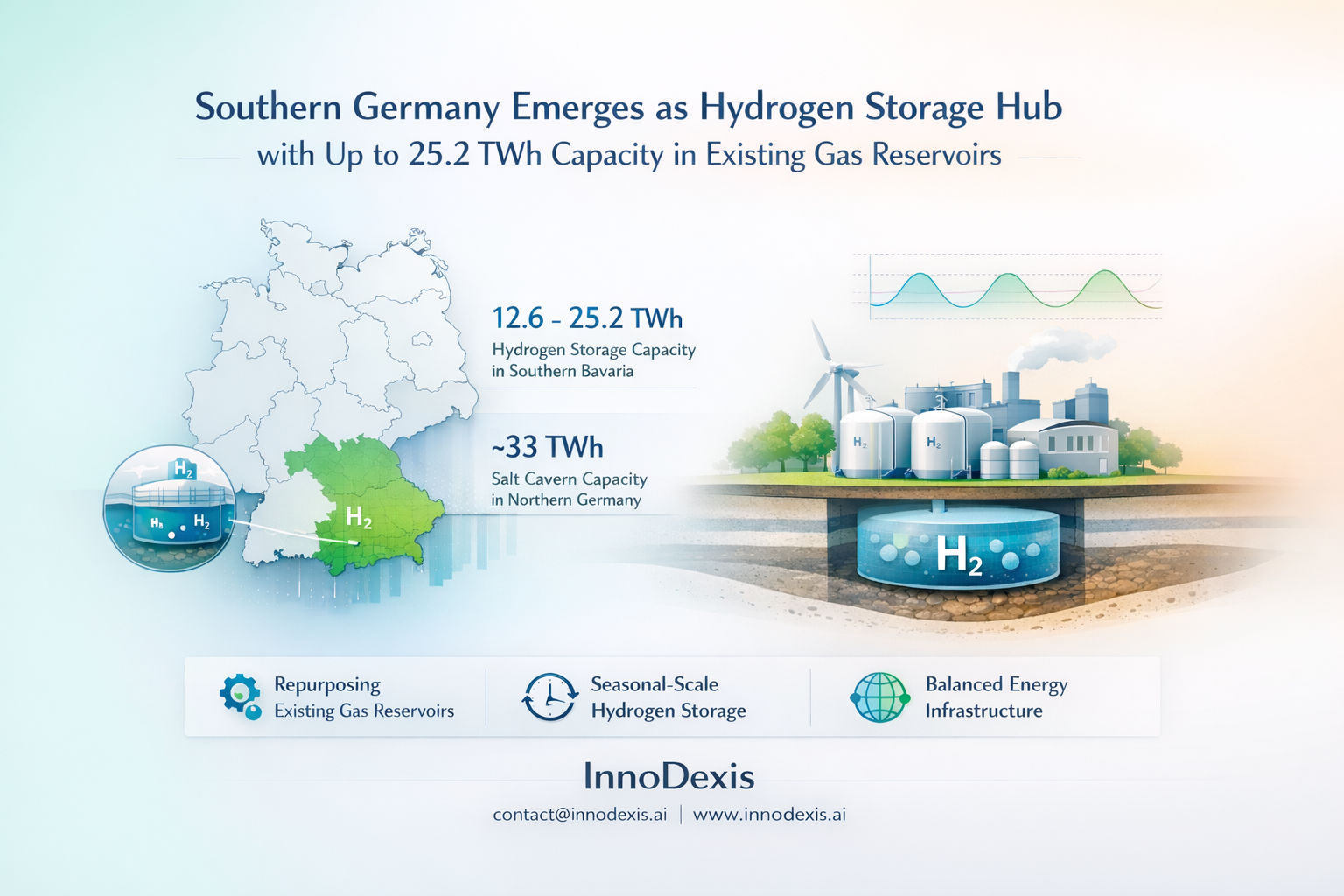
InnoDexis has published its latest Innovation Intelligence Report covering hydrogen energy storage, analyzing geological and infrastructure-based innovations in southern Germany. The report reveals that existing natural gas pore storage sites in southern Bavaria offer an estimated hydrogen storage potential of 12.6 to 25.2 TWh. This capacity approaches the scale of northern Germany’s salt cavern storage, indicating that hydrogen storage constraints may be addressed through repurposing existing subsurface infrastructure rather than building entirely new systems.
Key Findings
A study conducted by the Technical University of Munich and the Technical University of Leoben identifies southern Bavaria as a significant hydrogen storage zone, with estimated capacity ranging from 12.6 to 25.2 TWh. This finding positions the region as a potential contributor to large-scale hydrogen energy systems within Germany.
The estimated storage capacity in southern Bavaria is comparable to northern Germany’s salt cavern capacity of approximately 33 TWh. This parity suggests that hydrogen storage infrastructure can be geographically diversified rather than concentrated in a single region.
The identified storage solution utilizes porous rock formations and depleted natural gas reservoirs. These geological structures are already in place, enabling hydrogen storage without the need to construct entirely new infrastructure systems.
Seasonal-scale hydrogen storage is enabled through these subsurface formations, addressing a key limitation in current energy systems. The ability to store energy over extended periods supports balancing supply and demand fluctuations across seasons.
The approach reflects a broader shift toward repurposing legacy fossil fuel infrastructure. By leveraging existing gas storage assets, the transition toward hydrogen systems may be accelerated while reducing the need for capital-intensive greenfield developments.
Strategic Insight and Trend Analysis
The findings indicate a structural shift in how hydrogen storage challenges are being addressed. Rather than focusing solely on expanding production capacity, attention is increasingly directed toward solving long-duration storage constraints. The identification of southern Bavaria’s geological capacity highlights the importance of subsurface assets in enabling scalable hydrogen systems.
The comparability between southern Bavaria’s pore storage capacity and northern Germany’s salt cavern infrastructure suggests a transition from centralized to distributed storage models. This geographic balancing reduces dependency on a single region and enhances resilience within national energy systems.
The use of existing porous rock formations and depleted reservoirs demonstrates a broader trend toward infrastructure reuse. Instead of developing entirely new storage solutions, the data indicates that legacy fossil fuel systems can be adapted to support emerging clean energy requirements. This approach aligns with cost efficiency and deployment speed considerations.
The ability to achieve seasonal-scale hydrogen storage represents a critical step in integrating hydrogen into broader energy systems. Long-duration storage enables hydrogen to function as a buffer for renewable energy variability, supporting grid stability over extended timeframes.
Collectively, these developments suggest that the hydrogen transition may be driven as much by infrastructure adaptation as by technological innovation. The data points toward a model in which existing assets are reconfigured to meet new energy system demands.
Global and Industry Implications
For corporates and R&D teams, the findings highlight the potential to repurpose existing gas infrastructure for hydrogen storage. This creates opportunities to accelerate deployment timelines while reducing capital expenditure associated with new infrastructure development.
For investors and capital allocators, the identification of large-scale storage capacity within existing assets suggests a shift in investment focus toward infrastructure conversion and optimization. The ability to leverage established systems may alter risk-return profiles in hydrogen-related investments.
For policymakers and national innovation bodies, the results indicate that regional geological assets can play a strategic role in energy transition planning. Distributed storage capacity may support energy security while reducing reliance on concentrated infrastructure hubs.
InnoDexis Statement
“The identification of large-scale hydrogen storage potential within existing geological formations highlights a structural transition from infrastructure expansion to infrastructure adaptation in the evolving energy system,” noted InnoDexis in its latest intelligence report.
Conclusion
The analysis of southern Bavaria’s hydrogen storage capacity indicates that one of the primary constraints in hydrogen adoption—long-duration storage—may be addressed through existing subsurface infrastructure. As energy systems evolve, the ability to repurpose legacy assets into functional components of the hydrogen economy will likely influence deployment speed and system resilience. Monitoring how these storage models are integrated into national energy strategies will be critical. The complete Hydrogen Storage Innovation Intelligence Report is available to InnoDexis subscribers and enterprise clients.
About InnoDexis
InnoDexis is a global Innovation Intelligence platform that tracks, analyzes, and interprets breakthrough innovations, prototypes, and emerging technologies across industries and countries. Its intelligence helps corporates, investors, and policymakers understand the true structure and direction of global innovation. Learn more at innodexis.ai.