South Korean Researchers Discover Mode-Dependent Reaction Site Switching in Silver Nanocatalysts, Reframing Solid Oxide Cell Design
A joint team from Seoul National University, KAIST, and the Korea Basic Science Institute has established that silver nanocatalyst reaction sites shift depending on operational mode enabling decoupled surface and interface engineering for the first time in solid oxide cell design.
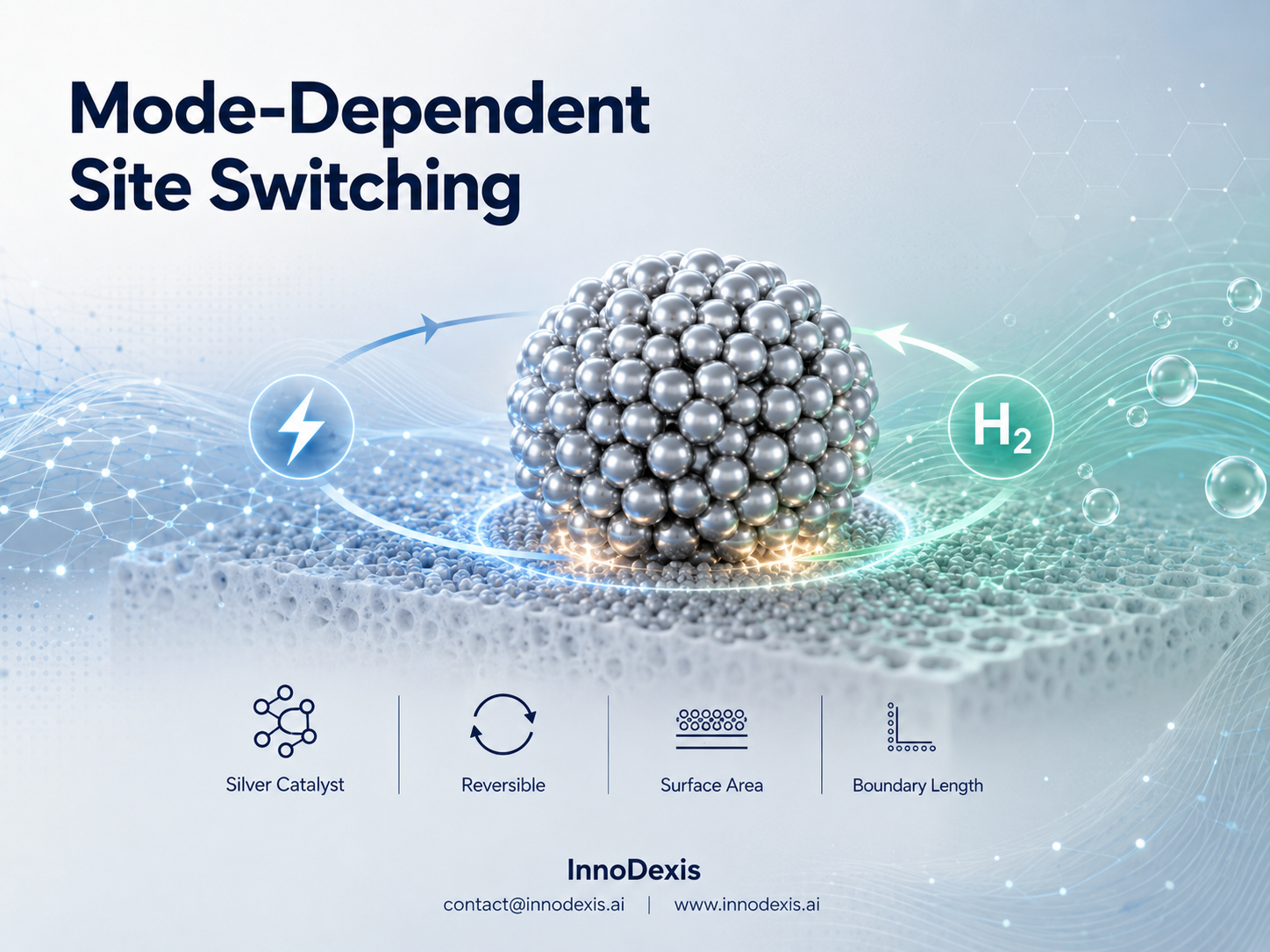
InnoDexis has published its latest Innovation Intelligence Report covering solid oxide cell catalyst technology, analyzing a high-significance discovery from South Korea. The report reveals that a joint research team from Seoul National University, KAIST, and the Korea Basic Science Institute has discovered that silver nanocatalysts shift their active reaction sites depending on whether a solid oxide cell is generating electricity or producing hydrogen — a finding that resolves a long-standing question in catalysis science and reframes nanocatalyst design from material selection toward targeted geometry and interface engineering.
Key Findings
During electricity generation mode, catalytic activity in silver nanocatalysts scales with the boundary length between silver nanoparticles and the electrode surface. During hydrogen production mode, catalytic activity scales with the surface area of the silver nanoparticles themselves. The two operational modes therefore engage fundamentally different reaction sites — a distinction that prior solid oxide cell catalyst design had not systematically accounted for, having treated both modes as requiring a single unified optimisation approach.
The reaction site switching between modes is reversible across operational cycles. This reversibility confirms that the mode-dependent behaviour is a stable, repeatable property of the silver nanocatalyst system rather than a transient or degradation-related phenomenon — a distinction that is essential for assessing its relevance to real-world solid oxide cell operation, where cells cycle between generation and production modes under working conditions.
Silver outperformed all metals tested in the study, including cobalt, palladium, and platinum. This finding is significant because palladium and platinum are among the most widely studied and commercially deployed catalytic metals. Silver's superior performance across the tested field, combined with its distinct mode-dependent reaction site behaviour, positions it as a material of primary interest for next-generation solid oxide cell catalyst development.
The discovery directly resolves a long-standing question in solid oxide cell research: where catalytic reactions occur and under what conditions. Prior catalyst design relied on empirical trial-and-error and single-parameter optimisation, which could not account for the distinct geometric and interfacial requirements of each operational mode. The identification of mode-dependent reaction sites provides a mechanistic foundation that single-parameter approaches structurally could not deliver.
Surface and interface engineering can now be targeted separately and independently for each operational mode. This decoupling represents a shift from optimising a single material property to engineering two distinct physical parameters — nanoparticle surface area for hydrogen production and boundary length for electricity generation — within the same catalyst system.
Strategic Insight and Trend Analysis
The strategic significance of this discovery extends beyond the specific performance characteristics of silver nanocatalysts. The core finding — that reaction sites are mode-dependent and that surface and interface can be engineered separately — reframes the design logic of an entire class of electrochemical devices.
Solid oxide cells are dual-function systems: they generate electricity from hydrogen and produce hydrogen from electricity, depending on operational direction. The assumption embedded in most catalyst design work to date has been that a single optimisation approach can serve both functions adequately. This research demonstrates that assumption to be structurally incorrect. Each mode engages a different physical site, and therefore requires a different geometric parameter to be optimised. A catalyst designed without accounting for this distinction is, by definition, sub-optimal for at least one operational mode.
The implications for efficiency gains are direct. If existing solid oxide cell designs have been optimised using single-parameter approaches that do not account for mode-dependent site switching, then unrealised efficiency potential exists across deployed systems — not only in future designs. The research team's finding that silver outperformed cobalt, palladium, and platinum across all tested conditions strengthens this point: the field's conventional material hierarchy may require reassessment in light of mode-dependent performance criteria.
The commercialisation horizon is characterised in the dataset as five to ten years for translation to commercial porous electrode architectures. This timeline reflects the engineering complexity of applying a laboratory-scale nanocatalyst discovery to industrial electrode geometries — but it also signals that the pathway from discovery to deployment is defined and technically coherent rather than speculative.
Global and Industry Implications
For corporates and R&D teams in clean energy and electrochemical technology, the finding that surface and interface can be engineered separately introduces a new design parameter set for solid oxide cell development programmes. Organisations currently running single-parameter catalyst optimisation programmes should evaluate whether their design frameworks account for mode-dependent reaction site behaviour — particularly those developing reversible solid oxide cells for grid-scale energy storage and green hydrogen production.
For investors and capital allocators, the five-to-ten year commercialisation horizon positions this discovery as a foundational advance rather than a near-term product signal. However, the identification of silver as outperforming platinum and palladium in this system has material implications for precious metal catalyst supply chain strategies and for the relative attractiveness of silver-based catalyst intellectual property in the solid oxide cell sector.
For policymakers and national innovation bodies, the South Korean institutional collaboration across Seoul National University, KAIST, and the Korea Basic Science Institute demonstrates the value of coordinated national research investment in clean energy technology. The discovery directly advances the scientific foundation for green hydrogen production and clean electricity generation — two priorities central to national net-zero strategies globally.
InnoDexis Statement
"The discovery that silver nanocatalyst reaction sites are mode-dependent transforms solid oxide cell design from empirical material selection into a precise engineering discipline — one where surface area and boundary length are optimised independently for each operational direction," noted InnoDexis in its latest intelligence report.
Conclusion
As green hydrogen production and grid-scale clean electricity generation become central to national energy strategies, the efficiency of solid oxide cells will be a critical determinant of deployment viability. The identification of mode-dependent reaction site switching in silver nanocatalysts establishes a new design framework for the field — one with a defined commercialisation pathway and measurable efficiency implications for both existing and future systems. InnoDexis will continue to monitor advances in solid oxide cell catalyst design, green hydrogen technology, and the translation of nanocatalyst discoveries into commercial electrode architectures. The complete Solid Oxide Cell Catalyst Innovation Intelligence Report is available to InnoDexis subscribers and enterprise clients.
About InnoDexis
InnoDexis is a global Innovation Intelligence platform that tracks, analyzes, and interprets breakthrough innovations, prototypes, and emerging technologies across industries and countries. Its intelligence helps corporates, investors, and policymakers understand the true structure and direction of global innovation. Learn more at innodexis.ai.