South American Clinical Data Joins Three-Continent Health AI Network as Mayo Clinic Platform Expands Global Validation Infrastructure
Einstein Hospital Israelita's integration into Mayo Clinic Platform_Connect brings South American clinical data into a privacy-preserving global health AI network spanning 8 institutions across 7 countries and 3 continents directly addressing geographic underrepresentation in AI development.
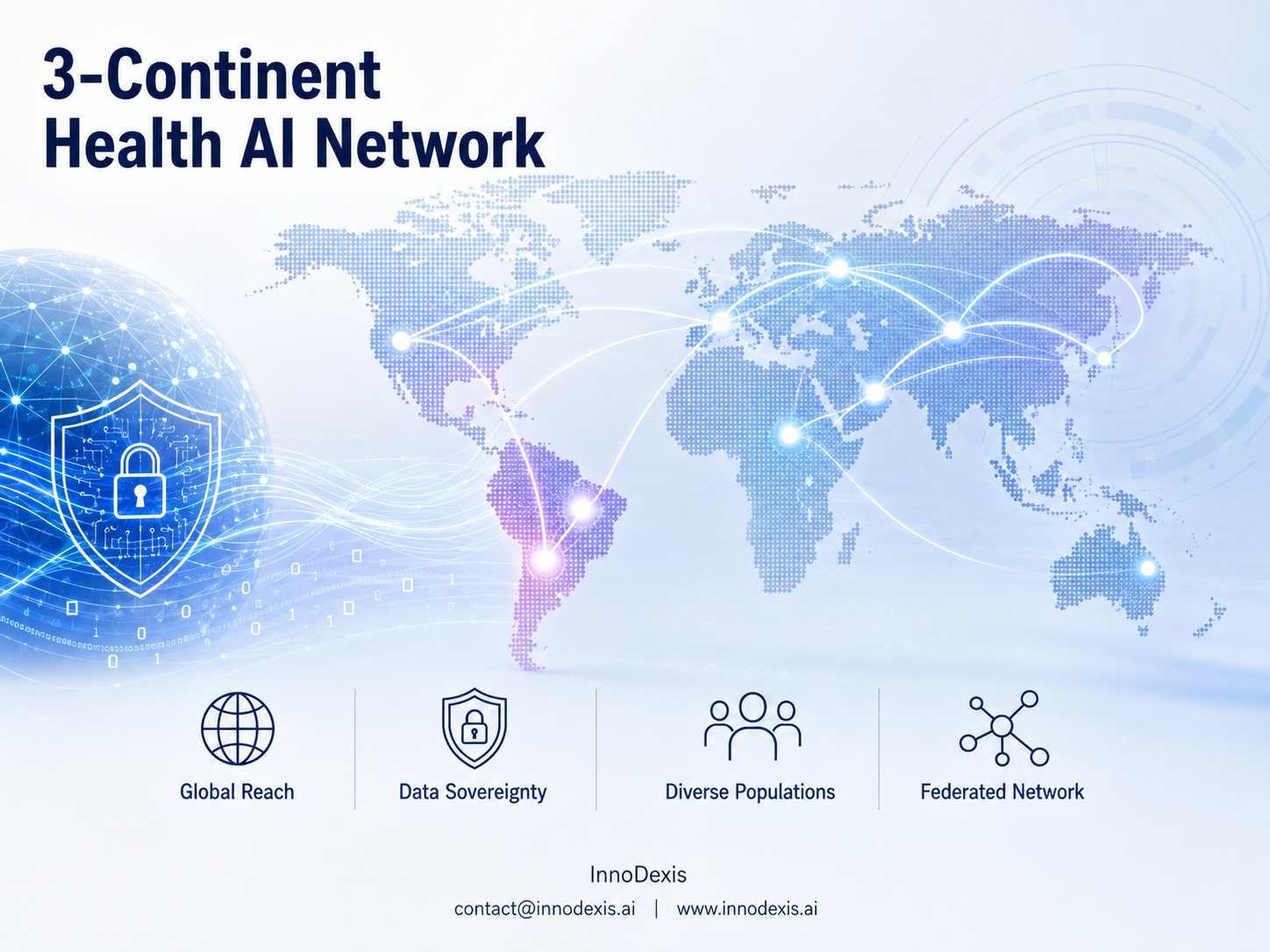
InnoDexis has published its latest Innovation Intelligence Report covering global health AI infrastructure, analyzing a landmark network integration spanning seven countries across three continents. The report reveals that Mayo Clinic Platform and Einstein Hospital Israelita have integrated Einstein's clinical data into Mayo Clinic Platform_Connect — a secure, privacy-preserving global health AI network — bringing South American clinical data into a validated multicenter research infrastructure for the first time. The integration addresses a structural gap in health AI development, where South American clinical data has been largely absent from global training and validation datasets.
Key Findings
Mayo Clinic Platform_Connect now spans 8 member institutions across 7 countries and 3 continents, following Einstein Hospital Israelita's integration via Mayo Clinic Platform's Early Adopter Program. Member institutions include Seoul National University Hospital, Aga Khan, Sheba, Mercy, University Health Network, and Einstein — representing a genuinely diverse set of patient populations across North America, South America, Asia, the Middle East, and Africa. This geographic reach distinguishes Platform_Connect from regionally concentrated health AI networks that have historically dominated the field.
The integration operates under a privacy-preserving access model with no centralised data pooling. Institutional data control is preserved across all eight member institutions, meaning patient data does not leave its originating institution. This architecture directly resolves the tension between the need for large, diverse datasets to train and validate clinical AI and the regulatory, ethical, and sovereignty constraints that have historically prevented centralised data aggregation at global scale.
South American clinical data has been largely absent from global health AI development prior to this integration. The underrepresentation of South American patient populations in AI training datasets has been a recognised structural limitation, as AI models trained on narrow regional datasets generalise poorly across different genetic, demographic, and epidemiological profiles. Einstein Hospital Israelita's inclusion directly addresses this gap, expanding the demographic coverage of the network in a clinically meaningful way.
The network enables multicenter studies and AI algorithm validation across genuinely diverse patient populations without requiring centralised data pooling — a capability that has not previously been achievable at this scale. The shared infrastructure is designed for responsible AI development, preserving institutional data control while enabling cross-institutional research that would otherwise require complex bilateral data-sharing agreements or physical data transfers.
Einstein Hospital Israelita joined through Mayo Clinic Platform's Early Adopter Program, indicating a structured institutional pathway for network expansion. This programme signals that Platform_Connect is designed for continued growth, with a defined mechanism for onboarding additional institutions and extending geographic coverage further across underrepresented regions.
Strategic Insight and Trend Analysis
The dominant trend this integration signals is a structural shift in how global health AI validation infrastructure is being built — from regionally siloed clinical datasets toward federated networks that preserve institutional data sovereignty while enabling population-level AI research across genuinely diverse geographies.
The significance of this shift cannot be assessed solely by the number of institutions or countries involved. The more important structural question is whether the network's geographic composition reflects the demographic diversity required to produce AI models that generalise credibly across different patient populations. A three-continent network that includes South American, East Asian, Middle Eastern, African, and North American clinical data moves meaningfully closer to that standard than any single-region infrastructure could achieve.
The privacy-preserving, no-centralised-pooling architecture is equally significant. The central obstacle to global health AI collaboration has not been institutional unwillingness to share data — it has been the absence of infrastructure that enables collaboration without requiring institutions to relinquish data control. Platform_Connect's federated model resolves this by creating shared research capability without shared data custody, a distinction that matters both regulatorily and ethically.
This infrastructure-level innovation also reframes what multicenter AI studies can credibly claim. Research validated across 8 institutions in 7 countries, including populations from South America, Asia, and the Middle East, carries materially stronger generalisability claims than studies validated within a single healthcare system or region. As regulatory frameworks for clinical AI mature globally, the evidentiary standard for generalisability is likely to rise — and networks like Platform_Connect establish the infrastructure required to meet that standard.
Global and Industry Implications
For corporates and R&D teams developing clinical AI, the Platform_Connect expansion signals that the infrastructure for population-diverse AI validation is becoming accessible at an institutional level without requiring bilateral data-sharing agreements. Organisations developing diagnostic, prognostic, or treatment-recommendation algorithms now have a concrete reference model for how multicenter validation across diverse geographies can be structured while preserving data sovereignty at each participating institution.
For investors and capital allocators, the integration highlights the growing strategic value of health AI network infrastructure as an asset class distinct from individual AI models or diagnostic tools. A validated, privacy-preserving network spanning three continents and eight institutions represents durable infrastructure whose value scales with each additional member — making network expansion a compounding return rather than a linear one.
For policymakers and national innovation bodies, the Einstein Hospital Israelita integration demonstrates that geographic underrepresentation in health AI is a solvable infrastructure problem rather than an inherent constraint of federated research models. National health agencies in underrepresented regions now have a validated pathway for integrating their clinical data into global AI research networks while retaining full institutional data control.
InnoDexis Statement
"Platform_Connect's expansion to three continents demonstrates that privacy-preserving federated infrastructure can resolve the geographic representation gap in health AI — shifting the field from regionally siloed datasets to globally validated models without centralised data pooling," noted InnoDexis in its latest intelligence report.
Conclusion
As clinical AI moves toward regulatory scrutiny and real-world deployment across diverse healthcare systems, the generalisability of models trained and validated on narrow regional datasets will face increasing challenge. The expansion of Mayo Clinic Platform_Connect to include South American clinical data through Einstein Hospital Israelita marks a meaningful step toward the population-diverse validation infrastructure that credible global health AI requires. InnoDexis will continue to monitor the expansion of federated health AI networks, geographic representation in clinical datasets, and the regulatory frameworks shaping AI validation standards globally. The complete Global Health AI Infrastructure Intelligence Report is available to InnoDexis subscribers and enterprise clients.
About InnoDexis
InnoDexis is a global Innovation Intelligence platform that tracks, analyzes, and interprets breakthrough innovations, prototypes, and emerging technologies across industries and countries. Its intelligence helps corporates, investors, and policymakers understand the true structure and direction of global innovation. Learn more at innodexis.ai.