Soil Liming Could Protect Crop Roots in Heatwaves Above 40°C as University of Nottingham Links Soil pH to Root Thermo-Signalling
University of Nottingham researchers found that neutral soils favour root growth during heat stress while acidic soils worsen thermal damage, pointing to agricultural liming as a low-cost, readily available way to protect crops.
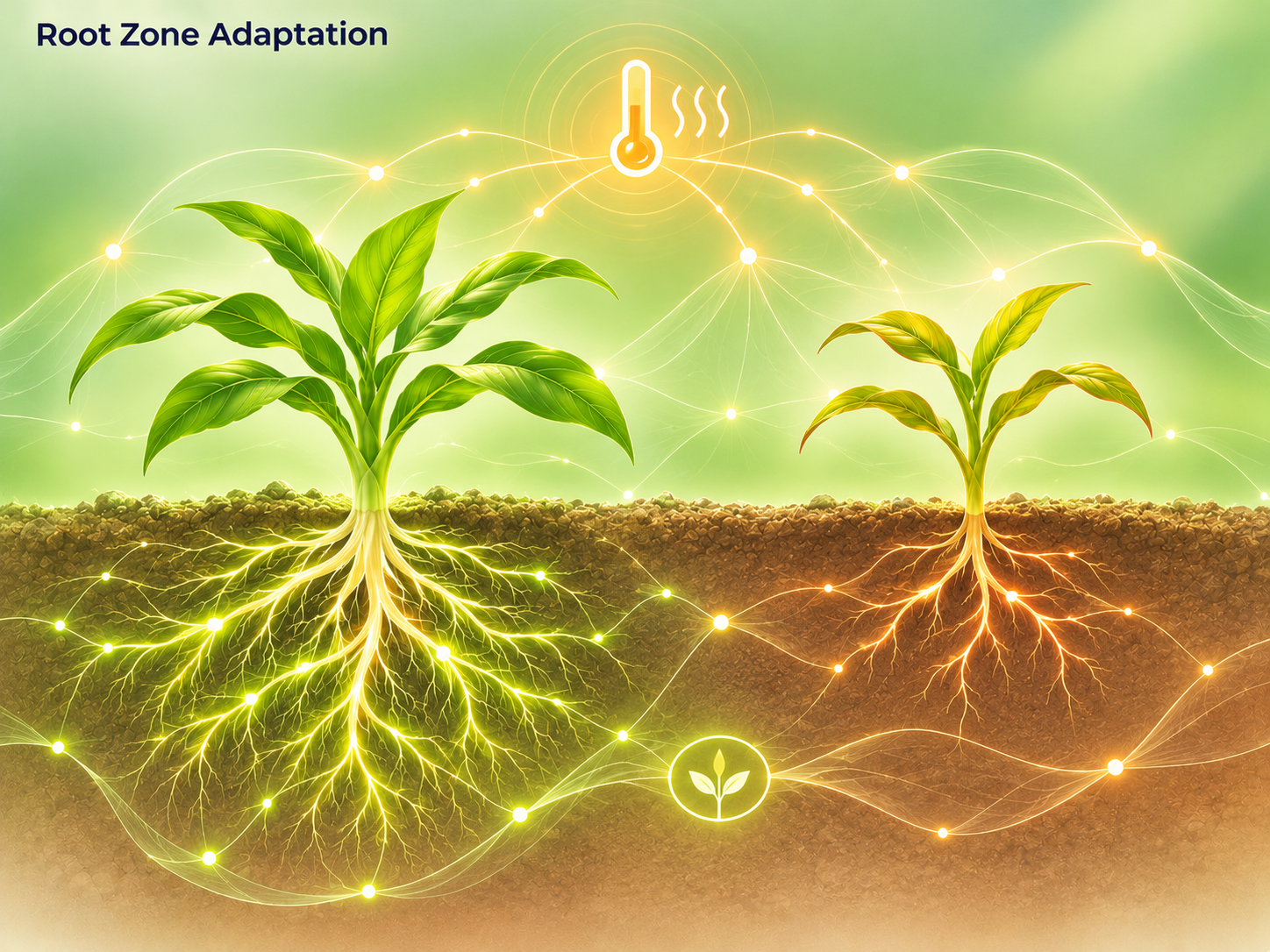
InnoDexis has published its latest Innovation Intelligence Report covering climate-resilient agriculture and soil management, analyzing one innovation from the United Kingdom, published on 17 November 2026. The report reveals that University of Nottingham researchers have shown that soil pH mediates how plant roots respond to high temperatures, with neutral soils favouring root growth during heat stress and acidic soils worsening thermal damage, which positions agricultural liming as a low-cost, readily available strategy to help protect crop productivity and root survival during extreme heatwaves.
Key Findings
Soil pH significantly influences how plant roots respond to high temperatures. Neutral soils favour root growth during heat stress, while acidic soils worsen thermal damage, and the experimental study was run under temperatures exceeding 40°C. The finding matters because soil acidity is a variable that farmers can already manage, which allows agronomists and farmers to use existing soil management practices to build resilience against warming global temperatures.
Rhizospheric pH mediates thermo-signalling that coordinates root growth under heat stress. This links soil chemistry directly to molecular root biology and explains why pH changes how roots tolerate heat, rather than only showing that it does.
Agricultural liming, the addition of lime to acidic soils to raise pH and improve buffering capacity, is the proposed intervention. It uses an established, low-cost practice and does not require long-term genetic engineering or novel synthetic chemical inputs, which keeps the barrier to adoption low. It differs from heatwave strategies centred solely on atmospheric cooling, shade or irrigation.
Commercial readiness is rated medium. The mechanism is newly validated in academic research, but liming is already a widespread farming practice. Farm-level guidance could be integrated within 1 to 3 years, agricultural lime is widely manufactured and distributed, and no regulatory approval is apparent.
Field validation is still required. Specific pH thresholds for different crop species and soil types remain unknown, laboratory insights must be translated to heterogeneous field soils, and extreme temperatures can exceed root resilience regardless of pH buffering.
Strategic Insight and Trend Analysis
The dominant trend in this research is the treatment of soil management as a near-term heatwave adaptation lever. Heat mitigation has centred on atmospheric cooling, shade or irrigation, with genetic engineering as the longer-term route to heat tolerance. This study shifts attention to the root zone, showing that soil pH determines whether roots keep growing or suffer thermal damage when temperatures rise.
The significance is practical as well as scientific. The work bridges soil chemistry and molecular root biology, and it points to an intervention that relies on existing infrastructure: standard lime production, distribution and application equipment. That is why the implementation horizon is 1 to 3 years rather than the long cycle associated with new seed traits, and why the approach complements plant genetic engineering with immediate, accessible soil management techniques.
The evidence has clear boundaries. Primary risks centre on translating basic thermo-signalling mechanisms into field-validated protocols for varied soil types. Over-liming could cause nutrient deficiencies or micro-nutrient imbalances, and farmers may be reluctant to adjust liming outside standard maintenance cycles without a precise predictive return during heatwaves.
Rahul Bhosale of the School of Biosciences frames the broader point: understanding how soil properties influence plant responses to environmental stress will be critical for developing climate-resilient cropping systems. For agribusinesses and climate-tech funds, the implication is to treat soil chemistry management as an immediate lever alongside long-term biotech crop traits.
Global and Industry Implications
For corporates and R&D teams, the work is directly accessible to agricultural extension services, soil amendment suppliers and commercial farming operations. Development of specialized soil buffering formulations tailored to crop root thermo-tolerance and precision liming algorithms tied to predicted heatwaves are identified as opportunities, and field trials will define the targets.
For investors and capital allocators, the profile is low regulatory risk and a short horizon. Agricultural lime is an approved soil amendment globally, and agribusinesses and climate-tech funds are advised to view soil chemistry management as an immediate climate adaptation lever alongside long-term biotech seed traits. Input cost fluctuations and higher application densities are the financial risks.
For policymakers and national innovation bodies, the finding supports integrating soil pH management into climate adaptation agronomy and extreme weather preparation plans. Field-scale validation trials across key staple crops are needed to establish optimal pH targets for severe thermal events. No regulatory approval is apparent, because lime is an established agricultural input.
InnoDexis Statement
"The Nottingham findings shift heatwave adaptation toward soil pH, a variable farmers already manage, where an established low-cost practice meets a newly validated root mechanism, and field trials will decide its reach," noted InnoDexis in its latest intelligence report.
Conclusion
The next milestones to watch are field-scale validation trials across key staple crops, the specific pH thresholds for different crop species and soil types, and the translation of laboratory thermo-signalling insights into heterogeneous field soils. Whether liming can be tuned to predicted heatwaves will determine how far the approach moves from a general soil practice toward precision agronomy. InnoDexis will continue to track soil health, climate adaptation agronomy and root biology as this field develops. The complete Soil Liming and Crop Heat Resilience Innovation Intelligence Report is available to InnoDexis subscribers and enterprise clients.
About InnoDexis
InnoDexis is a real-time innovation intelligence platform connecting scientific discovery to commercial opportunity. Powered by InnoGraph, its proprietary innovation knowledge graph, the platform maps technologies across the entire lifecycle, from early-stage research (TRL 1) to market deployment (TRL 9), connecting researchers, institutions, startups, companies, products and emerging opportunities.
Covering 40+ specialised industry segments and 360 technology areas, InnoDexis delivers innovation tracking, research discovery, product and startup intelligence, investment insights, and AI-powered reports. Its mission is to bridge the gap between scientific discovery and real-world impact.
InnoDexis — From Lab to Market: Real-Time Innovation Intelligence.