Severe Periodontitis Independently Associated with Early Kidney Dysfunction in 6,179-Participant Study, Pointing to Dentistry as a Frontline Screening Channel
Population-scale data from Hamburg establishes a significant, confounder-adjusted link between severe gum disease and early-stage chronic kidney disease, with systemic inflammation accounting for approximately 35% of the association.
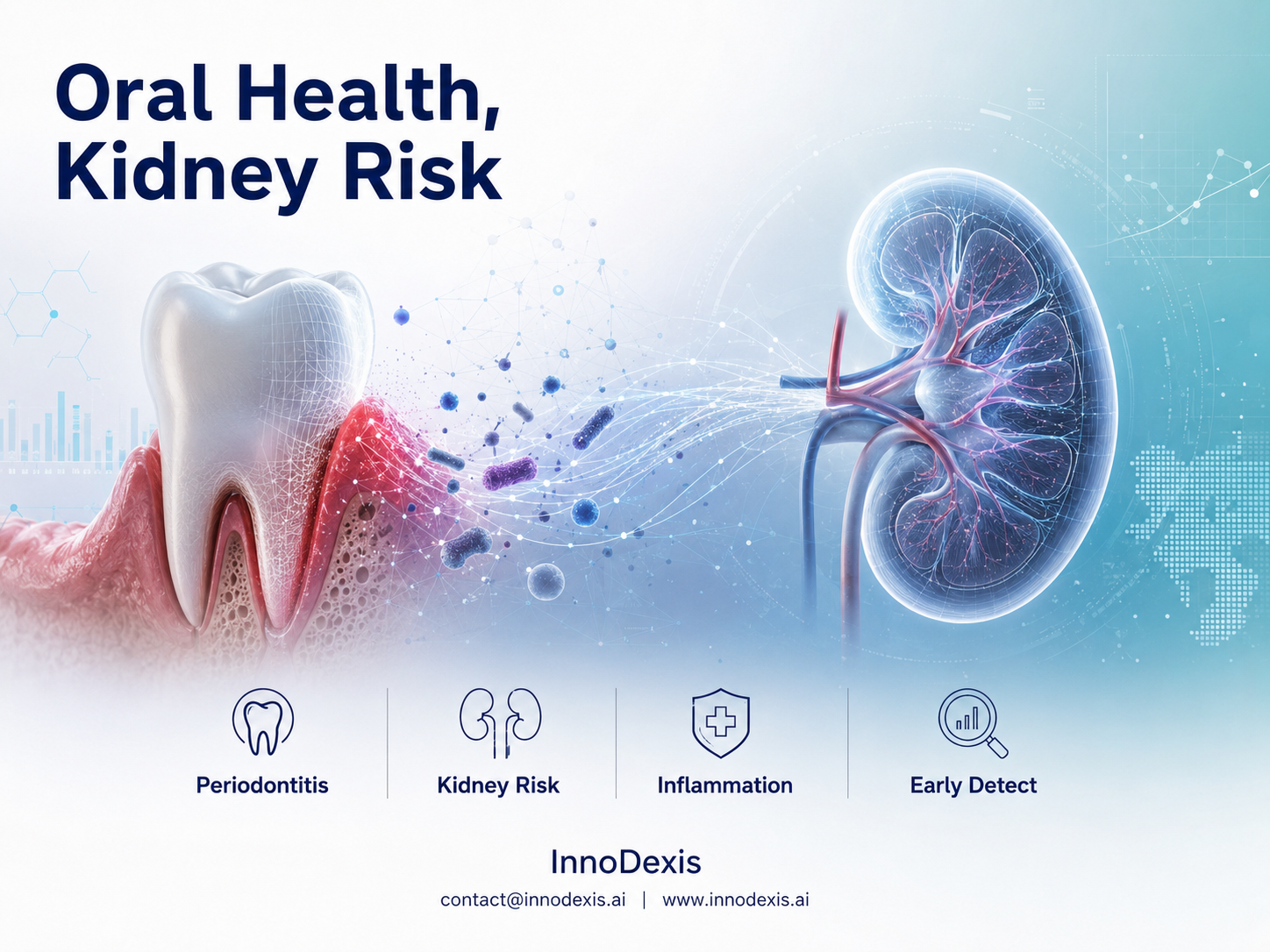
InnoDexis has published its latest Innovation Intelligence Report covering the intersection of oral health and chronic kidney disease, analyzing a population-scale clinical study of 6,179 participants conducted by researchers from the University Medical Center Hamburg-Eppendorf and the Hamburg Center for Kidney Health. The report reveals that severe periodontitis is independently and significantly associated with early-stage chronic kidney disease after adjustment for age, sex, diabetes, and smoking — and that systemic inflammation accounts for approximately 35% of the observed association, with additional biological mechanisms remaining under active investigation.
Key Findings
Severe periodontitis prevalence increased markedly across the kidney function spectrum, rising from 14% in participants with normal kidney function to 36% in those with moderately reduced kidney function. This near-tripling of prevalence across the kidney function gradient represents a clinically significant pattern at population scale, establishing periodontitis as a measurable correlate of kidney dysfunction detectable through routine dental examination.
The association between severe periodontitis and reduced kidney filtration rate remained statistically significant after adjustment for all major confounders, including age, sex, diabetes, and smoking status. The confounder-adjusted result is a critical methodological distinction: it confirms that the observed relationship is not explained by shared risk factors alone, and that periodontitis carries an independent association with early kidney dysfunction.
Systemic inflammation accounted for approximately 35% of the association between severe periodontitis and reduced kidney filtration rate. While inflammation is a recognised shared pathway between periodontal and systemic disease, the 35% mediation figure indicates that the majority of the association operates through mechanisms beyond inflammation — including microbial dissemination and endothelial dysfunction — both of which remain under active investigation by the research team.
Standardised periodontal assessments were combined with kidney biomarkers in the study design, establishing a methodologically rigorous framework for linking oral and renal health data at population scale. This approach demonstrates that existing clinical infrastructure — routine dental examination — is sufficient to generate data relevant to kidney health monitoring, without requiring new diagnostic technology or specialist referral pathways.
The study positions dentistry as a potential frontline screening touchpoint in integrated chronic disease detection. Chronic kidney disease is frequently identified late, when intervention options are limited. The availability of a low-cost, widely accessible diagnostic signal — periodontal status — in advance of symptomatic kidney disease represents a structural opportunity to shift detection earlier in the disease trajectory.
Strategic Insight and Trend Analysis
The dominant signal emerging from this dataset is not simply a statistical association between two disease categories — it is a structural argument for reconfiguring how chronic disease screening is organised across clinical disciplines.
Chronic kidney disease affects a substantial proportion of the global adult population and is routinely detected at stages where meaningful intervention is already constrained. The Hamburg study contributes population-scale evidence that a diagnosable oral condition — severe periodontitis — is independently associated with early kidney dysfunction, identifiable through an examination that already occurs routinely in dental practice. The bottleneck this finding exposes is not diagnostic technology. It is the absence of structured information sharing between dental and medical care systems.
The 35% inflammation mediation figure is analytically important precisely because of what it does not explain. If systemic inflammation were the dominant or complete pathway, the clinical implication would be relatively contained — treat inflammation, reduce kidney risk. The evidence that 65% of the association operates through other mechanisms, including microbial dissemination and endothelial dysfunction, means the biological relationship is more complex and the potential therapeutic surface is correspondingly broader.
This study adds population-scale data to a growing evidence base connecting oral inflammatory disease to systemic conditions including cardiovascular disease, diabetes, and now kidney dysfunction. The accumulation of this evidence across multiple systemic disease categories is gradually shifting oral health from a siloed clinical discipline toward a recognised systemic health indicator — a repositioning with significant implications for how dental data is collected, shared, and acted upon within integrated care models.
Global and Industry Implications
For corporates and R&D teams, particularly those operating in digital health, diagnostics, and integrated care platforms, the findings identify a near-term product and service opportunity: building the data infrastructure that connects periodontal assessment outputs to nephrology and primary care workflows. The diagnostic signal already exists within current clinical practice — the gap is integration, not invention.
For investors and capital allocators, the study reinforces the commercial case for oral-systemic health platforms and preventive screening technologies. As the evidence base linking periodontal status to multiple systemic conditions strengthens, the addressable market for integrated oral health diagnostics expands beyond dentistry into nephrology, cardiology, and chronic disease management — each representing a distinct revenue and partnership pathway.
For policymakers and national innovation bodies, the findings present a tractable policy lever: structured data-sharing protocols between dental and medical care systems could enable earlier chronic kidney disease detection at population scale using existing clinical infrastructure, without requiring new capital investment in diagnostic technology or specialist workforce expansion.
InnoDexis Statement
"The Hamburg periodontitis-kidney study demonstrates that the diagnostic signal for early kidney dysfunction may already exist within routine dental care — the structural challenge is whether health systems are designed to act on it," noted InnoDexis in its latest intelligence report.
Conclusion
As the evidence connecting oral inflammatory disease to systemic conditions continues to accumulate at population scale, the case for integrating periodontal assessment into chronic disease screening pathways becomes increasingly difficult to set aside. The mechanisms linking severe periodontitis to kidney dysfunction — inflammation, microbial dissemination, and endothelial dysfunction — each represent research frontiers with therapeutic implications that extend well beyond oral health. InnoDexis will continue tracking developments at the oral-systemic health intersection, including emerging interdisciplinary care models and the therapeutic potential of periodontal intervention on systemic disease outcomes. The complete Oral-Systemic Health Innovation Intelligence Report is available to InnoDexis subscribers and enterprise clients.
About InnoDexis
InnoDexis is a global Innovation Intelligence platform that tracks, analyzes, and interprets breakthrough innovations, prototypes, and emerging technologies across industries and countries. Its intelligence helps corporates, investors, and policymakers understand the true structure and direction of global innovation. Learn more at innodexis.ai.