Scientist-to-Executive Data Shows 11,758 Named Lead Scientists Against 4,149 Executive Mentions Where CEOs Get 1,649 and Science and Technology Leaders Only 124
A people reading of 2,884 research and 2,280 corporate records finds that only 186 of 11,758 lead scientists appear in more than one record and only 11 appear in a record issued by a company, so anyone sourcing technology through people should read research records, not press-release executive lists.
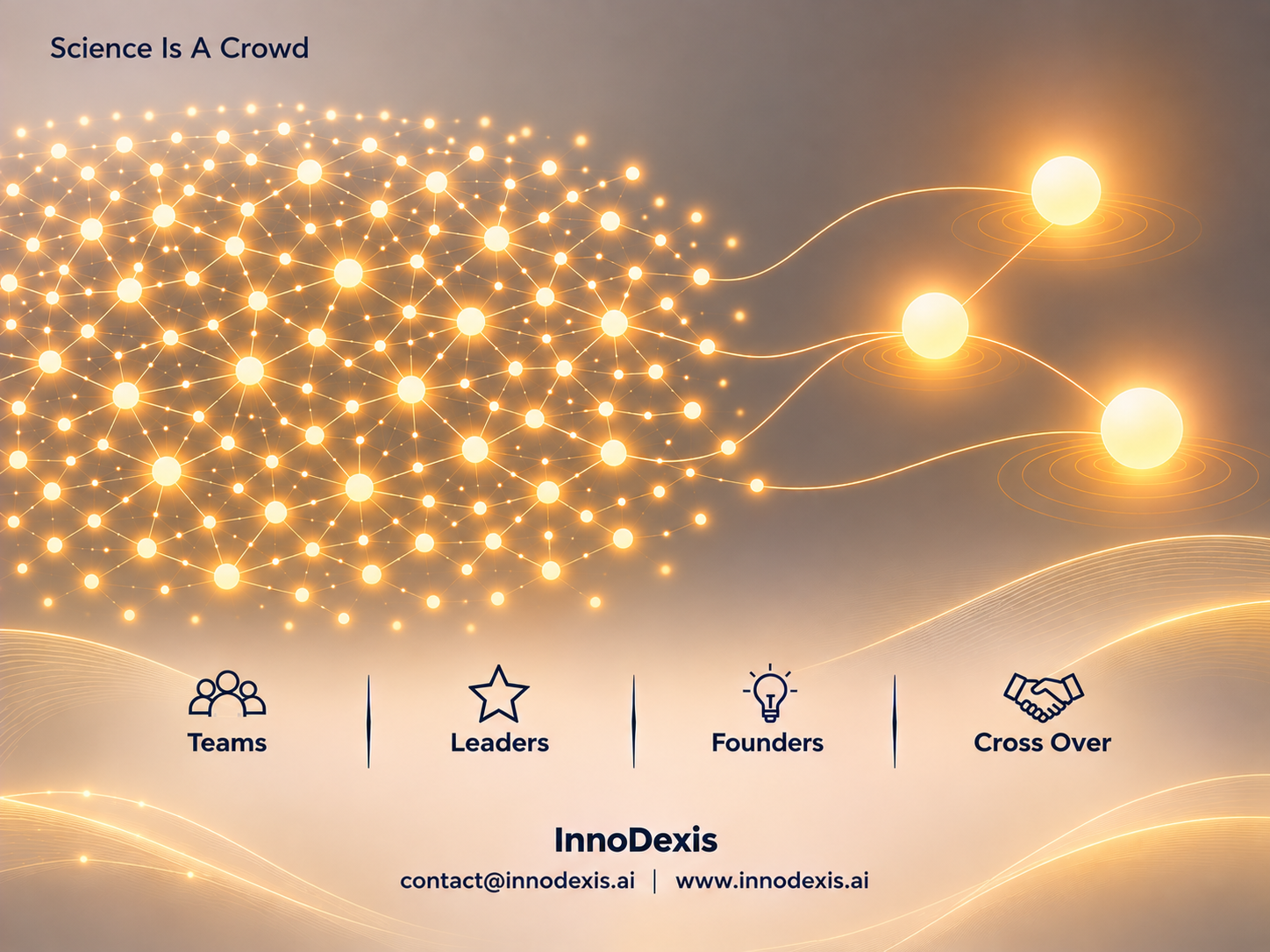
InnoDexis has published its latest Innovation Intelligence Report covering the scientist-to-executive people map, analyzing 11,758 named lead scientists in 2,742 research records and 4,149 executive mentions in 2,012 corporate records during the complete 1–31 October 2026 window. The report reveals that science is made by a crowd while the market speaks through CEOs: 40 percent of executive mentions are CEOs or presidents, 3.0 percent are science and technology leaders, and only 66 scientists appear in a corporate record alongside their own institution. Only 11 appear in a record a company issued.
Key Findings
Science is a crowd, not stars. 2,742 of 2,884 research records, 95.1 percent, name lead scientists, together 11,758 different people, the typical record names 3 and a quarter name five or more, only 186 people, 1.6 percent, appear in more than one record and no one appears more than three times.
Companies speak through CEOs. 2,012 of 2,280 corporate records, 88.2 percent, name executives, 4,149 mentions in all, with CEOs and presidents 1,649, vice presidents and directors 667, founders 397 and chief technology, science, medical or research officers and heads of R&D 124, 3.0 percent.
Few scientists cross over. Of 11,758 lead scientists, 93 names match the corporate stream and 66 survive the institution check, mostly universities publishing their own news, and only 11 appear in a record issued by a company, including the MIT, BioOrbit, RMIT, Dana-Farber and MD Anderson handoffs.
Science leaders vary by technology. They are 8.2 percent of executive mentions in health, 3.3 percent in compute and 2.7 percent in AI and software, against 0.7 percent in fintech and agrifood, and in gated announcements they rise to 4.3 percent while CEOs are 43 percent.
Teams are the unit of science. 1,613 research records name a team or consortium and 780 name principal investigators, with the median team 3 scientists, the largest named team 75, and teams smallest in energy, environment, space and agrifood at two.
Strategic Insight and Trend Analysis
The defining structural finding is that the people who produce results and the people who speak for companies are almost entirely different groups, and the overlap is small enough to list by name. A research release is written around the person who did the work, a company release around the person who owns the outcome, so the executive list in a press release is the wrong place to look for the people who will carry science into a company.
The most active scientists are the better map. Li-Huei Tsai at MIT, Jay Shendure at the University of Washington, Vamsi Mootha at the Broad Institute, Hao Li at Tohoku University, Rolf Müller at the Helmholtz Centre for Infection Research and Mary-Ellen Taplin at Dana-Farber each appear in three October records, in Alzheimer's biology, cell-history recording, mitochondria, hydrogen catalysts, antibiotics and prostate cancer, areas with few company announcements.
Handoff is visible through a few people. Records naming a science or technology leader are High momentum in 30 percent of cases against 14.6 percent overall, mostly the gate effect of readouts and approvals, and the company-side bridges sit at TRL 7–9. Names are counted as written, so the 186 repeat count is an upper bound, 1,001 executive mentions have no clear title and company announcements are 84 percent quoted, so who is quoted matters more than the quote.
Global and Industry Implications
For corporates and R&D teams, build contact lists from research records rather than executive quotes, ask every partner for its technical lead and put your own CSO or CTO in your releases. Approach teams and consortia as units, since 1,613 records name one, such as the Alliance for Clinical Trials in Oncology. Large named teams are the gaining pattern, with a median of three scientists per record.
For investors and capital allocators, track repeat scientists and confirmed bridges as early signals of company formation, since a scientist named in a company release is the clearest sign the science has moved. Named areas include Alzheimer's biology, cell-history recording, mitochondria, hydrogen catalysts and antibiotics, and contacting a scientist before licensing is the cheapest point of contact.
For policymakers and national innovation bodies, fund programmes that keep teams together across the step into a company, since science is made by teams, not individuals, and agree co-announcement between institutions and partners, as Dana-Farber and MD Anderson did with Amgen and Roche. Names in this report come only from public releases and contact should follow institutions' own routes.
InnoDexis Statement
"Science is made by a crowd and the market speaks through CEOs — the people who carry results into companies are visible in research records and almost invisible in company announcements," noted InnoDexis in its latest intelligence report.
Conclusion
Because names are counted as written, common names can merge different people, roles are read from titles and bridges require the institution in the same record, the findings are cross-sectional and the repeat count is an upper bound. The signals to watch are whether a tracked scientist appears in a company release, whether a scientist founds or joins a company, whether a company names a CSO or CTO in a deal release, and whether a repeat scientist publishes again in the same area. The complete Scientist-to-Executive Report October 2026 is available to InnoDexis subscribers and enterprise clients.
About InnoDexis
InnoDexis is a real-time innovation intelligence platform connecting scientific discovery to commercial opportunity. Powered by InnoGraph, its proprietary innovation knowledge graph, the platform maps technologies across the entire lifecycle, from early-stage research (TRL 1) to market deployment (TRL 9), connecting researchers, institutions, startups, companies, products and emerging opportunities.
Covering 40+ specialised industry segments and 360 technology areas, InnoDexis delivers innovation tracking, research discovery, product and startup intelligence, investment insights, and AI-powered reports. Its mission is to bridge the gap between scientific discovery and real-world impact.
InnoDexis — From Lab to Market: Real-Time Innovation Intelligence.