Research Talent Is Long-Tailed as 88.0% of 12,797 Named Scientists Appear Once While Universities and Hospitals Form Companies at Twice the Rate of Research Institutes
An analysis of 3,440 institution-attributed research records from 1,022 institutions in 38 countries finds research capability spread across a long tail, with the top 20 institutions holding just 12.4 percent of output, while conversion capacity sits in hospitals, universities and only 7 of 148 executive appointments.
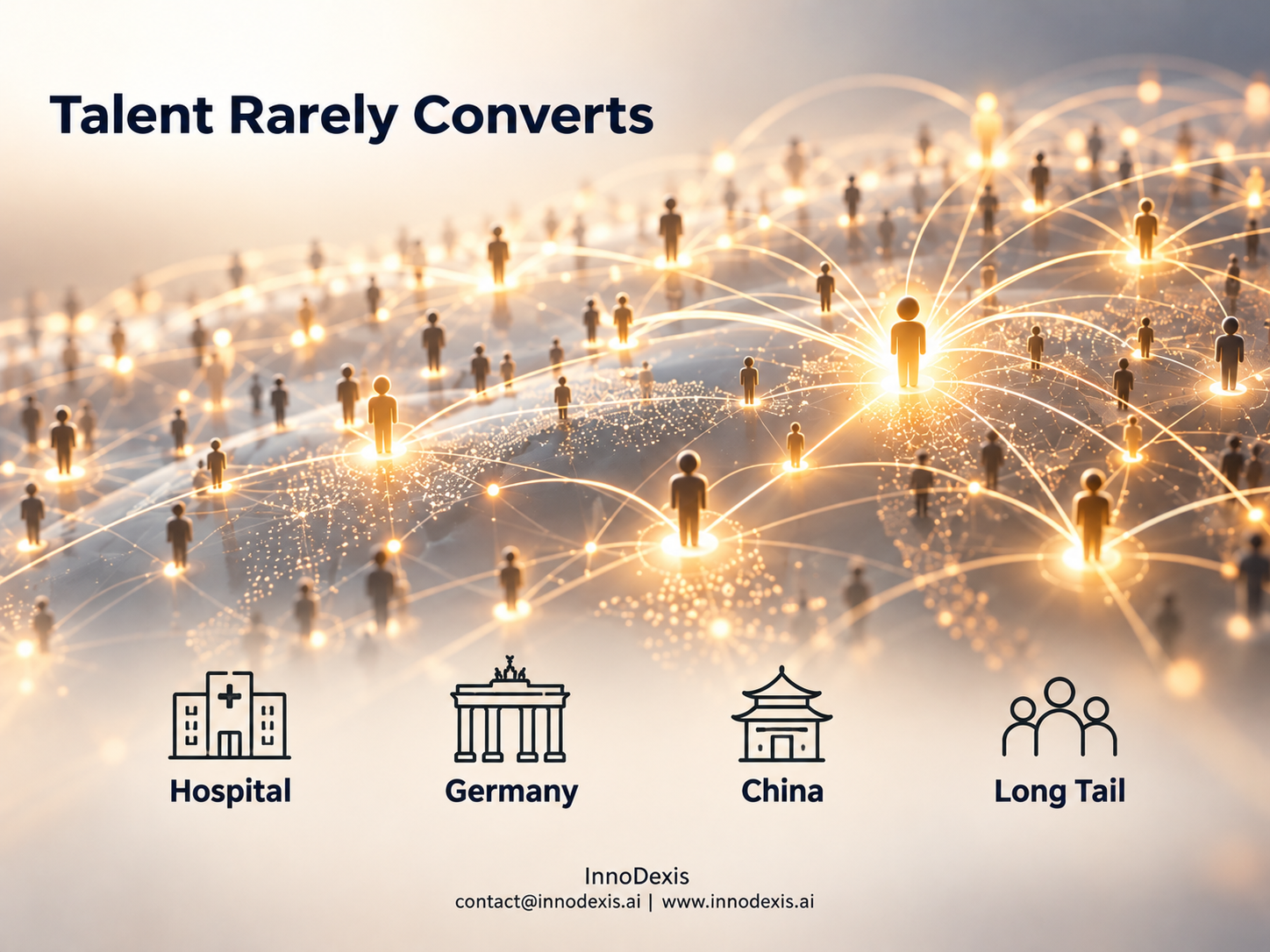
InnoDexis has published its latest Innovation Intelligence Report covering institutions and research talent, analyzing 3,440 institution-attributed research records from 1,022 institutions in 38 countries, naming 12,797 distinct lead scientists, and 148 executive appointments among 4,840 corporate records during the 1–29 September 2026 observation window. The report reveals that research talent is everywhere and conversion talent is rare: 88.0 percent of named scientists appear once, the top 20 institutions hold 12.4 percent of records, and universities and hospitals form companies at about four per 100 records against 2.1 for research institutes.
Key Findings
Talent is long-tailed. Of 12,797 named scientists, 11,255 appear once and only 247 appear three or more times, while 384 of 986 institutions outside congress sources appear once and it takes 217 institutions to reach 57.5 percent of records.
Institution type predicts conversion. Hospitals form 4.2 companies per 100 records and universities 4.0, against 2.1 for research institutes, and bridge to the corporate stream at 13.9 and 14.4 percent against 4.2 percent for institutes, which reflects their process and fundamental-science mission rather than quality.
Hospitals are the most rigorous large producers. They record 0.97 rigour signals and 13.6 percent High readiness, and Mass General Brigham, with 2.00 rigour signals and 23.1 percent High readiness across 13 records, names 210 scientists, the most per record. Societies and congresses are higher still at 26.5 percent High but are venues, not employers.
National systems differ in shape. German output is 31.7 percent research institutes, with 242 records from Fraunhofer, Helmholtz, Max Planck and Leibniz bodies, US output is 57.0 percent universities and 22.0 percent hospitals, and China’s is 77.7 percent research institutes, mostly the Chinese Academy of Sciences.
Corporate leadership is managerial. Only 7 of 148 executive appointments are technical, none names a chief AI or data officer, appointments score 3.97 with no High-momentum records, and Nutromics’ appointment of Prof Kevin Plaxco as Chief Scientific Officer is the named example.
Strategic Insight and Trend Analysis
The defining structural finding is that capability and conversion are distributed in opposite ways. Research is spread across a long tail, with the top 100 institutions holding 36.6 percent of records, while conversion concentrates in hospitals, a few universities and the rare companies that hire technical leadership. A search that stops at the top institutions misses most of the work, and a partnership without a converting institution or a company with technical leadership is unlikely to reach market.
Size is not readiness. MIT, with 43 records, has no record rated High readiness yet forms the most companies of any institution, 5, while Yale, with 31 records, is the most applied large institution at 22.6 percent High, and Cambridge and Oxford sit at 16.7 and 17.6 percent. Durham forms three companies from 14 records, and Japan’s collaboration share, 61.4 percent multi-affiliation, and readiness, 3.7 percent High, are the lowest of the major systems.
Collaboration is the default. Records name 4.25 lead scientists and 3.48 affiliations on average, 81.0 percent list two or more affiliations, and multi-affiliated records are slightly more ready, 11.9 percent High against 9.9 percent. The named-scientist field, 95.8 percent filled, is therefore the most direct route in, since a partnership starts with a person rather than a university, and recurring names include Purna Kashyap and Ruben Mars at Mayo Clinic, Lu Qi at Tulane and Achim Menges at Stuttgart.
Global and Industry Implications
For corporates and R&D teams, source by named scientist rather than institution, since 247 scientists recur three or more times, and agree IP early, since any result has several institutional owners. Use hospitals for regulated products, Germany’s institute network, including Fraunhofer ILT, IFAM and ISE, for process and manufacturing work, and KAIST and Tohoku for materials and catalysts. Hiring scientific leadership from research institutions, as Nutromics has done, builds conversion capacity that partnerships alone do not.
For investors and capital allocators, the thesis is to back teams that include a recurring named scientific lead and a converting institution, such as MIT, NTU Singapore, Durham, Mass General Brigham, Mayo Clinic and UCLA Health. Named opportunities include microbiome-oncology at Mayo Clinic, CAR-NKT work at UCLA and the Cologne trial group, and due diligence should check whether the lead appears in multiple records and whether the institution has formed companies before.
For policymakers and national innovation bodies, conversion policy should fit the national shape: institute-heavy systems such as Germany and China need transfer mechanisms, including transfer centres at Fraunhofer and Helmholtz institutes, while university systems such as the UK and Australia already bridge. Talent-flow data, which this corpus lacks, is the named collection priority.
InnoDexis Statement
“Research talent is everywhere; conversion talent is rare — for anyone sourcing technology or talent the long tail is the opportunity and the risk, and a partnership starts with a person, not a university,” noted InnoDexis in its latest intelligence report.
Conclusion
Because institution and scientist names are not alias-merged, talent-flow and ecosystem fields are empty, and one month supports no trend, the findings are cross-sectional. The signals to watch are whether technical appointments rise above 10 percent of executive appointments, whether a research institute opens a transfer or prototype centre, whether named scientists move into companies, and whether hospital spin-outs convert into regulated products. Each is a specific, observable test. The complete Institution & Talent Map Report September 2026 is available to InnoDexis subscribers and enterprise clients.
About InnoDexis
InnoDexis is a real-time innovation intelligence platform connecting scientific discovery to commercial opportunity. Powered by InnoGraph, its proprietary innovation knowledge graph, the platform maps technologies across the entire lifecycle, from early-stage research (TRL 1) to market deployment (TRL 9), connecting researchers, institutions, startups, companies, products and emerging opportunities.
Covering 40+ specialised industry segments and 360 technology areas, InnoDexis delivers innovation tracking, research discovery, product and startup intelligence, investment insights, and AI-powered reports. Its mission is to bridge the gap between scientific discovery and real-world impact.
InnoDexis — From Lab to Market: Real-Time Innovation Intelligence.