Research Signal Leads Its Linked Corporate Mention in 93.6% of Matched Pairs as InnoDexis Traces 656 Individual Lab-to-Market Connections Across a Hub-and-Long-Tail Network
A record-level graph analysis finds that research precedes corporate signal by a median of 61 days, that 83.5% of technology transfers stay within their originating cluster, and that 59.1% of linked institutions connect to exactly one Corporate-stream record.
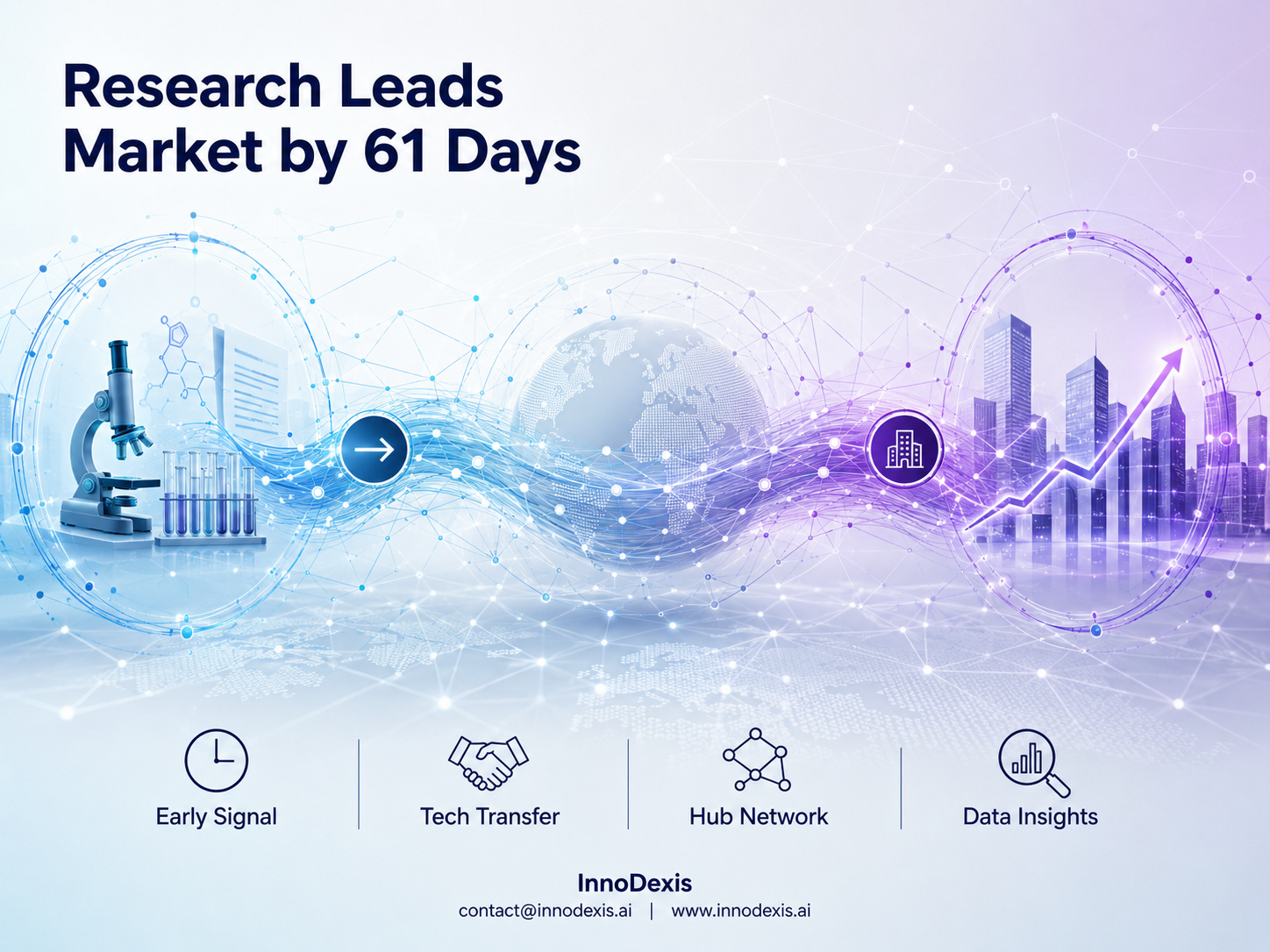
InnoDexis has published its latest Innovation Intelligence Report — The InnoGraph Report — tracing individual links from laboratory research to commercial market signal across 656 Corporate-stream records and 609 distinct research institutions drawn from the InnoDexis Institute and Corporate streams. The report reveals that research signal leads its linked corporate mention in 93.6% of matched pairs, with a median lag of 61 days and an interquartile range of approximately 38 to 76 days. This is the first InnoDexis analysis to measure the direction and timing of lab-to-market information flow at the individual record level rather than through aggregate cluster comparison.
Key Findings
Research signal demonstrably precedes corporate signal in the overwhelming majority of traced pairs. Of 1,227 linked pairs with valid dates on both sides, 93.6% show the institution's research date predating its linked Corporate-stream mention. The median lag is 61 days, with the bulk of pairs falling between one and three months and a visible peak just past the two-month mark. Only 6.1% of pairs show a corporate mention preceding the research signal — cases the report attributes to ongoing multi-year institutional relationships rather than genuine reverse causality.
Faithful technology transfer — where an institution's research cluster and its linked Corporate-stream record share at least one technology classification — accounts for 83.5% of the 829 cluster-classifiable linked pairs. The remaining 16.5% cross-pollinate into a different cluster, and those jumps are not evenly distributed. Six of the eight most common cross-pollination transfers run between just three clusters: Healthcare and Medtech, Biotechnology and Genomics, and Artificial Intelligence and Machine Learning — a triangle reflecting the genuine interdisciplinary overlap of AI-driven drug discovery, computational biology, and AI-assisted diagnostics rather than arbitrary category-jumping.
The network connecting 609 linked institutions to 656 Corporate-stream records takes a sharply hub-and-long-tail shape rather than an evenly distributed web. University of Texas leads all institutions with 38 distinct Corporate-stream connections, followed by University of California at 29, Stanford University at 24, and the National Institutes of Health at 21. Only 12 institutions reach 11 or more connections, while 360 of 609 linked institutions — 59.1% of the total — connect to exactly one Corporate-stream record. This distribution confirms that named lab-to-market linkage in the current dataset is strongest for a small set of large, prolific institutions and systematically thinner for smaller or less prominently announced research programmes.
A worked example of University of Texas's 38 linked Corporate-stream records illustrates both the signal quality and the noise present in named-entity linkage at scale. Genuine, specific research-to-company relationships are confirmed for Sensorium Therapeutics, Stealth BioTherapeutics, TAU Systems, and fluidIQ — a CNS-drug biotech, a mitochondrial-disease biotech, a compact particle-accelerator developer, and a respiratory-fluidics medtech company. However, a manual scan of the full 38-record list also identified a contemporary art fair, a watch manufacturer, and a historic airline-branding firm as cases where the University of Texas name most plausibly appears as an incidental mention rather than an active research partnership.
The report identifies four structural limitations that bound its conclusions. The named-entity linkage method captures population-level directional signal across 1,227 pairs but cannot confirm any individual link without manual review. The lag measurement uses an institution-level median date rather than a paper-level date, which likely widens the lag distribution compared to a more precise paper-to-company comparison. The cluster transfer classification inherits the keyword taxonomy's treatment of adjacent fields as separate categories, which may overstate the Healthcare-Biotech-AI cross-pollination triangle. And the six-month observation window can demonstrate the direction of research-leads-corporate signal at a weeks-to-months scale but structurally cannot test InnoDexis's core 12 to 36-month early-signal thesis — that validation requires a multi-year historical archive.
Strategic Insight and Trend Analysis
The most significant analytical contribution of The InnoGraph Report is the conversion of InnoDexis's platform thesis — that research signal leads market signal — from a structural argument into a measurable, record-level finding. The 93.6% directional consistency across 1,227 independent pairs is not explained by occasional noisy links or by aggregate cluster correlation between two streams that happen to discuss similar topics. It is the first time InnoDexis has produced record-level evidence that information flow across its two streams runs in a consistent, predictable direction, with research systematically preceding the corporate announcements that reference the same institutions.
The faithful transfer finding adds operational precision to that directional claim. The 83.5% same-cluster transfer rate confirms that the dominant mode of lab-to-market movement is disciplinary continuity — a quantum photonics research programme produces a quantum photonics company, not a logistics software platform. The 16.5% cross-pollination rate, concentrated in the Healthcare-Biotech-AI triangle, identifies the specific interdisciplinary territory where the keyword taxonomy's cluster boundaries are most permeable and where the most commercially active cross-disciplinary research is occurring simultaneously.
The hub-and-long-tail network structure carries its own strategic implication. The small core of hyper-connected institutions — led by University of Texas, UC, Stanford, and NIH — accounts for a disproportionate share of all currently traceable linkage, which creates both a strength and a blind spot for any intelligence product built on this linkage layer. The strength is that the most active research-to-commercial institutions are well represented and well documented. The blind spot is that the 59.1% of institutions appearing exactly once are almost certainly under-counted relative to their true commercial activity — smaller institutions, non-English-language programmes, and privately-held industrial research partnerships are all systematically less likely to generate the kind of named announcement that exact-string matching can detect. A confidence-scoring layer on the linkage table — distinguishing active partner mentions from incidental ones — would sharpen both the hub signal and the long-tail signal simultaneously.
Global and Industry Implications
For corporates and R&D teams, the 83.5% faithful transfer rate and the Healthcare-Biotech-AI cross-pollination triangle together provide a directly actionable technology scouting map. Organisations whose product development spans any two of these three clusters — AI-enabled diagnostics, computational drug discovery, or bioinformatics platforms — will find the cross-pollination data identifies the specific institutions already bridging those fields in practice, providing a shortlist of partnership targets whose research activity is already confirmed to be reaching Corporate-stream announcements in adjacent domains. The worked University of Texas example also establishes a due-diligence template: named-entity linkage identifies candidate relationships efficiently at scale, but manual confirmation of the specific link type remains necessary before treating any individual pair as an active partnership signal.
For investors and capital allocators, the 61-day median lag between research signal and linked corporate mention establishes a measurable early-warning window that is directionally consistent across 93.6% of traced pairs. Within the current six-month observation window, this confirms that InnoDexis Institute-stream monitoring provides a lead on Corporate-stream announcements measured in weeks to months — a window that is operationally significant for sourcing and positioning decisions even before the full 12 to 36-month horizon can be tested against a multi-year historical archive. The hub-and-long-tail distribution also identifies where the current linkage signal is most and least reliable: University of Texas, UC, Stanford, and NIH connections carry the highest confirmation density; single-connection institutions at the long tail require individual verification before investment thesis construction.
For policymakers and national innovation bodies, the report's identification of the six-month window limitation as the primary constraint on validating InnoDexis's 12 to 36-month early-signal thesis points directly to a data infrastructure policy gap. National research databases that archive institutional publication records longitudinally — with consistent institutional name fields, publication dates, and technology classification — would enable exactly the multi-year lag analysis this report cannot yet perform. Investment in standardised, machine-readable research output databases at the national level would directly accelerate the evidence base for research-to-market intelligence at the scale and precision this report demonstrates is technically achievable within a single six-month window.
InnoDexis Statement
"The InnoGraph analysis converts InnoDexis's platform thesis from a structural argument into a measurable finding — research signal leads its linked corporate mention 93.6% of the time, at a median of 61 days, across more than a thousand independently traced pairs," noted InnoDexis in its latest intelligence report.
Conclusion
The InnoGraph Report establishes that the directional flow of information from research institution to corporate market signal is measurable, consistent, and documentable at the individual record level across 656 traced connections and 609 linked institutions. Across 1,227 dated pairs, the evidence confirms a 93.6% research-leads-corporate directional rate, an 83.5% faithful technology transfer rate, and a sharply hub-shaped network where a small core of hyper-connected institutions accounts for a disproportionate share of all currently traceable linkage. As the named-entity linkage layer is extended with paper-level date precision, a confidence-scoring system separating active partnerships from incidental mentions, and a multi-year historical archive enabling full validation of the 12 to 36-month early-signal thesis, the InnoGraph framework will become the most precise record-level lab-to-market intelligence tool InnoDexis has produced. The complete InnoGraph Report is available to InnoDexis subscribers and enterprise clients.
About InnoDexis
InnoDexis is a global Innovation Intelligence platform that tracks, analyzes, and interprets breakthrough innovations, prototypes, and emerging technologies across industries and countries. Its intelligence helps corporates, investors, and policymakers understand the true structure and direction of global innovation. Learn more at innodexis.ai.