Research Partner Needs Name Clinics 335 Times and Factories 231 Times While Only 25 of 1,856 Corporate Partnership Objectives Name Academic Partners
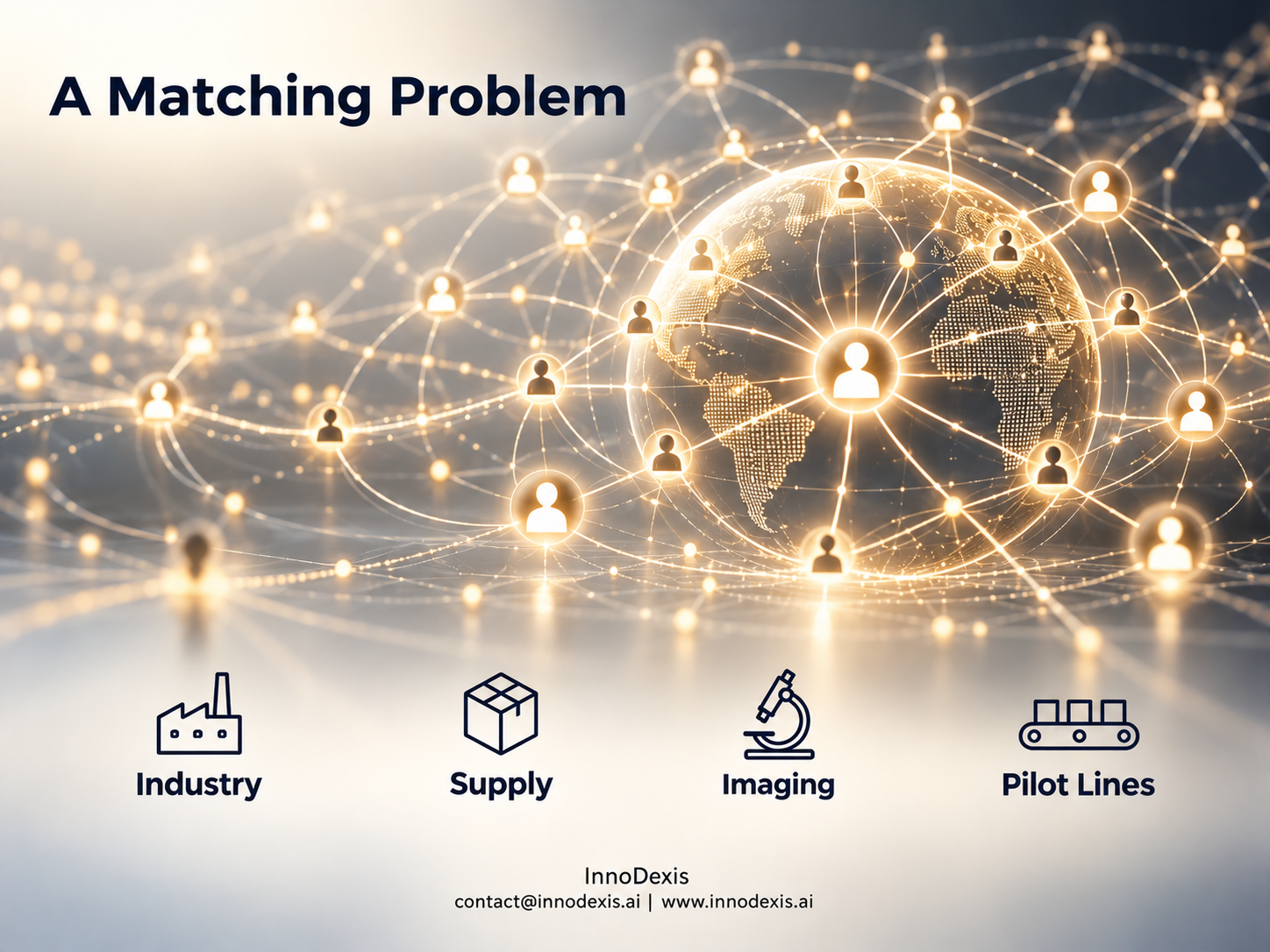
A cross-stream analysis of 1,217 research records stating partner needs and 1,856 corporate partnership objectives finds the marketplace gap is a matching problem, not a shortage, since the manufacturing and clinical capacity researchers ask for already exists in the corporate stream, between companies.
InnoDexis has published its latest Innovation Intelligence Report covering the research partner-needs marketplace, analyzing 1,217 research records that state partner needs, 789 that state equipment needs and 1,856 corporate partnership objectives during the 1–29 September 2026 observation window. The report reveals that researchers ask for clinics and factories while companies partner for integration and distribution: clinical partners top research needs at 335 and manufacturing or scale-up partners follow at 231, while integration tops corporate partnering at 335 and academic partnership is the stated objective in 25 corporate records.
Key Findings
Clinical and manufacturing partners top research needs. Researchers ask first for clinical partners or patients, 335 records, then manufacturing or scale-up partners, 231, industry or commercial partners, 214, technical expertise, 171, facilities or field sites, 164 and international partners, 143.
Companies partner for integration. Corporate objectives lead with technology integration, 335, then funding, 163, supply and manufacturing, 149, distribution and market access, 140, clinical and trial work, 136 and co-development, 128, while only 240 of 2,066 partnered corporate records, 11.6 percent, name a research institution.
Needs are field-specific. Therapeutics records ask for clinical partners in 60 percent of stated needs, materials, semiconductors, energy and robotics ask for manufacturing or scale-up partners in 51, 50, 42 and 42 percent, and space and cybersecurity ask for international partners in 33 percent.
Asia asks for industry. Japanese and Chinese needs records ask for industry partners in 39 and 38 percent of cases, against 12 percent in the United States, where clinical partners dominate at 35 percent, and records stating industry-partner needs are only 4.7 percent High readiness against 12.1 percent for records stating no need.
Funding is public and equipment is imaging-led. NIH is named in 75 records, NSF in 50 and NSFC in 19, with private funders few, the Moore Foundation at 6, Novo Nordisk at 5 and Eli Lilly at 4, while equipment needs centre on imaging and microscopy, 170, field sensors and satellites, 121, sequencing, 109 and compute, 94, and pilot lines are named only 6 times.
Strategic Insight and Trend Analysis
The defining structural finding is that the marketplace gap is a matching problem, not a shortage. The research stream names what it needs, and the corporate stream shows companies with supply, manufacturing and clinical capacity partnering with each other, with 149 supply and manufacturing objectives roughly matching the 231 research scale-up needs in scale but not in counterparty. A matching layer that routes scale-up needs to companies already making manufacturing deals, and clinical needs to those running clinical partnerships, would address the stream’s most-stated needs directly. Patent filing analysis, which would show licensing readiness, cannot be delivered.
Corporate partnering is dominated by company-to-company deals. Strategic alliances, 250, strategic partnerships, 67, licensing, 63, joint ventures, 38 and research collaborations, 35, are the leading types, and academic partnering is stated as an objective in only 25 of 1,856 records. Companies are not seeking research partners in announcements, so research must reach them. Funding is rarely stated as a need anywhere, only 47 records, because funding asks are made through grants, not partnership statements.
Asks come before the work is ready. Records stating needs are less ready, 9.9 percent High against 12.1 percent, and industry-seeking records least, 4.7 percent, which shows groups ask for partners before their work is mature, while needs are stated in only 34.0 percent of research records and corporate objectives in 38.3 percent. Categories are multi-label keyword families of analyst summaries, and the aim is matching, not market sizing.
Global and Industry Implications
For corporates and R&D teams, the 231 scale-up asks and 214 industry asks are open invitations, and answering them at the early stage secures technology at research-agreement cost. Named asks include University of Stuttgart’s timber-concrete slabs, Bauhaus Weimar’s secondary building materials, Fraunhofer ITWM’s predictive-maintenance sensors and VTT’s plant ingredients, with Japanese and Chinese industry-seeking groups the most active. Instrument makers and cloud providers can offer access programmes matched to named equipment needs.
For investors and capital allocators, matching and access services serve an unmet market, including clinical-network operators, pilot-line operators and equipment-access programmes. Due diligence should check whether a portfolio company’s partners include the research groups whose needs it meets, and co-funding with NIH, NSF, ERC and Horizon Europe grants leverages public money.
For policymakers and national innovation bodies, pilot and manufacturing infrastructure is under-named but widely needed, so shared pilot lines, clinical research networks open to academic sponsors and challenge-based co-funding clear the marketplace’s two biggest needs. Publishing matching registers of research needs is the named priority, and industry associations can broker policy and academic asks at low cost.
InnoDexis Statement
“Researchers ask for clinics and factories; companies partner for integration and distribution — the capacity research says it needs already exists in the corporate stream, and the two sides are not yet connected,” noted InnoDexis in its latest intelligence report.
Conclusion
Because needs are stated in 34.0 percent of research records, corporate objectives in 38.3 percent, categories are multi-label keywords, readiness is analyst-assigned and one month supports no trend, the findings are cross-sectional. The signals to watch are whether academic partnering objectives rise, whether a research group announces an industrial partner or a manufacturer announces an academic pilot, whether funders launch co-funding calls with industry, and whether a core facility opens industry access. The complete Research Partner-Needs Marketplace Report September 2026 is available to InnoDexis subscribers and enterprise clients.
About InnoDexis
InnoDexis is a real-time innovation intelligence platform connecting scientific discovery to commercial opportunity. Powered by InnoGraph, its proprietary innovation knowledge graph, the platform maps technologies across the entire lifecycle, from early-stage research (TRL 1) to market deployment (TRL 9), connecting researchers, institutions, startups, companies, products and emerging opportunities.
Covering 40+ specialised industry segments and 360 technology areas, InnoDexis delivers innovation tracking, research discovery, product and startup intelligence, investment insights, and AI-powered reports. Its mission is to bridge the gap between scientific discovery and real-world impact.
InnoDexis — From Lab to Market: Real-Time Innovation Intelligence.