Randomized Trial of Coronary Clot Retrieval Device Delivers 26% Infarct Size Reduction with Zero Strokes and Zero Deaths in STEMI Patients
The NATURE randomized controlled trial of Vesalio's enVast Coronary Clot Retriever met its primary endpoint across 154 patients, providing the first high-quality randomized evidence base for mechanical thrombectomy in STEMI cases with large thrombus burden.
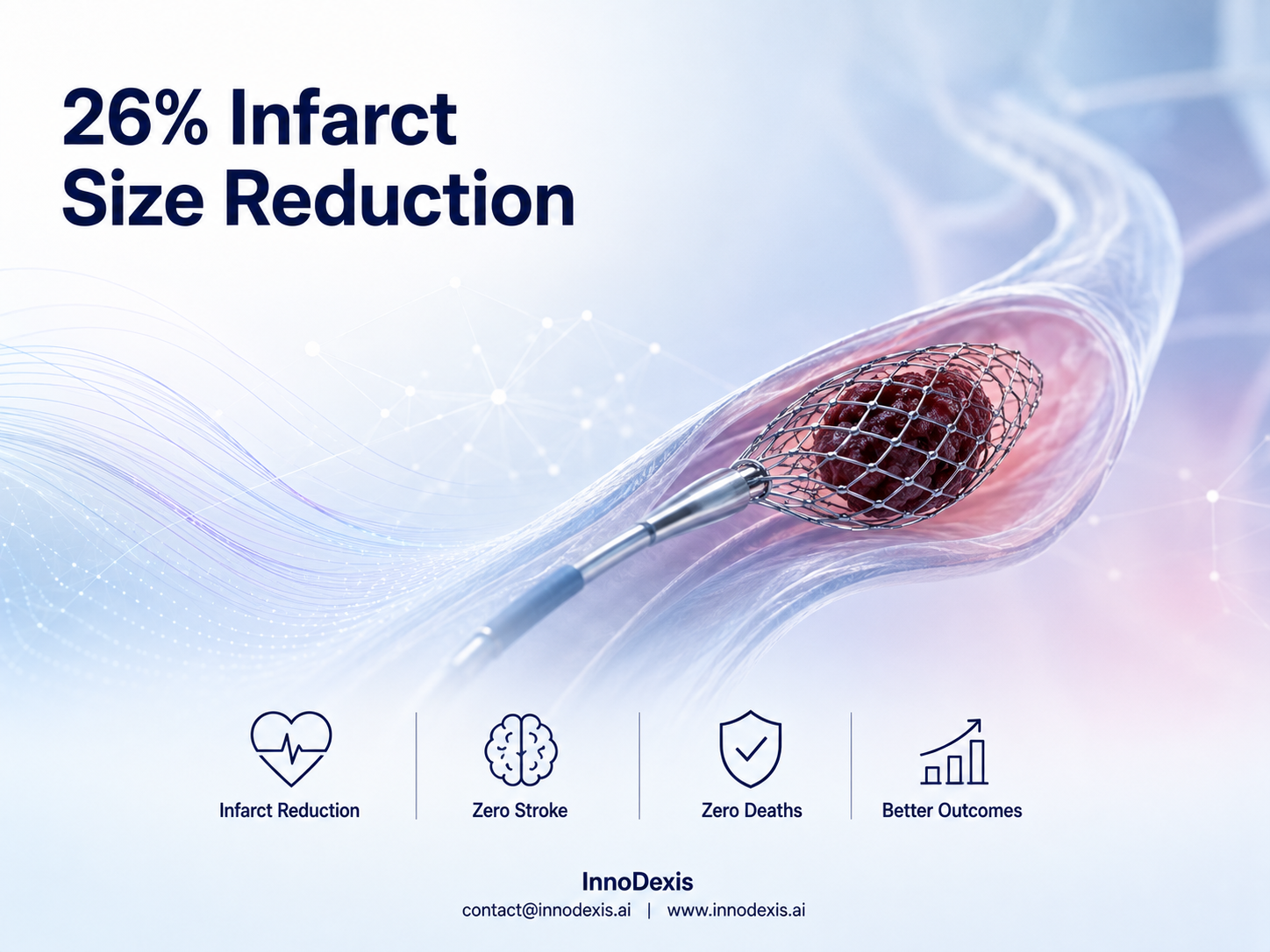
InnoDexis has published its latest Innovation Intelligence Report covering interventional cardiology and medical device innovation, analyzing the clinical trial results of the enVast Coronary Clot Retriever evaluated in the NATURE randomized controlled trial. The report reveals that Vesalio, in collaboration with the Cardiocentro Ticino Institute, has produced randomized evidence demonstrating a 26% reduction in infarct size versus standard of care in STEMI patients with large thrombus burden — with zero strokes and zero deaths recorded in the enVast arm — directly addressing the long-standing absence of high-quality randomized trial evidence for mechanical thrombectomy in this patient group.
Key Findings
The NATURE trial met its primary endpoint across 154 patients randomized 1:1 at 11 centers, demonstrating a 26% reduction in infarct size versus standard of care as measured by CK-MB AUC, with a p-value of 0.001. This result establishes statistical significance across a multi-center randomized design, providing the evidentiary foundation that mechanical thrombectomy in STEMI has lacked in prior clinical literature.
The infarct size reduction was independently confirmed through a second measurement approach: cardiac MRI at day 3 showed a 25% relative reduction in infarct size in the enVast arm versus control. The consistency of the finding across two independent measurement methodologies — CK-MB AUC and cardiac MRI — strengthens the credibility of the primary endpoint result and reduces the risk of measurement-specific artefact.
The enVast arm recorded zero strokes and zero deaths, compared with 1.3% strokes and 2.6% deaths in the control group. This safety profile is clinically significant in a patient population where procedural complications carry substantial consequences. The absence of stroke and mortality events in the treatment arm, across 77 patients at 11 centers, provides a safety signal that directly addresses one of the primary adoption barriers for adjunctive mechanical thrombectomy devices.
The Major Adverse Cardiac Events rate in the enVast arm was 1.3%, compared with 3.8% in the control group. This composite outcome measure captures the breadth of cardiac risk across the trial period and reinforces the directional consistency of benefit seen across the individual endpoint measures — infarct size, stroke, mortality, and MACE all trending in the same direction in the treatment arm.
The enVast Coronary Clot Retriever has already been used in more than 20,000 patients across more than 60 countries prior to the NATURE trial. This real-world deployment scale at the time of the randomized trial provides context for the device's existing clinical footprint and indicates that the NATURE results, if adopted into protocol, would apply to a device with established manufacturing, distribution, and operator familiarity across a broad international base.
Strategic Insight and Trend Analysis
The central strategic implication of the NATURE trial is not the device result itself but what it resolves at the evidentiary level. Mechanical thrombectomy in STEMI has faced a specific and well-defined adoption barrier: the absence of high-quality randomized controlled trial data demonstrating benefit over standard primary percutaneous coronary intervention. The NATURE trial directly addresses that gap with a multi-center, randomized, 1:1 design producing statistically significant results across two independent measurement approaches.
This evidentiary shift moves mechanical thrombectomy from the category of optional adjunct — where adoption depends on individual operator preference or institutional protocol — toward the category of evidence-backed protocol candidate. The distinction is significant for how interventional cardiology guidelines are developed and how hospital procurement and training decisions are made. Guideline bodies require randomized controlled trial evidence before recommending procedural changes at scale; NATURE provides that evidence in a replicable trial design across 11 centers.
The safety profile further strengthens the strategic case. A 26% reduction in infarct size is a meaningful efficacy signal, but zero strokes and zero deaths in the treatment arm — against 1.3% and 2.6% respectively in the control group — addresses the risk-benefit calculus that has historically made clinicians cautious about adjunctive device adoption in an already complex procedural environment. When efficacy and safety signals align directionally across all measured endpoints, the argument for protocol integration becomes structurally difficult to defer.
The trial's design — 154 patients, 11 centers, 1:1 randomization — is explicitly described as a replicable framework for the broader interventional cardiology community. This positions NATURE not only as a definitive trial for the enVast device but as a methodological reference for future thrombectomy research across the field.
Global and Industry Implications
For corporates and R&D teams in medical devices and interventional cardiology, the NATURE results establish a clinical evidence benchmark for coronary thrombectomy devices. Organisations developing competing or complementary devices in the STEMI space now have a defined efficacy and safety standard against which their own clinical programmes will be measured. The 11-center, 154-patient trial design also provides a validated template for future randomized evaluations in this indication.
For investors and capital allocators, the NATURE trial outcome strengthens Vesalio's commercial position in a device category that now has randomized evidence supporting broader adoption. The existing deployment of the enVast device across 20,000 patients in 60+ countries indicates an established international distribution infrastructure that can absorb increased demand if guideline bodies move to recommend adjunctive mechanical thrombectomy in large thrombus burden STEMI cases.
For policymakers and national innovation bodies, the trial results present a defined clinical question: if randomized evidence demonstrates 26% infarct size reduction and zero strokes in the treatment arm, what are the health system implications of maintaining standard primary PCI as the sole default protocol in eligible STEMI patients? Health technology assessment bodies will now have a randomized evidence base from which to evaluate reimbursement and protocol recommendations.
InnoDexis Statement
"The NATURE trial resolves the central evidentiary gap that has constrained mechanical thrombectomy adoption in STEMI, shifting the clinical conversation from anecdotal experience to randomized proof of reduced infarct size, reduced MACE, and a zero-stroke, zero-death safety record in the treatment arm," noted InnoDexis in its latest intelligence report.
Conclusion
The NATURE trial results represent a structural shift in the evidentiary landscape for mechanical thrombectomy in STEMI with large thrombus burden. As guideline bodies, hospital systems, and interventional cardiology practitioners evaluate the implications of randomized evidence showing consistent benefit across infarct size, MACE, stroke, and mortality endpoints, the pathway from optional adjunct to protocol recommendation becomes materially shorter. InnoDexis will continue to monitor guideline developments, replication trials, and adoption patterns for mechanical thrombectomy across interventional cardiology. The complete Interventional Cardiology Innovation Intelligence Report is available to InnoDexis subscribers and enterprise clients.
About InnoDexis
InnoDexis is a global Innovation Intelligence platform that tracks, analyzes, and interprets breakthrough innovations, prototypes, and emerging technologies across industries and countries. Its intelligence helps corporates, investors, and policymakers understand the true structure and direction of global innovation. Learn more at innodexis.ai.