R&D Collaboration Data Shows 382 Research Records Seeking an Industry Partner Against Only 33 of 366 Corporate Partnerships Including a Research Institution
A marketplace reading of 1,206 research needs and 366 corporate partnerships finds that 288 of the 382 industry-partner requests name no industrial partner today, while announced academic partnerships carry 6 percent High momentum against 14 percent for all partnerships.
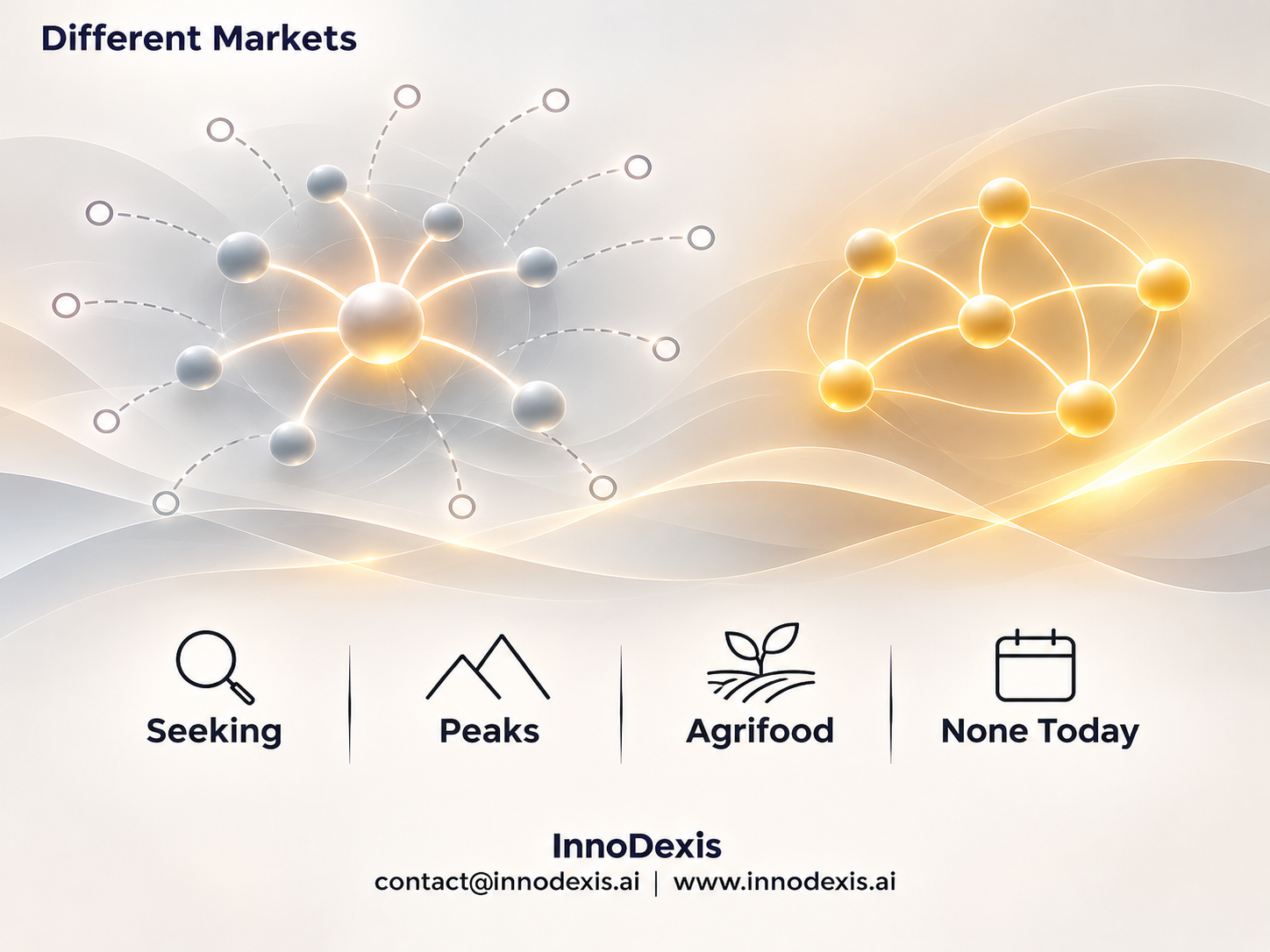
InnoDexis has published its latest Innovation Intelligence Report covering the R&D collaboration network and partner-needs marketplace, analyzing 1,206 research records that state a collaboration need and 366 corporate partnerships from 2,884 research and 2,280 corporate records during the complete 1–31 October 2026 window. The report reveals that research asks for partners to scale while companies partner with each other to sell: 382 research records seek an industry partner, 75 percent of them with none named, but only 33 of 366 corporate partnerships include a research institution.
Key Findings
Research asks for counterparts, not cash. 1,206 research records, 41.8 percent, state a collaboration need: clinical partners and patient cohorts in 460, an industry partner in 382, scale-up and manufacturing capacity in 233, interdisciplinary partners in 194 and regulators and standards bodies in 143, while funding is named in only 43.
Most requests for industry are unanswered. Of 382 records seeking an industry partner, 288, 75 percent, name none today, the request peaks at 18 percent of laboratory-stage and 19 percent of validated records against 7 percent at TRL 7–9, and the median stated time to market is 4.0 years.
Companies partner to sell. Only 33 of 366 corporate partnerships and alliances, 9.0 percent, include a university, institute, hospital or laboratory, and their objectives are distribution and market access in 133, technology integration in 104, co-development in 99, data and AI in 89 and manufacturing and supply in 46.
Threads do not match. Health research asks for an industry partner in 160 records against 49 health partnerships, AI and software runs the other way with 40 requests and 95 partnerships, and fintech has 51 partnerships against 2 requests, while materials has 34 requests against 14 partnerships and agrifood 32 against 9.
Announced academic partnerships carry little momentum. They are High momentum 6 percent of the time against 14 percent for all partnerships, and research names 2,897 distinct strategic partners, led by NASA with 33 records, mostly public and academic rather than companies.
Strategic Insight and Trend Analysis
The defining structural finding is that the partnership market is busy and the research demand is large, but they are different markets. The company that answers research's stated needs, manufacturing, clinical access and licensing, faces almost no announced competition for the partnership, because corporate partnerships have drifted toward distribution agreements. Research needs peak at TRL 3–6, the stage where a partner shapes the technology, and the window closes as results reach market-ready.
The requests are specific and dated. Fraunhofer IEG asks utilities and mine owners for mine-water heat, Sungkyunkwan University asks stack manufacturers for protonic ceramic cells, the University of Surrey asks roll-to-roll coaters for low-toxicity perovskite above 18 percent efficiency, Manchester asks transducer makers for lead-free piezoelectrics with a Curie temperature raised by over 350 °C, and Oak Ridge asks battery manufacturers to validate scrap-reduction methods.
Germany is the most collaborative system, with 59 percent of research naming an R&D collaboration, while the United States has the largest volume but names an industrial partner in only 18 percent. Raw name matching overstates bridging 3.4 times, with 79 verified parties led by AstraZeneca at 9. Quiet agreements are invisible, so announced academic partnerships are a floor, the needs are keyword-classified and a research group that asked in October may already have found a partner.
Global and Industry Implications
For corporates and R&D teams, answer stated research needs directly, starting with scale-up and manufacturing requests, and offer lines, clinics and data in exchange for first refusal. Named requests include Surrey's perovskite, SKKU's cells, Manchester's piezoelectrics and ORNL's batteries, and a monthly read of the collaboration-needs field is the scouting method. Health groups also ask pharma for biomarker validation, as QST does for its tau tracer.
For investors and capital allocators, fund companies built to answer research needs, such as contract manufacturing, clinical networks and pilot lines, and back startups that partner with research groups early. Named opportunities include pilot manufacturing for new materials from Manchester, Linköping and Surrey and stack integration for SKKU's cells, and due diligence should ask whether the research partner has named the company.
For policymakers and national innovation bodies, fund brokering between research needs and companies and answer regulatory requests, since 143 records ask for regulators and standards bodies. Matchmaking programmes should read research releases rather than only applications, and a national partner-needs register, with grid-connection rules for vehicle storage and electrolysis frameworks as named requests, is the priority.
InnoDexis Statement
"Research asks for partners to scale; companies partner with each other to sell — the company that answers research's stated needs faces almost no announced competition for the partnership," noted InnoDexis in its latest intelligence report.
Conclusion
Because needs and objectives are classified by keyword, quiet academic agreements are invisible and one month supports no trend, the findings are cross-sectional. The signals to watch are whether a research release names a partner type in your field, whether a competitor announces a co-development partnership with a university, whether a university launches an industry consortium, and whether a public programme funds matching of research needs and companies. The complete R&D Collaboration Network & Partner-Needs Marketplace Report October 2026 is available to InnoDexis subscribers and enterprise clients.
About InnoDexis
InnoDexis is a real-time innovation intelligence platform connecting scientific discovery to commercial opportunity. Powered by InnoGraph, its proprietary innovation knowledge graph, the platform maps technologies across the entire lifecycle, from early-stage research (TRL 1) to market deployment (TRL 9), connecting researchers, institutions, startups, companies, products and emerging opportunities.
Covering 40+ specialised industry segments and 360 technology areas, InnoDexis delivers innovation tracking, research discovery, product and startup intelligence, investment insights, and AI-powered reports. Its mission is to bridge the gap between scientific discovery and real-world impact.
InnoDexis — From Lab to Market: Real-Time Innovation Intelligence.