Quantum Time Crystals Advance Toward Functional Infrastructure as Researchers Achieve External Mechanical Control
Research from Aalto University demonstrates the first successful coupling of a quantum time crystal with a mechanical oscillator, enabling controllable optomechanical behavior.
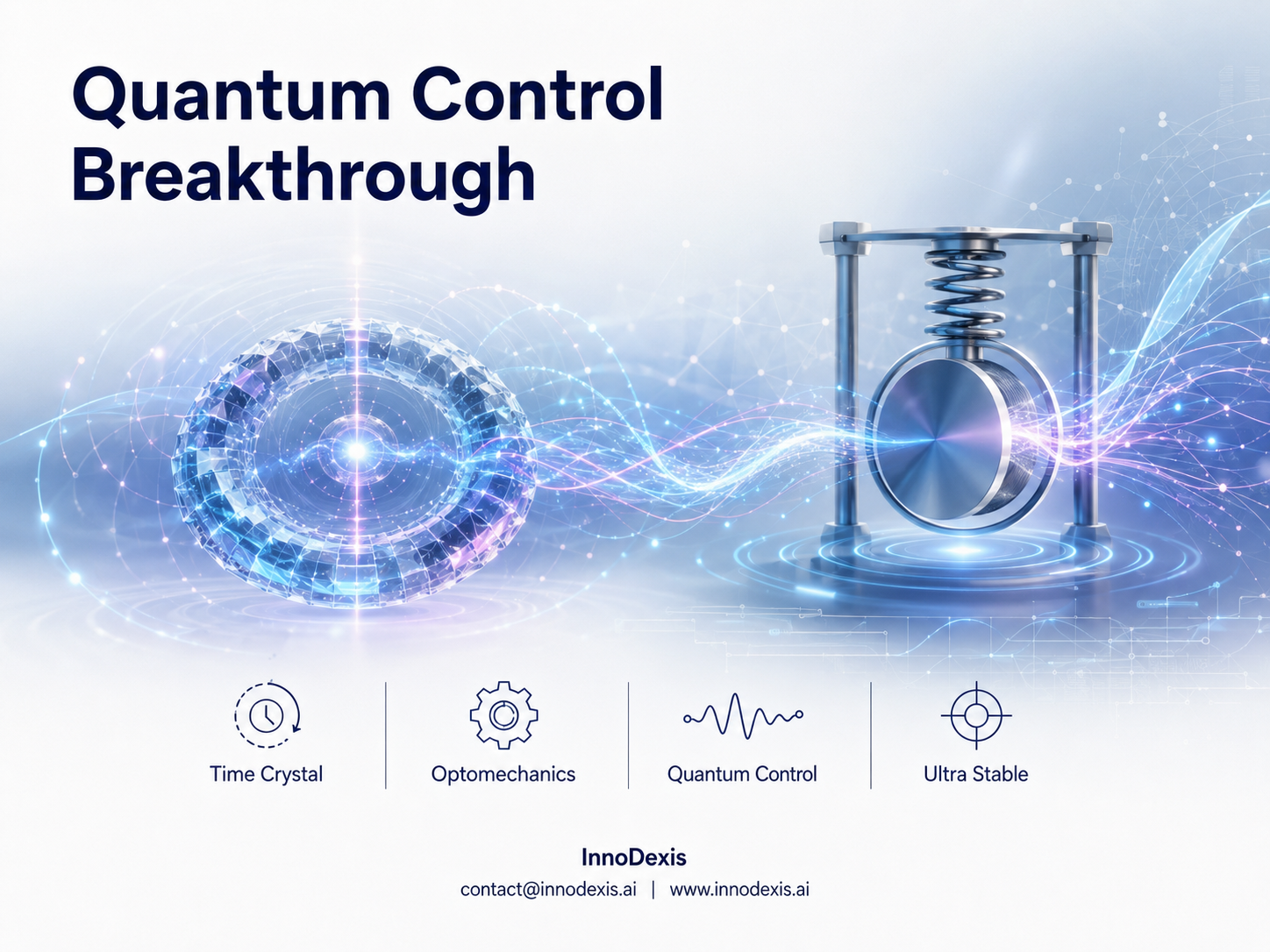
InnoDexis has published its latest Innovation Intelligence Report covering quantum systems and optomechanical research, analyzing recent developments from Aalto University. The report reveals that researchers have successfully connected a quantum time crystal to a mechanical oscillator, transforming a previously isolated quantum phenomenon into a controllable physical system. The findings indicate that quantum technologies are increasingly moving from theoretical demonstrations toward engineered architectures with potential applications in sensing, memory, and quantum infrastructure.
Key Findings
Researchers at Aalto University achieved the first successful external control of a quantum time crystal through mechanical coupling. This development marks a significant transition from observing isolated quantum behavior to actively interfacing quantum states with external systems.
The connected system demonstrated stable oscillatory motion for up to 10^8 cycles. Sustained stability at this scale is notable because maintaining coherent quantum behavior over extended durations remains one of the primary challenges in quantum technology development.
Mechanical coupling enabled the creation of a controllable optomechanical platform. By linking the quantum time crystal to a mechanical oscillator, researchers established a framework through which quantum oscillations can interact with physical devices in a measurable and regulated manner.
The findings suggest potential relevance for quantum memory systems and ultra-sensitive sensing technologies. Stable and persistent oscillatory states may support applications requiring long-duration coherence or precise signal detection under low-energy conditions.
The study also demonstrates a broader shift in quantum research priorities. Rather than focusing exclusively on observing exotic quantum phenomena, current efforts increasingly emphasize integrating those phenomena into functional and controllable architectures.
Strategic Insight and Trend Analysis
The research from Aalto University reflects a broader transition within quantum technology from experimental validation toward systems-level engineering. Quantum time crystals were previously regarded largely as isolated theoretical or laboratory phenomena, with limited practical interaction beyond controlled observation. The successful coupling of a time crystal to a mechanical oscillator changes that positioning by introducing a pathway for controllable integration.
One of the defining challenges in quantum computing and sensing systems is maintaining stability while enabling interaction with external environments. Quantum states are often highly sensitive to disruption, limiting their usefulness in operational settings. The ability of the connected system to sustain oscillatory motion across 10^8 cycles indicates progress toward addressing durability and coherence constraints.
The emergence of controllable optomechanical systems also suggests that future quantum infrastructure may increasingly depend on hybrid architectures that combine quantum behavior with engineered mechanical interfaces. This integration could support more practical implementations of quantum memory, sensing, and signal-processing systems.
The findings further indicate that the current phase of quantum innovation is shifting from discovery toward infrastructure development. As quantum phenomena become more controllable and interoperable with physical systems, the focus is likely to expand beyond proving existence toward building scalable technological platforms. This progression mirrors earlier transitions in computing and semiconductor technologies, where theoretical breakthroughs eventually evolved into deployable engineering ecosystems.
Global and Industry Implications
For corporates and R&D teams, the findings highlight the growing importance of hybrid quantum-mechanical architectures. Organizations developing quantum hardware, sensing systems, or photonic infrastructure may increasingly prioritize technologies capable of integrating stable quantum states into operational platforms.
For investors and capital allocators, the transition from theoretical quantum phenomena to controllable engineering systems may indicate emerging commercial pathways within quantum infrastructure. Areas such as quantum sensing, memory, and optomechanical systems could attract increasing attention as stability and controllability improve.
For policymakers and national innovation bodies, advances in controllable quantum systems reinforce the strategic significance of long-term investment in quantum research infrastructure. Supporting the transition from laboratory discovery to engineering integration may become central to national competitiveness in advanced computing and sensing technologies.
InnoDexis Statement
“The successful coupling of a quantum time crystal with a mechanical oscillator indicates that quantum research is increasingly entering an engineering phase where previously isolated phenomena can begin functioning as controllable infrastructure components,” noted InnoDexis in its latest intelligence report.
Conclusion
The development at Aalto University demonstrates that quantum time crystals are beginning to move beyond theoretical physics into controllable system architectures. As researchers continue integrating stable quantum states with external mechanical platforms, the potential applications for sensing, memory, and broader quantum infrastructure may expand significantly. Monitoring how these systems evolve from experimental setups into scalable technologies will be critical in understanding the next stage of quantum innovation. The complete Quantum Systems and Optomechanical Innovation Intelligence Report is available to InnoDexis subscribers and enterprise clients.
About InnoDexis
InnoDexis is a global Innovation Intelligence platform that tracks, analyzes, and interprets breakthrough innovations, prototypes, and emerging technologies across industries and countries. Its intelligence helps corporates, investors, and policymakers understand the true structure and direction of global innovation. Learn more at innodexis.ai.