Quantum Research Expands into Artistic Integration as Public Engagement Scales Beyond 6,000 Participants
Embedding artists within quantum laboratories signals a structural shift toward communication as a core component of scientific development.
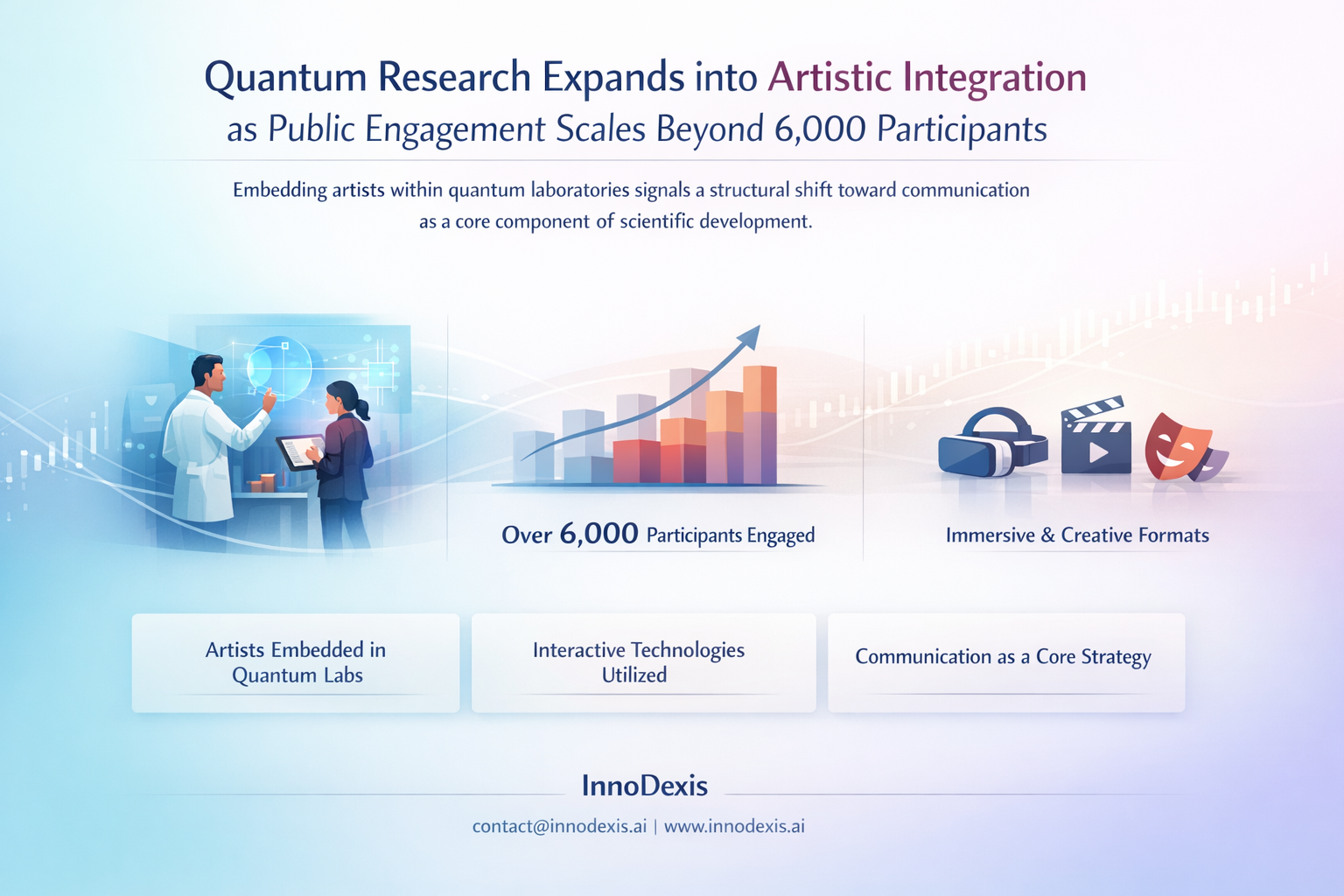
InnoDexis has published its latest Innovation Intelligence Report covering quantum science and interdisciplinary innovation, analyzing emerging integration models across research environments during the 2026–2027 period. The report reveals that quantum research institutions are increasingly embedding artists directly within laboratory settings to enhance interpretation, communication, and public engagement. With more than 6,000 individuals already engaged through public-facing programs, the findings indicate that communication is evolving from a secondary function into a structural component of scientific advancement.
Key Findings
A quantum research program at the Yale Quantum Institute has introduced an Artist-in-Residence model for 2026–2027, embedding artist Toni Dove directly within a quantum science environment. This approach reflects a shift from external science communication toward internal, collaborative integration within research workflows.
Artists are participating inside laboratory environments rather than interpreting outputs post-development. This proximity enables real-time interaction with scientific processes, allowing complex quantum concepts to be explored through creative and experiential methods alongside ongoing research activity.
Technologies such as motion sensing, artificial intelligence interaction, and robotics are being applied to translate quantum principles into immersive formats. These tools extend beyond traditional visualization, enabling dynamic engagement with abstract scientific concepts through interactive systems.
Outputs generated from these collaborations span multiple formats, including film, gaming, theater, and scientific visualization. The diversity of formats indicates that communication strategies are expanding across both digital and experiential media channels.
Public-facing engagement has already reached more than 6,000 participants, demonstrating measurable interest in accessible representations of quantum science. This level of engagement suggests that immersive and interdisciplinary approaches may broaden the audience base for complex scientific domains.
Strategic Insight and Trend Analysis
The integration of artistic practice within quantum research environments reflects a broader shift in how scientific complexity is addressed at scale. Quantum science presents inherent challenges not only in development but also in interpretation, as its principles are often abstract and non-intuitive. The data indicates that institutions are beginning to treat this challenge as a structural constraint rather than a peripheral issue.
Embedding artists directly within laboratories introduces a parallel layer of translation that operates alongside scientific discovery. Rather than functioning as a post-process activity, communication is being incorporated into the development cycle itself. This model suggests that interpretation, visualization, and experiential framing may influence how research is understood, validated, and extended.
The use of interactive technologies such as AI-driven systems, motion sensing, and robotics further indicates that communication methods are evolving toward participatory and immersive formats. These approaches allow complex systems to be experienced rather than solely described, potentially reducing barriers to comprehension.
The progression from equations to experiences represents a directional shift in scientific communication. As quantum technologies advance toward broader application, the ability to convey their relevance and function may become increasingly linked to adoption. The findings suggest that institutions are recognizing communication as a foundational layer that supports the transition from research to real-world implementation.
Global and Industry Implications
For corporates and R&D teams, the integration of artistic and experiential methodologies within research environments indicates new approaches to internal knowledge transfer and external stakeholder communication. Organizations operating in complex technology domains may consider incorporating interdisciplinary frameworks to enhance clarity and engagement.
For investors and capital allocators, the findings highlight communication as a factor that may influence technology adoption and market readiness. The ability of a technology to be understood by broader audiences can affect its commercialization trajectory, particularly in domains characterized by high conceptual complexity.
For policymakers and national innovation bodies, the model demonstrates how public engagement can be structured within advanced research programs. Initiatives that integrate communication directly into scientific development may support wider societal understanding and acceptance of emerging technologies.
InnoDexis Statement
“The integration of artistic practice within quantum research environments indicates that communication is becoming a structural component of innovation systems, shaping how complex technologies are interpreted, adopted, and scaled,” noted InnoDexis in its latest intelligence report.
Conclusion
The emergence of artist-in-residence models within quantum laboratories reflects a broader evolution in how scientific complexity is addressed and communicated. As quantum technologies progress toward real-world applications, the ability to translate abstract principles into accessible experiences may influence adoption pathways. The combination of interdisciplinary collaboration and immersive technologies suggests that communication will play an increasingly central role in innovation ecosystems. The complete Quantum Science and Interdisciplinary Innovation Report is available to InnoDexis subscribers and enterprise clients.
About InnoDexis
InnoDexis is a global Innovation Intelligence platform that tracks, analyzes, and interprets breakthrough innovations, prototypes, and emerging technologies across industries and countries. Its intelligence helps corporates, investors, and policymakers understand the true structure and direction of global innovation. Learn more at innodexis.ai.