Quantum-Logic Spectroscopy Controls Forbidden Vibrations in Single Nitrogen Ions at University of Basel, Delivering 10x Frequency Precision
University of Basel researchers co-trapped a single nitrogen molecular ion with a calcium ion to detect and control forbidden vibrational transitions without destroying the molecule, improving the precision of its fundamental vibrational frequency tenfold.
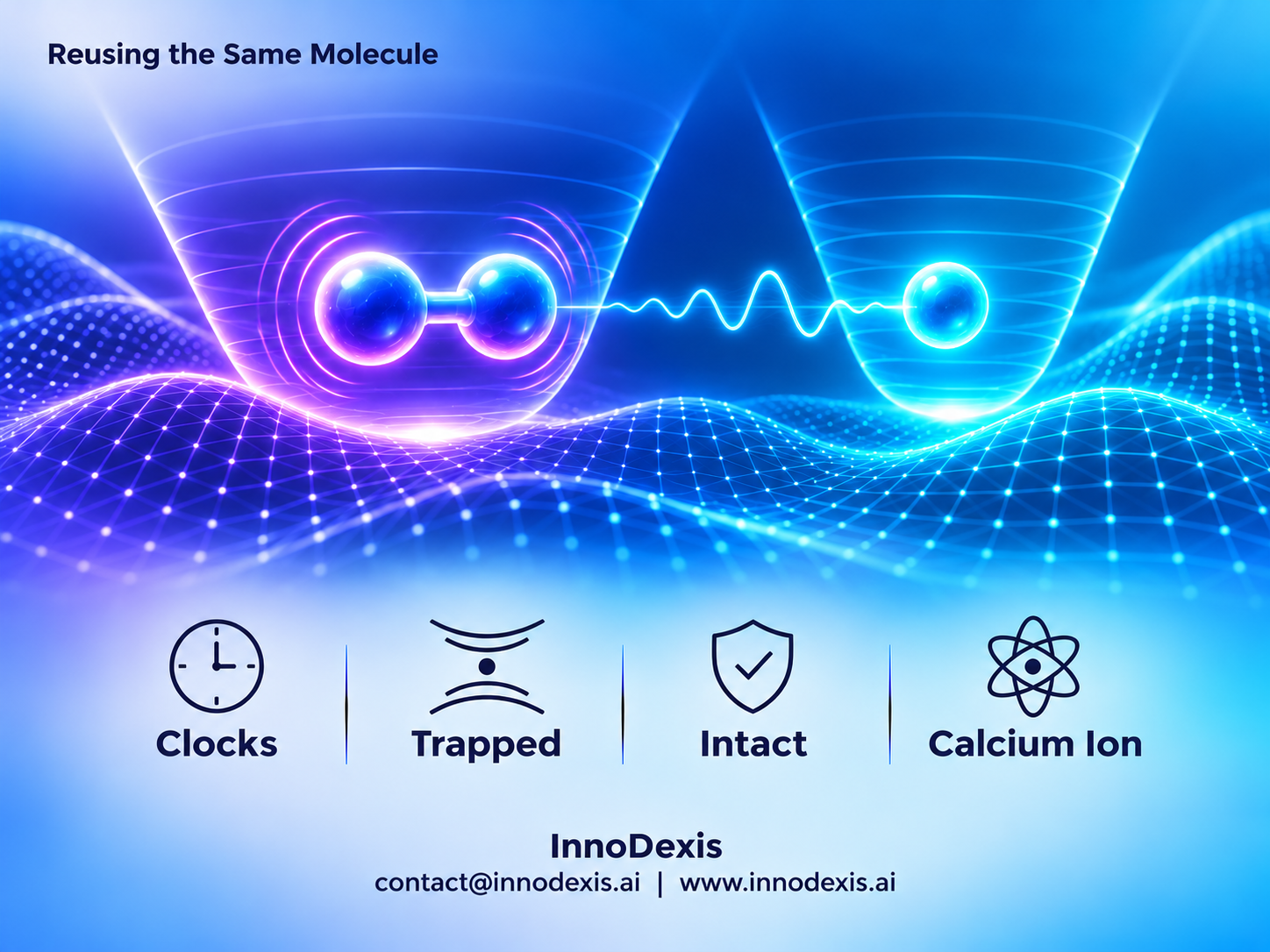
InnoDexis has published its latest Innovation Intelligence Report covering molecular quantum metrology, analyzing one innovation from Switzerland, published on 10 November 2026. The report reveals that University of Basel researchers achieved the first coherent control and identification of forbidden vibrational transitions in single isolated molecular ions without destroying the sample, using quantum-logic spectroscopy with a co-trapped calcium ion, and determined the fundamental vibrational frequency of nitrogen molecular ions ten times more precisely than previous measurements, a result relevant to molecular clocks and quantum bits.
Key Findings
The fundamental vibrational frequency of nitrogen molecular ions was determined 10 times more precisely than in previous measurements. The result was obtained by combining measurements across several hundred individually prepared molecules, so the gain rests on repeated single-molecule experiments.
This is the first coherent control and identification of forbidden vibrational transitions in single isolated molecular ions without destroying the sample. Forbidden transitions are extremely weak, which makes their initial frequency identification technically demanding, and controlling them is what opens the route to precise molecular references.
The method is quantum-logic spectroscopy. A single charged nitrogen molecule is co-trapped with a single calcium ion, and the state of the nitrogen ion, which does not emit light, is read out non-destructively by an optical laser measurement of the calcium messenger atom.
Earlier chemical methods for observing forbidden vibrational transitions destroyed the molecular sample in every measurement cycle. Co-trapping with a calcium messenger atom leaves the molecule intact, so the same single molecule can be measured repeatedly. Dr. Aleksandr Shlykov, co-first author, notes that reusing the same molecule was crucial to finding such faint lines.
The selected forbidden transitions are highly insensitive to environmental perturbations. This supports use as references for molecular clocks and quantum bits, and for testing whether the masses of protons and electrons remain constant over time.
Strategic Insight and Trend Analysis
The dominant trend in this research is a shift from destructive to non-destructive measurement of single molecules, which turns molecular vibrations into a usable precision resource. Stefan Willitsch, professor and co-director of NCCR Precision, states that the highest precision comes from experiments on single molecules that are not lost in the process. Quantum-logic spectroscopy with a calcium messenger ion delivers exactly that, and the tenfold gain in frequency precision is the evidence.
The significance is structural. Transitions that are insensitive to external disturbance are what clocks and qubits need, and the work could disrupt existing atomic optical clocks and quantum computing architectures by introducing disturbance-insensitive molecular reference systems. It also creates a non-destructive platform for tests of fundamental constants, including time variation in proton and electron mass, and opens pathways to search for physics beyond the Standard Model.
The evidence has clear limits. The result is a proof of concept on single trapped ions in a university laboratory, and commercial readiness is low. Scalability is limited by complex vacuum traps and multi-laser optical setups, technical complexity and cost are high compared with established atomic optical clocks, and ions can be lost or heated during extended measurement cycles.
Open research questions include characterizing and controlling additional disturbance mechanisms in complex molecular energy levels, and extending the measurements to further forbidden vibrational and rotational transitions in nitrogen and other molecular ions. Competing atomic optical lattice clocks reaching advanced deployment first is the main competitive risk.
Global and Industry Implications
For corporates and R&D teams, the technique is transferable to precision metrology manufacturers and quantum hardware companies through licensing of quantum-logic control techniques and ion trap system architectures. Corporate strategists in defense and navigation should monitor molecular clock development as a potential successor to atomic clocks, given the intrinsic isolation of these transitions from environmental disturbances. Miniaturization of ultra-high vacuum systems, stable multi-wavelength lasers and ion trapping optics is the integration work required.
For investors and capital allocators, the profile is long-dated. Commercial readiness is low, specialized laboratory metrology and precision physical tests are expected in 5 to 10 years, and commercial molecular clock devices take longer. Uncertain timelines for molecular-ion qubits and high cost against atomic clocks are the principal risks, and competing precision timekeeping platforms may reach deployment first.
For policymakers and national innovation bodies, the work shows the value of sustained funding for fundamental physics. The researchers are affiliated with NCCR Precision and the Basel Quantum Center, no regulatory approval requirement is apparent, and the applications span quantum information processing, telecommunications, and aerospace and defense.
InnoDexis Statement
“Non-destructive single-molecule control turns forbidden vibrational transitions from a detection problem into a measurement resource, and the path from laboratory proof of concept to deployable molecular clocks now depends on integration and scalability,” noted InnoDexis in its latest intelligence report.
Conclusion
The next milestones to watch are the construction of baseline precision molecular clock systems to evaluate real-world frequency stability against atomic clocks, and the extension of quantum-logic measurements to additional forbidden vibrational and rotational transitions in nitrogen and other molecular ions. Applying the technique to probe time variation in proton-to-electron mass ratios is a named future study. InnoDexis will continue to track molecular clocks, trapped-ion quantum information processing and precision metrology as this field develops. The complete Molecular Quantum Metrology Innovation Intelligence Report is available to InnoDexis subscribers and enterprise clients.
About InnoDexis
InnoDexis is a real-time innovation intelligence platform connecting scientific discovery to commercial opportunity. Powered by InnoGraph, its proprietary innovation knowledge graph, the platform maps technologies across the entire lifecycle, from early-stage research (TRL 1) to market deployment (TRL 9), connecting researchers, institutions, startups, companies, products and emerging opportunities.
Covering 40+ specialised industry segments and 360 technology areas, InnoDexis delivers innovation tracking, research discovery, product and startup intelligence, investment insights, and AI-powered reports. Its mission is to bridge the gap between scientific discovery and real-world impact.
InnoDexis — From Lab to Market: Real-Time Innovation Intelligence.