Quantum-Gas Microscope Resolves All 10 Spin States of Strontium-87 in a Single Shot as ICFO Opens a Readout Path for Qudit Quantum Computing
ICFO researchers used a red narrow-line transition laser to image individual strontium-87 atoms across all ten spin states in one shot, a step toward qudit readout and multi-spin quantum simulation.
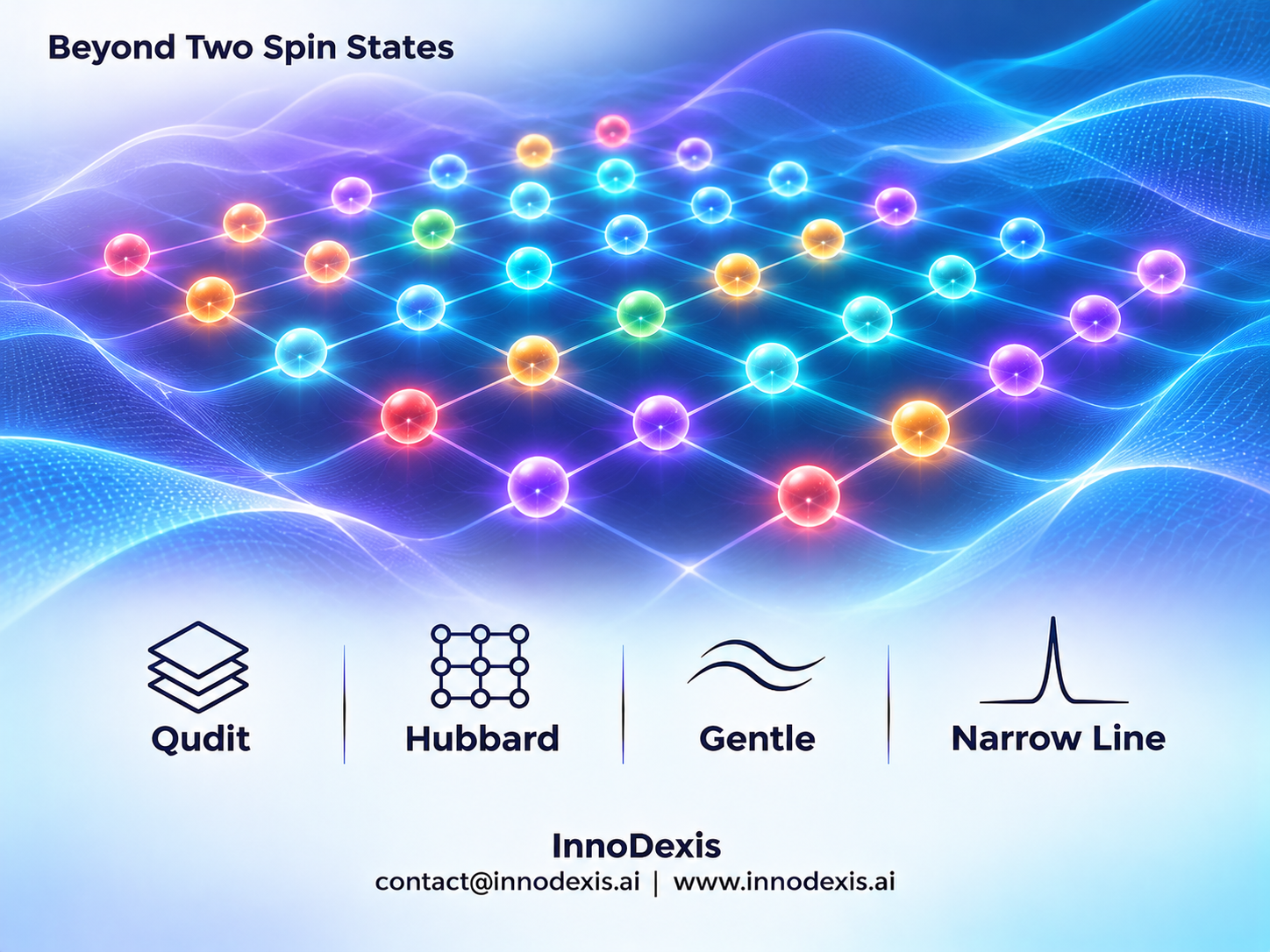
InnoDexis has published its latest Innovation Intelligence Report covering quantum-gas microscopy for quantum simulation and quantum computing, analyzing one innovation from Spain, published on 17 November 2026. The report reveals that researchers at ICFO, The Institute of Photonic Sciences, developed a single-shot imaging protocol that resolves all ten spin states of strontium-87 atoms at the single-atom level using a red narrow-line transition laser, making it the first quantum-gas microscope able to detect individual atoms with ten spin states in a single shot.
Key Findings
The microscope resolved all ten spin states of strontium-87 atoms in a single experimental run, at single-atom resolution. It is the first quantum-gas microscope capable of this, and it extends imaging beyond the two spin states of traditional electronic models.
The method relies on a red narrow-line transition laser. Atoms in specific spin states are transferred sequentially and excited to emit fluorescence photons without disturbing the other states. According to first author Carlos Gas-Ferrer, the transition is gentle enough to preserve spin while strong enough to produce a fluorescence signal, which gives each spin state its own readout channel.
The result matters for simulation of complex materials. It allows the Hubbard model to be simulated with more than two spin states, and it enables high-order SU(N) Fermi-Hubbard simulations. The identified targets are exotic quantum magnetism, spin liquid phases and research into high critical temperature superconductors. Realizing artificial materials with exotic magnetic configurations is among the targeted experiments.
It also provides a multi-state readout platform for qudit-based quantum computing. Strontium-87 offers ten distinct spin channels, unlike spinless strontium-84, which the group imaged in 2024, and interest in qudit architectures is growing because they increase quantum information density.
The apparatus is operational, but commercial readiness is low, because it is an experimental laboratory system for fundamental research and early-stage quantum hardware development. The work was published in Physical Review X on 16 November 2026, and operational qudit hardware is estimated at 5 to 10 years away.
Strategic Insight and Trend Analysis
The dominant trend in this research is the move from two-state to multi-state quantum systems, and the role of measurement in making that move possible. Binary qubit models dominate commercial platforms today. The ICFO result shows that a neutral-atom system can be read out across ten spin states at once, which gives qudit architectures a concrete physical foundation rather than a theoretical one.
This matters at two levels. For computing, qudits expand quantum information capacity beyond binary qubits, and strontium-87 offers a clear physical architecture for doing so. For science, access to all ten spin states opens simulations of artificial materials with exotic magnetic configurations and may unlock new physics in high-temperature superconductivity models. Unlike spinless strontium-84 imaging, strontium-87 provides ten distinct spin channels distinguishable through multi-color fluorescent readout, and the gentle optical transition preserves unread spin states while still producing strong fluorescence.
The evidence has clear limits. The system needs custom optical lattice arrays and ultra-stable, narrow-linewidth laser systems, and the optical alignment and sequential transfer process are complex. The principal technical risks are laser stability and state readout fidelity across all ten spin channels, including possible loss of fidelity during the sequential transfer steps. Competition comes from alternative qubit modalities such as superconducting circuits and trapped ions, and commercial two-state platforms are expected to stay dominant in the short term.
The next test is whether quantum gate operations can be implemented on multi-spin strontium-87 qudits within the microscope setting.
Global and Industry Implications
For corporates and R&D teams, the work is directly usable by quantum hardware developers building neutral-atom quantum computers, and the potential for technology transfer into neutral-atom qudit platforms is rated high. Scaling the readout will require custom optical lattice arrays and ultra-stable, narrow-linewidth laser systems. Advances in neutral-atom quantum computing and growing interest in qudit architectures support the case.
For investors and capital allocators, the profile is long-dated. Commercial readiness is low, operational qudit hardware is 5 to 10 years away, and competing qubit modalities and commercial two-state platforms will stay ahead in the short term. The opportunity lies in qudit quantum processors and in materials discovery for high-temperature superconductors, rather than near-term revenue.
For policymakers and national innovation bodies, this is fundamental research from ICFO and ICREA in Spain with cross-sector reach into high-performance computing and superconducting materials discovery. No regulatory approval is apparent. Semiconductor research and materials science are named as secondary markets.
InnoDexis Statement
“Resolving ten spin states in a single shot moves the quantum-gas microscope from binary outcomes to multi-state systems, and the open test is whether readout fidelity holds across all ten spin channels,” noted InnoDexis in its latest intelligence report.
Conclusion
The next milestones to watch are quantum gate operations on multi-spin strontium-87 qudits within the microscope, tests of qudit control and logic algorithms, and demonstrations that spin is preserved during optical excitation and transfer cycles. Realization of complex spin liquid behavior in artificial strontium-87 materials would show the simulation value of the platform. InnoDexis will continue to track qudit architectures, neutral-atom quantum computing and quantum simulation as this field develops. Reliable ten-channel readout at scale is the point to watch. The complete Quantum-Gas Microscopy and Qudit Readout Innovation Intelligence Report is available to InnoDexis subscribers and enterprise clients.
About InnoDexis
InnoDexis is a real-time innovation intelligence platform connecting scientific discovery to commercial opportunity. Powered by InnoGraph, its proprietary innovation knowledge graph, the platform maps technologies across the entire lifecycle, from early-stage research (TRL 1) to market deployment (TRL 9), connecting researchers, institutions, startups, companies, products and emerging opportunities.
Covering 40+ specialised industry segments and 360 technology areas, InnoDexis delivers innovation tracking, research discovery, product and startup intelligence, investment insights, and AI-powered reports. Its mission is to bridge the gap between scientific discovery and real-world impact.
InnoDexis — From Lab to Market: Real-Time Innovation Intelligence.