Quantinuum Deploys 98-Qubit Helios Quantum Computer Inside Oracle Cloud Infrastructure as Managed Enterprise Service
A multi-year strategic partnership between Quantinuum and Oracle has moved enterprise quantum access from specialised facility procurement to managed cloud deployment within existing enterprise governance and workflows.
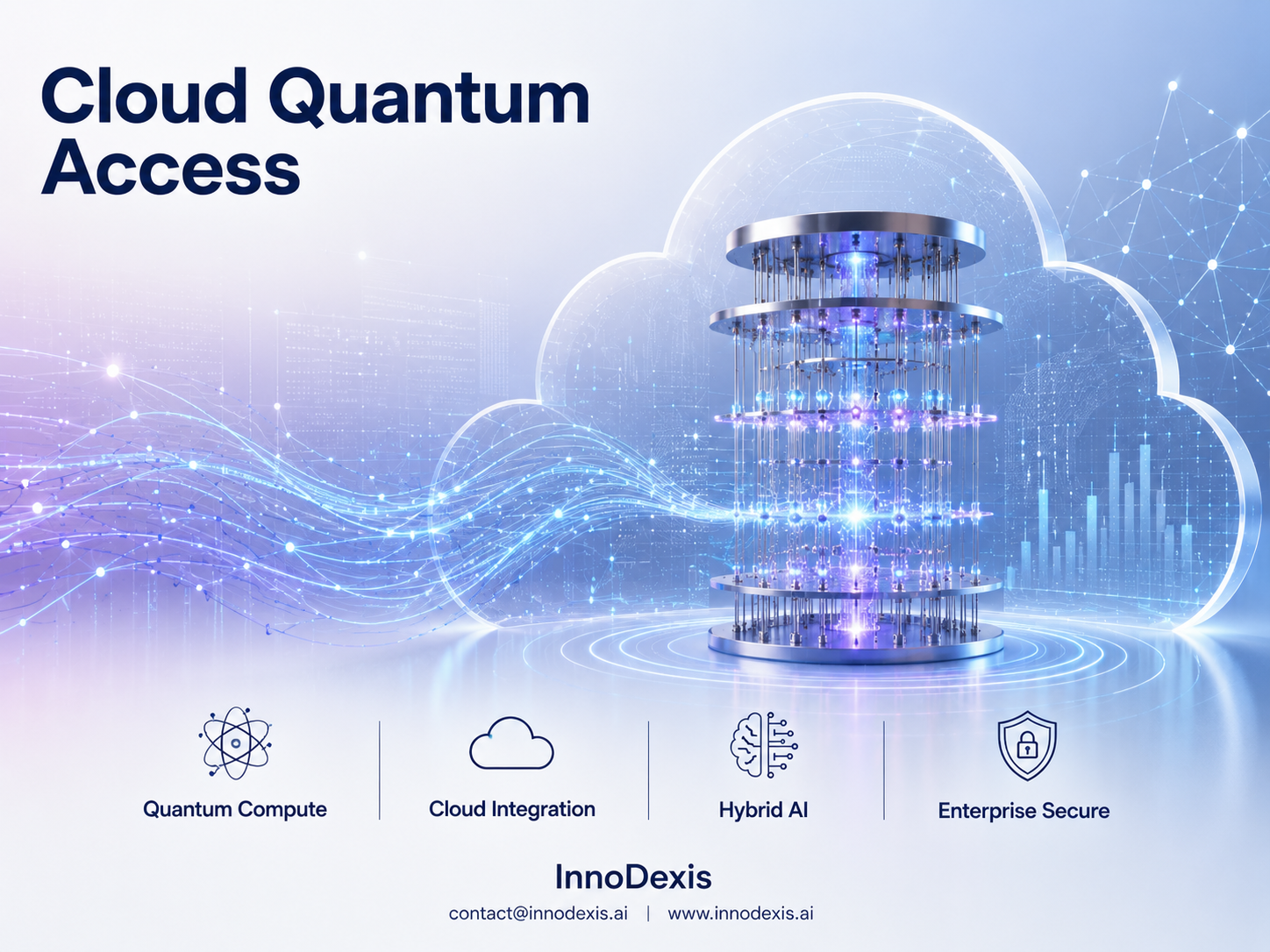
InnoDexis has published its latest Innovation Intelligence Report covering quantum computing infrastructure and enterprise cloud integration, analyzing a landmark commercial partnership announced between Quantinuum and Oracle. The report reveals that Quantinuum's Helios quantum computer — a 98-physical-qubit trapped-ion system achieving 99.921% average two-qubit gate fidelity — has been deployed directly inside Oracle Cloud Infrastructure as a managed cloud service, enabling enterprise customers to access hybrid quantum-AI workloads through existing cloud governance frameworks without specialised procurement or dedicated quantum facilities.
Key Findings
Helios achieves 99.921% average two-qubit gate fidelity, exceeding the industry benchmark known as the three-nines threshold. This performance level is significant because gate fidelity directly determines the reliability of quantum computations — higher fidelity reduces error rates and extends the complexity of problems that can be meaningfully solved on current quantum hardware.
The Helios system operates with 98 physical qubits and has demonstrated use involving 48 logical qubits. The distinction between physical and logical qubits is materially important for enterprise evaluation: logical qubits incorporate error correction and represent a more reliable unit of computation, making the demonstrated 48-logical-qubit capability a more practically meaningful performance indicator than physical qubit count alone.
Helios draws an estimated power consumption of less than 1% of the energy consumed by leading supercomputers — approximately 60 kilowatts compared to tens of megawatts for comparable classical supercomputing systems. This energy efficiency differential is a significant operational consideration for enterprises evaluating quantum compute alongside existing high-performance computing and GPU infrastructure, particularly under increasing pressure to reduce data centre energy consumption.
Oracle Cloud Infrastructure customers can access Helios quantum compute under existing cloud governance and access controls. This removes a structural barrier that has historically limited enterprise quantum adoption — the requirement for specialised procurement processes, dedicated facility agreements, and separate operational frameworks distinct from existing cloud infrastructure. Quantum compute becomes accessible through the same tools enterprises already use for AI and high-performance computing workloads.
Hybrid quantum-AI workloads now run inside existing enterprise cloud infrastructure as a result of this deployment. This integration positions quantum computing not as a standalone capability requiring separate organisational investment but as a component of the broader enterprise compute stack — a structural shift in how quantum access is operationally framed within large organisations.
Strategic Insight and Trend Analysis
The dominant strategic signal in this dataset is a reframing of the primary barrier to enterprise quantum adoption. The prevailing assumption in quantum computing deployment has been that the critical obstacle is technical — hardware capability, qubit count, error rates, and gate fidelity. The Quantinuum-Oracle partnership data suggests that the operational barrier has become at least as significant as the technical one.
Helios already exceeds the three-nines fidelity threshold. With 48 demonstrated logical qubits and sub-1% supercomputer energy consumption, the hardware profile is credible for defined enterprise workloads. What the Oracle Cloud deployment addresses is not the hardware gap but the access gap — the friction created by specialised procurement, dedicated facilities, and governance frameworks that sit outside standard enterprise cloud operations.
By embedding Helios inside Oracle Cloud Infrastructure, the partnership converts quantum compute from a separately managed capability into a component of existing enterprise cloud architecture. This is analogous to how GPU access was progressively integrated into cloud infrastructure — initially requiring specialised engagement and gradually becoming a standard selectable resource within familiar enterprise tools.
The multi-year structure of the partnership signals that both organisations are committed to a sustained integration roadmap rather than a pilot deployment. For enterprise technology strategists, this suggests that quantum compute availability within mainstream cloud environments is now a planning assumption rather than a speculative future scenario.
The question the dataset surfaces — which enterprise workloads will reach production-scale quantum integration first — is the critical strategic follow-on. Hybrid quantum-AI workflows, optimisation problems in logistics and finance, and quantum chemistry simulations for materials and pharmaceutical research are the most commonly cited near-term candidates, though the dataset does not specify which workload classes are currently in production on the Helios-OCI deployment.
Global and Industry Implications
For corporates and R&D teams, the OCI deployment means that quantum computing evaluation no longer requires a separate procurement engagement or dedicated infrastructure investment. Enterprises with existing Oracle Cloud relationships can integrate Helios into quantum feasibility assessments and hybrid workload testing within their current operational environment — materially lowering the organisational cost of quantum exploration.
For investors and capital allocators, the partnership represents a commercialisation signal for trapped-ion quantum hardware at the enterprise tier. Quantinuum's ability to secure a multi-year managed cloud deployment with a major cloud provider validates the commercial readiness of its hardware at current fidelity levels. Capital tracking the quantum computing sector should note that the competitive landscape is shifting toward cloud-integrated access models alongside standalone hardware deployment.
For policymakers and national innovation bodies, the managed cloud deployment model demonstrates that quantum computing access is becoming an infrastructure question as much as a research question. Policy frameworks that position quantum computing exclusively within national laboratory or defence contexts may underestimate the speed at which enterprise cloud integration is normalising quantum access across commercial sectors.
InnoDexis Statement
"The Helios deployment inside Oracle Cloud Infrastructure signals that the primary barrier to enterprise quantum adoption is shifting from hardware capability to operational integration — a transition that managed cloud access is now actively resolving," noted InnoDexis in its latest intelligence report.
Conclusion
Enterprise quantum computing is entering a phase where access models are as strategically significant as hardware specifications. As Helios becomes available through Oracle Cloud Infrastructure under standard enterprise governance frameworks, the conditions for production-scale quantum workload integration are advancing in parallel with continued hardware development. InnoDexis will continue to monitor enterprise quantum deployments, hybrid quantum-AI workflow development, and the evolution of cloud-integrated quantum access models across major providers. The complete Quantum Computing Enterprise Integration Intelligence Report is available to InnoDexis subscribers and enterprise clients.
About InnoDexis
InnoDexis is a global Innovation Intelligence platform that tracks, analyzes, and interprets breakthrough innovations, prototypes, and emerging technologies across industries and countries. Its intelligence helps corporates, investors, and policymakers understand the true structure and direction of global innovation. Learn more at innodexis.ai.