Proton Acceleration Hits Record 132 MeV as Long-Pulse Laser Lets Protons Surf a Continuous Wave
Researchers at the University of Osaka combined ultrathin graphene targets with a long-pulse laser and neural-network detection to sustain proton acceleration across picoseconds, reaching a record 132 MeV.
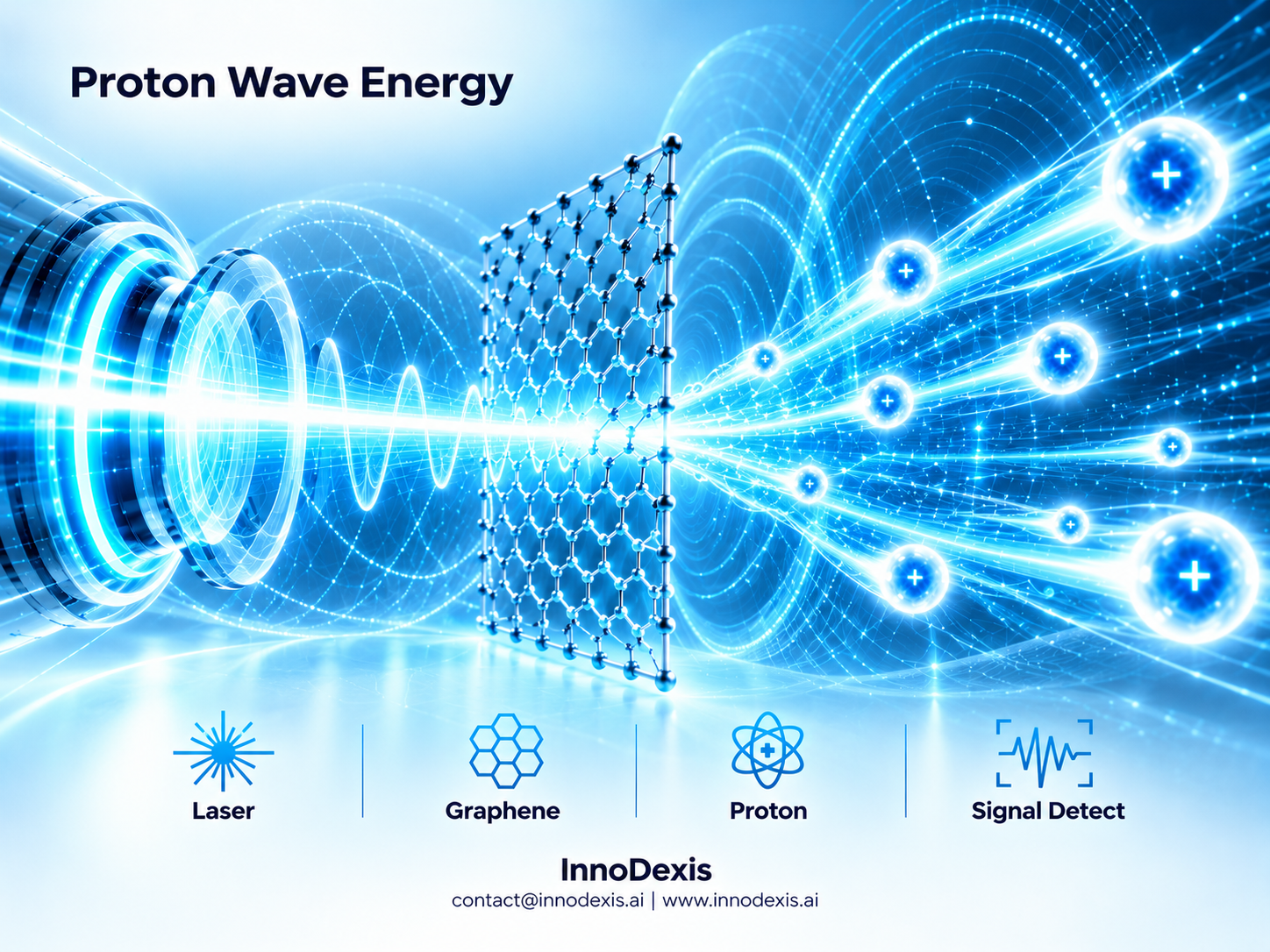
InnoDexis has published its latest Innovation Intelligence Report covering laser-driven particle acceleration, analyzing a research innovation developed at the University of Osaka. The report reveals that researchers combined ultrathin graphene targets, a long-pulse laser, and a neural network to accelerate protons to a record 132 MeV, sustaining acceleration across multiple picoseconds rather than relying on a single short burst, while achieving 99.2% precision in automated high-energy signal detection.
Key Findings
Protons were accelerated to 132 MeV, a record result attributed to a long-pulse laser design that allows protons to surf a propagating field continuously rather than being pushed in a single burst. This shifts the achievable energy ceiling from a function of pulse strength to a function of pulse duration.
Acceleration was sustained across multiple picoseconds, a fundamentally different exposure regime from conventional short-pulse methods, which cap proton energy the moment the field dissipates. Extending the acceleration window across picoseconds rather than a single instantaneous pulse is identified as the direct cause of the record energy achieved.
Ultrathin graphene targets withstood laser prepulses intact, resolving a long-standing limitation in which targets have historically disintegrated before the main laser pulse arrives. Target durability under these conditions is a prerequisite for sustaining acceleration over the picosecond timescales observed in this study.
A neural network achieved 99.2% precision in automatically identifying high-energy signals. This detection capability is described as what makes validating record energies possible at scale, addressing a measurement and verification requirement that becomes more demanding as acceleration regimes extend in duration and complexity.
Strategic Insight and Trend Analysis
The central strategic signal in this dataset is a reframing of what determines the energy ceiling in laser-driven proton acceleration. Conventional short-pulse approaches have treated proton energy as a function of how much force a single burst can deliver before the field dissipates. This result demonstrates that extending the duration of field exposure, rather than increasing the intensity of a single pulse, can produce a higher achievable energy — a structurally different lever for progress in the field.
This reframing depends on two supporting advances operating together rather than in isolation. Graphene targets capable of withstanding laser prepulses intact are what make sustained picosecond-scale exposure physically possible, since a target that disintegrates early would terminate acceleration before the extended window could be exploited. Neural network detection at 99.2% precision is what makes the resulting high-energy signals verifiable at the scale and reliability required to confirm a record result.
Taken together, these three elements — long-pulse field design, durable graphene targets, and automated high-precision detection — constitute a coherent system rather than three independent improvements. The durability of the targets and the sustained nature of the acceleration point toward compact laser-driven accelerators as a potential alternative to large-scale accelerator facilities, since the approach demonstrated here does not depend on the scale of infrastructure that conventional particle acceleration has historically required.
The dataset frames this as a shift in acceleration regime rather than an incremental gain within the existing short-pulse paradigm, with direct relevance to any application where compact, high-energy proton sources would offer a practical advantage over large fixed installations.
Global and Industry Implications
For corporates and R&D teams, the demonstrated combination of durable graphene targets and long-pulse laser design offers a technical pathway toward compact proton acceleration systems, relevant to organisations developing laser-driven particle sources for industrial or scientific instrumentation.
For investors and capital allocators, the dataset signals early-stage but structurally significant progress toward laser-driven accelerators as an alternative to large-scale facilities, with the neural network detection component representing a transferable capability relevant to automated validation in high-energy physics research more broadly.
For policymakers and national innovation bodies, the University of Osaka’s achievement of a record proton energy through a new acceleration regime reinforces the strategic value of sustained investment in laser-driven particle physics research, particularly where compact alternatives to large infrastructure could broaden access to high-energy proton sources.
InnoDexis Statement
“Sustaining proton acceleration across picoseconds rather than a single burst shifts the energy ceiling from pulse strength to pulse duration, a structural change in how laser-driven acceleration can be scaled,” noted InnoDexis in its latest intelligence report.
Conclusion
As compact laser-driven acceleration moves closer to viability, the combination of durable graphene targets, long-pulse field design, and high-precision automated detection demonstrated at the University of Osaka marks a meaningful technical step beyond the limitations of short-pulse methods. Continued validation of sustained picosecond-scale acceleration at increasing energies will clarify how close the field is to compact alternatives for applications including proton radiotherapy. InnoDexis will continue to track developments in laser-driven particle acceleration, target materials engineering, and AI-assisted detection in high-energy physics. The complete Laser-Driven Proton Acceleration Innovation Intelligence Report is available to InnoDexis subscribers and enterprise clients.
About InnoDexis
InnoDexis is a real-time innovation intelligence platform connecting scientific discovery to commercial opportunity. Powered by InnoGraph, its proprietary innovation knowledge graph, the platform maps technologies across the entire lifecycle, from early-stage research (TRL 1) to market deployment (TRL 9), connecting researchers, institutions, startups, companies, products and emerging opportunities.
Covering 40+ specialised industry segments and 360 technology areas, InnoDexis delivers innovation tracking, research discovery, product and startup intelligence, investment insights, and AI-powered reports. Its mission is to bridge the gap between scientific discovery and real-world impact.
InnoDexis — From Lab to Market: Real-Time Innovation Intelligence.