Products Available Now Score 5.12 Against 7.00 for Those on Regulatory Pathways as the Research Stream's Confirmed-Product Cohort Is 46.9% Corporate Press Releases
A dual-stream product analysis of 3,174 Research and 5,529 Corporate records finds that availability and assessed novelty move in opposite directions, that API and infrastructure products outscore services by 2.51 points, and that AI commercial product activity now exceeds research product activity by 6.8 percentage points.
InnoDexis has published its latest Cross-Stream Intelligence Report — What Shipped — analyzing product and platform naming fields across 3,174 valid Research-stream records and 5,529 valid Corporate-stream records during July 2026, identifying 5,906 named product or platform references. The report reveals that products available now score a mean InnoDexis score of 5.12 against 7.00 for products still on clinical or regulatory pathways, that API and infrastructure products lead all Corporate product types at 7.14 against Service at 4.63 across 1,607 records, and that 46.9% of the Research stream's 98 confirmed products originate from corporate entities rather than academic or public research institutions.
Key Findings
The Research product confirmation funnel narrows from 959 records naming a product — 30.2% of the valid corpus — to 331 records carrying a stated commercial readiness position, to 98 records clearing all three evidence bars simultaneously. The 3.1% confirmed-product rate is substantially higher than the 0.4% confirmed-prototype rate documented in the companion Prototypes and Signals report this month, and the report is explicit about why: a product has a customer, and a customer is a verifiable third party. Products are structurally easier to confirm than prototypes, which makes the confirmed-product cohort larger but not automatically more novel.
The composition of the confirmed-product cohort requires a direct finding before any external use. Across all 3,174 valid Research records, corporate entities account for 3.4%. Among the 959 records naming a product, 10.2%. Among the 98 confirmed products, 46.9% — nearly half. The Research stream's highest-confidence product cohort is close to half corporate press releases from companies including Siemens, Novartis, TotalEnergies, Roche, Maersk, Thales, and AkzoNobel indexed into the Research stream. The corrected number supporting the early-signal thesis is 47 genuinely academic or public-research confirmed products — half the unfiltered headline figure — and the report explicitly recommends using that figure rather than 98 in any external context until an entity-type field is added to the Research schema.
The Research readiness stage distribution is barbelled. Among the 187 classifiable records, 77 sit at early or pre-clinical stage and 70 are already commercially deployed, with only 40 in the pilot and near-market middle. The classifier was validated against stated TRL — a field it does not use as an input — and the ordering holds cleanly: early records carry a median stated TRL of 3, pilot and validation records 3.5, near-market 5, and commercially deployed 9. The structural gap between early-stage and deployed records at either end, with relatively few in between, replicates the same TRL 5 scarcity documented from a different direction in the companion Prototypes and Signals report.
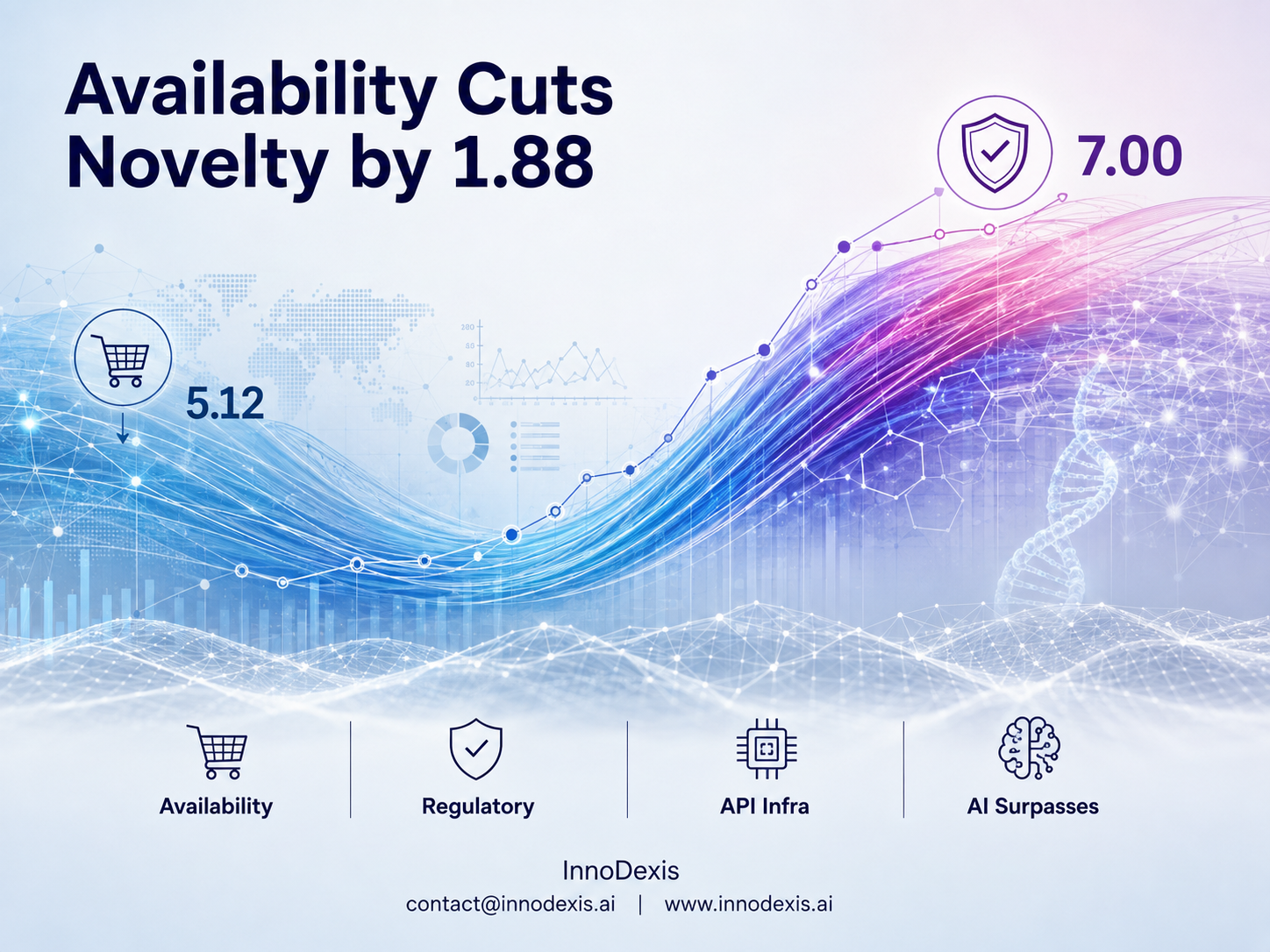
The Corporate stream availability paradox is the report's most operationally consequential finding for product scouting. Across 1,801 records with a classifiable availability statement, the mean InnoDexis score rises monotonically from 5.12 for products available now to 5.91 for dated future launches, 6.73 for limited or pilot availability, and 7.00 for products on clinical or regulatory pathways. The mechanism is compositional: immediate availability is cheap to announce for a service, a regional expansion, or a feature update, and those announcements are numerous. A product requiring a regulatory pathway is doing something novel enough to need one. Filtering for products available now selects against novelty, and the 271 records in pilot, limited-release, or regulatory-pathway status represent the month's highest-novelty Corporate product cohort despite accounting for the smallest volume.
API and infrastructure products lead all Corporate product types at a mean InnoDexis score of 7.14, followed by therapeutics at 6.96 and combined hardware-software systems at 6.77. Service is the lowest-scoring type at 4.63 across 1,607 records — nearly a third of the typed Corporate corpus. The two largest product categories by volume are also the two lowest by score, accounting for 2,230 of 5,363 typed records. The Corporate stream is, by volume, predominantly a service-announcement feed with a high-value technology feed embedded inside it, and any analysis reporting stream-wide averages without segmenting by product type is reporting the service feed rather than the deep-tech signal.
The domain gap analysis — comparing each domain's share of Research products against its share of Corporate products — identifies Biotech and Pharmaceuticals as the largest overhang at 13.7 percentage points, with 21.5% of Research products against 7.8% of Corporate ones, consistent with a decade-long translation cycle where research announcements accumulate far faster than commercial ones. AI and Machine Learning runs 6.8 points in the opposite direction — more corporate product activity than research product activity — indicating that commercial AI deployment has stopped waiting for the published research base and is running ahead of it. Advanced Materials runs 2.0 points negative on the same measure.
Strategic Insight and Trend Analysis
The most consequential analytical finding of the July 2026 What Shipped report is the demonstration that availability and novelty move in structurally opposite directions in the Corporate stream — and that this is not a month-specific artefact but a compositional property of corporate newsflow that will persist as long as service launches and regional expansions dominate immediate-availability announcements. The 1.88-point score differential between products available now and products on regulatory pathways is larger than the differential between most technology domain comparisons in the dataset, and it identifies a systematic bias in any scouting process that weights toward available product announcements.
The AI domain inversion carries the most significant medium-term strategic implication in the data. A domain where corporate product announcements outpace research product announcements by 6.8 points has crossed a threshold where the commercial layer has stopped waiting for the science — deployment is running ahead of the published research base, and the research activity that would normally precede commercial products is either happening inside companies rather than in institutions, or its translation cycle has compressed to the point where it no longer appears as a distinct precursor phase. Either reading identifies AI as the domain furthest from the early-signal structure the Research stream is designed to provide, and the one most dependent on the Corporate stream for current intelligence.
The 46.9% corporate entity composition in the confirmed-product cohort is a data-quality finding with a direct platform architecture implication rather than a measurement error. The Research product confirmation filter is functioning correctly — it is selecting for records with named products, stated commercial readiness, and independent validation, and companies do all three things more consistently than universities. The filter is producing valid output; the interpretation attached to it was inaccurate. The resolution is architectural: an entity-type field in the Research schema that makes the corporate or academic origin of a record filterable rather than inferred from institution names.
Global and Industry Implications
For corporates and R&D teams, the availability paradox finding provides a directly actionable scouting recalibration. The 271 records in pilot, limited-release, or regulatory-pathway status represent the Corporate stream's highest-novelty product cohort at a mean score above 6.73 — and they are the cohort most systematically missed by any product-intelligence process filtered for immediate availability. The domain overhang analysis identifies Biotech and Pharmaceuticals as the field with the largest accumulated Research product pipeline relative to its Corporate product output, confirming it as the highest-density environment for licensing and partnership conversations where Research-stream product announcements are the leading indicator. The AI domain inversion confirms that Corporate-stream product data is now the primary intelligence source for current AI product activity, with the Research stream providing diminishing early-warning advantage in that specific domain.
For investors and capital allocators, the 47 genuinely academic confirmed Research products — the corrected figure after removing corporate entities — are the cohort that supports the early-signal investment thesis, and the report is explicit that this figure should be used rather than the headline 98 until entity type becomes a filterable Research-stream field. The MoonPay PayBox spotlight record — a non-custodial payment vault enabling AI agent-initiated transactions with user approval gating — illustrates the class of API and infrastructure product that leads the Corporate stream's quality distribution at 7.14: built against a constraint that has just appeared, in a category that did not exist 18 months ago, with the binding constraint now institutional rather than technical. The 3D Systems Walter Reed point-of-care regulatory clearance is identified as a precedent-setting event whose commercial consequence depends on whether the clearance framework proves transferable beyond the specific institution and device class.
For policymakers and national innovation bodies, Novartis's traditional FDA approval for Fabhalta in IgA nephropathy — as distinct from accelerated approval — is the month's clearest illustration of how regulatory pathway status converts a probability-weighted pipeline entry into a confirmed revenue-generating product with a defined label. The distinction between traditional and accelerated approval carries direct health technology assessment and reimbursement policy implications that the availability paradox finding quantifies at the stream level: the 7.00 mean score for regulatory-pathway products versus 5.12 for immediately available ones confirms that the regulatory process is identifying and advancing the more substantive innovations, and that reimbursement frameworks calibrated to accelerate market access for available products may be systematically deprioritising the higher-quality pipeline cohort in favour of lower-novelty immediate-availability announcements.
InnoDexis Statement
"The products easiest to verify are the ones already for sale — and this month they score nearly two points below the products still working through pilots and regulatory pathways, confirming that availability and novelty move in opposite directions in corporate newsflow and that a scouting process filtered for what ships today systematically misses what matters tomorrow," noted InnoDexis in its latest intelligence report.
Conclusion
The July 2026 What Shipped report establishes that the relationship between product availability and assessed innovation quality is inverse and monotonic across the Corporate stream, that AI commercial product activity has outpaced research product activity by 6.8 percentage points indicating commercial deployment running ahead of the published research base, and that the Research stream's confirmed-product cohort requires an entity-type filter before it can accurately represent early-stage academic innovation. Across 5,906 named product references from 3,174 Research and 5,529 Corporate records, the evidence confirms that the 271 pilot and regulatory-pathway Corporate records represent the month's highest-novelty product cohort, that the 47 genuinely academic confirmed Research products are the defensible early-signal universe, and that product type is the single most discriminating field in the Corporate product schema. As the availability paradox is tested for persistence across consecutive monthly cycles, the AI domain inversion is tracked as an indicator of commercial-research decoupling, and entity type is added to the Research schema as a filterable field, the What Shipped framework will provide the most structurally precise product intelligence the InnoDexis platform produces each cycle. The complete What Shipped Product Intelligence July 2026 Report is available to InnoDexis subscribers and enterprise clients.
About InnoDexis
InnoDexis is a global Innovation Intelligence platform that tracks, analyzes, and interprets breakthrough innovations, prototypes, and emerging technologies across industries and countries. Its intelligence helps corporates, investors, and policymakers understand the true structure and direction of global innovation. Learn more at innodexis.ai.