Predictive Geospatial AI Gains Strategic Role in Climate Resilience as Water Infrastructure Faces Rising Pressure
Research from INESC TEC highlights the emergence of AI-driven forecasting systems for proactive water-resource management.
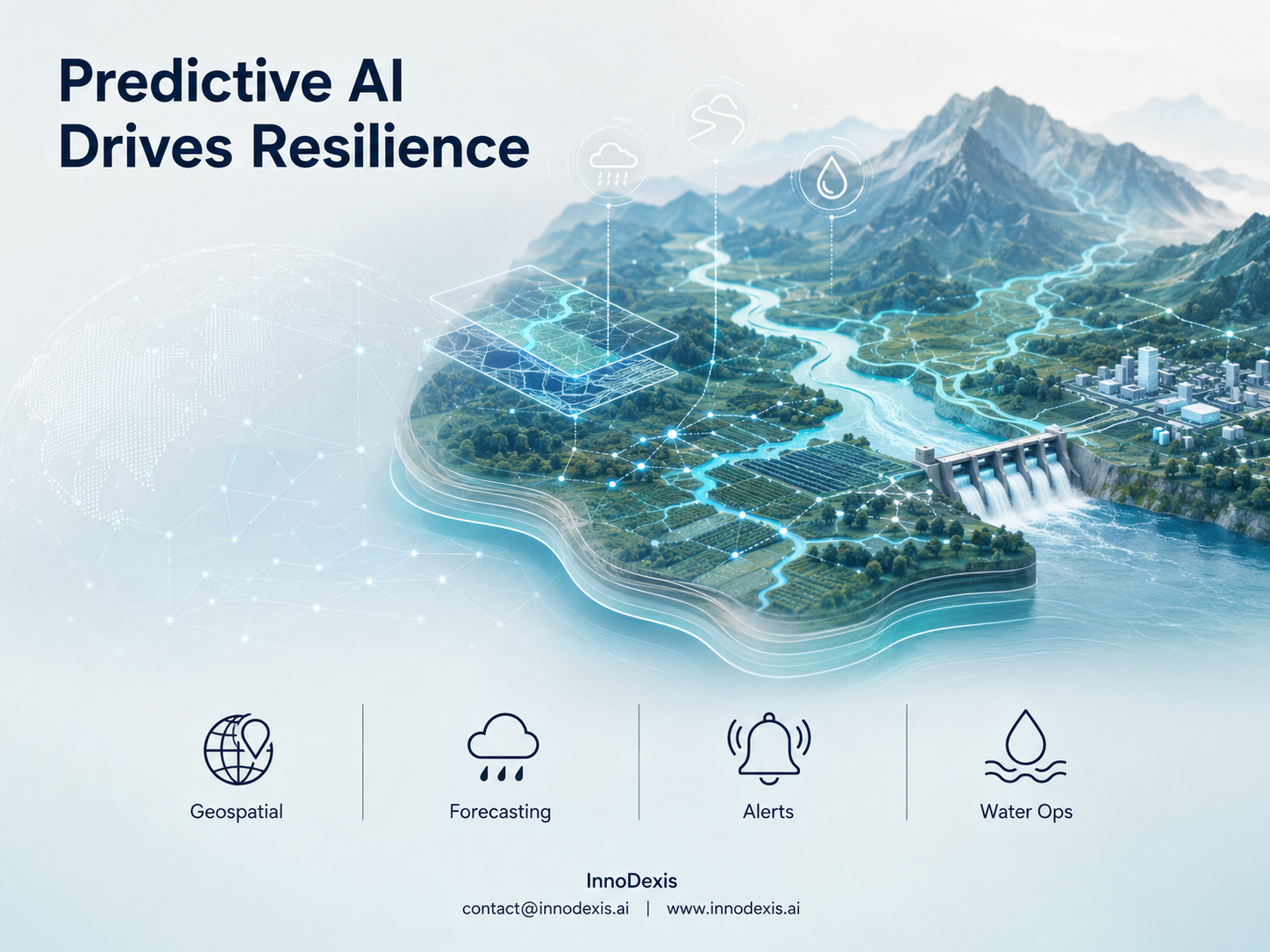
InnoDexis has published its latest Innovation Intelligence Report covering climate resilience and water infrastructure innovation, analyzing developments surrounding the WATERKNOW platform developed by INESC TEC. The report reveals that predictive geospatial AI systems are increasingly being positioned as foundational tools for climate adaptation and intelligent resource management. By integrating forecasting, hydrological modeling, analytics, and generative AI, the initiative reflects a broader shift from reactive infrastructure response toward anticipatory climate resilience systems.
Key Findings
The WATERKNOW platform integrates geospatial technologies, hydrological models, analytics, and generative AI into a unified climate resilience framework. This combination enables the system to process environmental, spatial, and operational data simultaneously, supporting more comprehensive water-resource analysis.
The platform is designed to generate both short-term hydrological forecasts and long-term climate scenarios. This dual-layer forecasting capability allows infrastructure operators to respond to immediate environmental conditions while also planning for structural climate risks over extended time horizons.
Automated alert functionality forms a central operational component of the system. WATERKNOW is intended to provide early warnings for municipalities, farmers, and dam operators, enabling intervention before disruptions escalate into broader infrastructure or resource-management failures.
The project focuses on river basins in Northern Portugal, positioning the region as a live operational environment for predictive climate infrastructure experimentation. The geographic deployment demonstrates how localized environmental systems can be continuously monitored and dynamically managed through AI-enabled forecasting architectures.
The findings indicate that water management systems are evolving beyond passive monitoring models. Instead, infrastructure is increasingly being designed to anticipate shortages, flooding risks, and operational stress through continuous analytical assessment and predictive modeling.
Strategic Insight and Trend Analysis
The developments surrounding WATERKNOW reflect a broader transformation in climate adaptation strategy, where predictive intelligence is becoming increasingly central to infrastructure management. Traditional water systems have largely operated through reactive intervention models, responding to shortages, flooding, or resource stress after disruptions occur. The integration of geospatial AI and climate forecasting signals movement toward anticipatory operational frameworks.
The combination of hydrological modeling, analytics, and generative AI introduces a system architecture capable of processing environmental variability in near real time. This allows infrastructure operators to move from static planning cycles toward adaptive decision-making processes informed by continuously updated forecasts and climate scenarios.
The inclusion of automated alerts for municipalities, agricultural stakeholders, and dam operators also demonstrates a shift toward distributed resilience systems. Rather than concentrating response capabilities within centralized authorities alone, predictive infrastructure platforms increasingly support coordinated decision-making across multiple operational stakeholders.
The focus on both short-term forecasting and long-term climate scenarios indicates that water infrastructure is being reconceptualized as a continuously managed digital system. Similar to how telecommunications or energy networks rely on ongoing monitoring and optimization, climate-related infrastructure may increasingly depend on predictive operational intelligence.
Collectively, the findings suggest that climate resilience strategies are moving toward infrastructure models where forecasting, automation, and geospatial intelligence function as integrated operational layers rather than supplementary analytical tools.
Global and Industry Implications
For corporates and infrastructure operators, the findings highlight the growing importance of predictive analytics platforms in managing operational climate risk. Utilities, agricultural systems, and infrastructure providers may increasingly require AI-enabled monitoring and forecasting capabilities to maintain resilience under variable environmental conditions.
For investors and capital allocators, predictive climate infrastructure represents an emerging segment within climate technology and smart infrastructure markets. Platforms capable of integrating forecasting, analytics, and operational automation may attract attention as governments and industries expand climate adaptation investments.
For policymakers and national resilience agencies, the deployment of systems such as WATERKNOW demonstrates how AI-driven forecasting can support public-sector climate preparedness. Integrating predictive geospatial intelligence into national infrastructure planning may become increasingly important as drought and flooding pressures intensify globally.
InnoDexis Statement
“The emergence of predictive geospatial AI systems indicates that future climate resilience strategies may depend increasingly on anticipatory infrastructure management rather than post-event response mechanisms,” noted InnoDexis in its latest intelligence report.
Conclusion
The WATERKNOW initiative developed by INESC TEC reflects a broader transition toward predictive climate infrastructure systems capable of continuously monitoring, forecasting, and optimizing water-resource management. As environmental volatility increases, the ability to anticipate operational stress before disruption occurs may become a defining capability for climate resilience planning. Monitoring how predictive AI platforms scale across infrastructure domains will be critical in understanding the future evolution of climate adaptation systems. The complete Climate Resilience and Water Infrastructure Innovation Intelligence Report is available to InnoDexis subscribers and enterprise clients.
About InnoDexis
InnoDexis is a global Innovation Intelligence platform that tracks, analyzes, and interprets breakthrough innovations, prototypes, and emerging technologies across industries and countries. Its intelligence helps corporates, investors, and policymakers understand the true structure and direction of global innovation. Learn more at innodexis.ai.