Potato Protein Replaces Wheat Gluten in Fava Bean Plant-Based Meat at a 25% Share in Heriot-Watt and Greenwich High-Moisture Extrusion Study
Heriot-Watt University and University of Greenwich researchers showed that a 75% fava bean and 25% potato protein blend forms a meat-like fibrous structure without gluten, with bitterness and astringency as the remaining barrier.
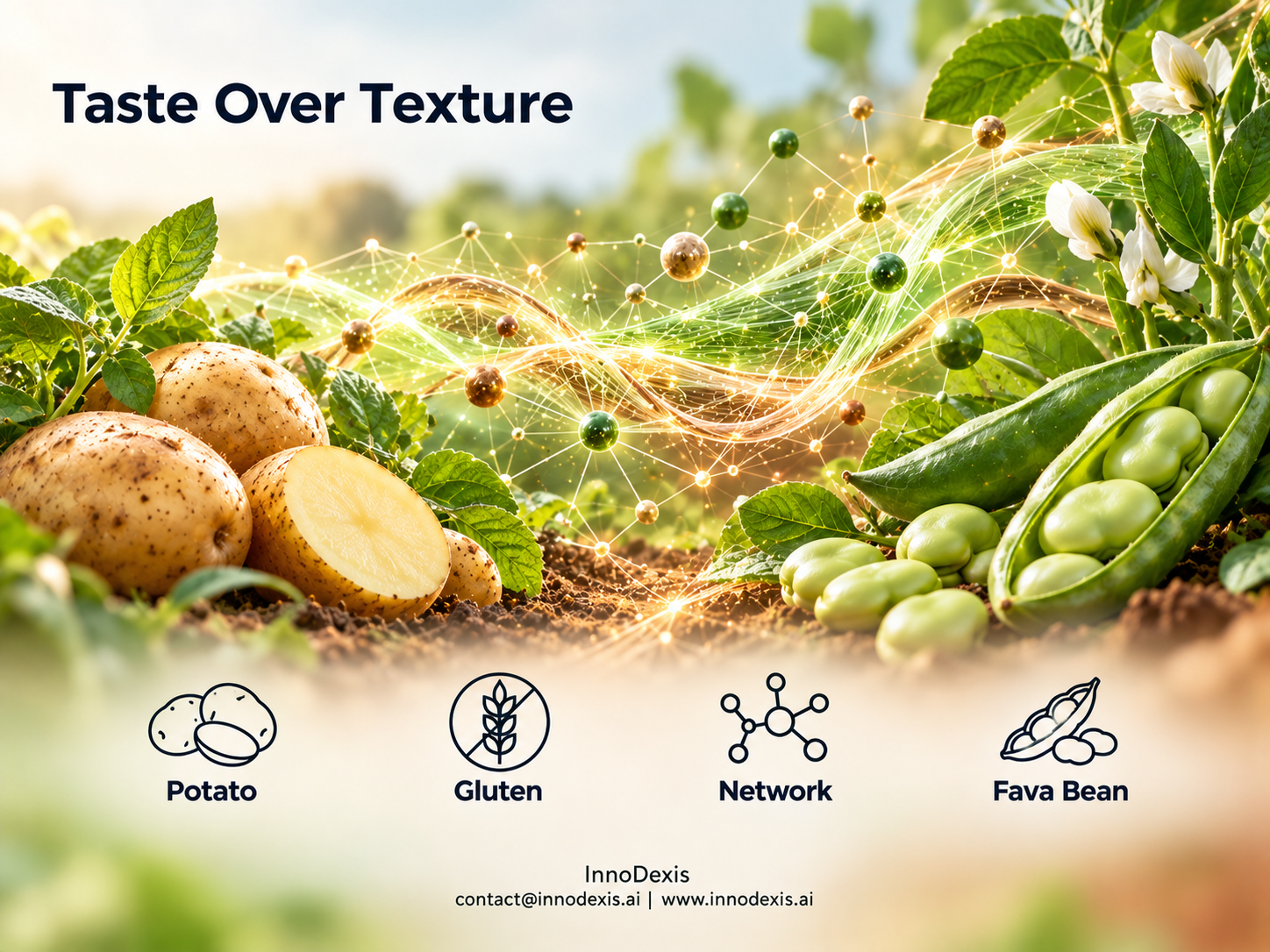
InnoDexis has published its latest Innovation Intelligence Report covering plant-based meat and sustainable proteins, analyzing one innovation from Heriot-Watt University and the University of Greenwich in the United Kingdom, published on 23 October 2026. The report reveals that a blend of 75% fava bean protein, a cool-climate crop, and 25% potato protein, processed by high-moisture extrusion, formed a protein network that mimics the fibrous structure of real meat without gluten, while bitterness, astringency and aftertaste remain the barrier to commercial adoption.
Key Findings
A blend of 75% fava bean protein and 25% potato protein formed a strong protein network under high-moisture extrusion. The network mimics the fibrous structure of real meat, which demonstrates that potato protein can act as a functional gluten replacement and produce realistic texture without common allergens.
The potato protein version was compared against fava bean protein alone and fava bean protein mixed with wheat gluten. The gluten version was softer and springier, but the potato protein version still provided the structure required for a meat alternative, so the texture gap is real but does not block the concept.
Taste is the weak point. The potato protein blend showed higher bitterness and astringency than the gluten-based version and left a stronger lingering aftertaste. The researchers measured these attributes with an electronic taste sensing system that detects bitterness, astringency, umami and aftertaste, giving the finding an objective basis.
The formulation relies on fava beans, a cool-climate crop that contains high levels of protein and remains underused in the meat-free sector, which depends heavily on soy, pea protein and wheat gluten. The approach therefore diversifies the protein base while serving consumers with coeliac disease or gluten sensitivity.
Results so far come from laboratory experiments, and commercial readiness is rated medium-low. The timeline is 2 to 4 years, depending on solving flavour and taste challenges, while manufacturing scalability is rated high because high-moisture extrusion is an established processing standard.
Strategic Insight and Trend Analysis
The dominant trend in this research is a shift in the bottleneck for gluten-free plant-based meat, from structure to flavour. The extrusion process succeeded in replicating meat-like texture without gluten. Commercial success is now constrained by undesirable organoleptic properties, namely bitterness and astringency, which food formulators must solve. Reducing the bitter and astringent aftertaste of potato protein is the specific research gap identified.
This distinction matters because the process side is already close to market-ready. High-moisture extrusion is established, fava beans are readily cultivated in cooler climates, and the ingredients and processing techniques are standard food-grade materials with no apparent regulatory barrier. Stephen Euston of Heriot-Watt states that food companies would need to find ways of reducing the bitterness before the approach could be widely used in consumer products.
At a market level, the approach offers diversification of plant protein sources beyond soy and pea and entry into the rapidly growing gluten-free vegan market. If commercialized, it could displace soy and wheat gluten in plant-based meat production and expand the market share of gluten-free substitutes.
The risks are equally concrete. Flavour profiles may remain unpalatable to general consumers without expensive masking agents, and consumers may reject the product because of the bitter taste or lingering aftertaste. The established dominance of soy and wheat-gluten options is the main competitive threat, which means taste performance will decide whether the texture advantage reaches the market.
Global and Industry Implications
For corporates and R&D teams, the approach requires food processors to adjust high-moisture extrusion parameters and to incorporate flavour masking or debittering steps for potato protein processing. Plant-based food manufacturers gain a route into gluten-free markets using locally sourceable, cool-climate crops, with flavour-formulation research as the immediate priority. The gluten-free, allergen-friendly profile delivers a strong fibrous structure without wheat gluten.
For investors and capital allocators, the guidance is specific: look for downstream flavour-masking technologies to pair with this extrusion process, since flavour masking technology partnerships are the identified opportunity. Commercial readiness is medium-low and the timeline is 2 to 4 years, so the investment case rests on solving taste rather than texture.
For policymakers and national innovation bodies, the research was supported by the UK Department for Environment, Food & Rural Affairs and the Bezos Earth Fund, through the Bezos Centre for Sustainable Protein at the University of Greenwich. It illustrates how public and philanthropic funding can broaden the alternative protein base beyond soy and pea while using sustainable cool-climate crops.
InnoDexis Statement
“Potato protein solves the structural problem of gluten-free plant-based meat but shifts the bottleneck to flavour, making taste rather than texture the deciding factor for commercial adoption,” noted InnoDexis in its latest intelligence report.
Conclusion
The next milestone to watch is flavour-formulation research that eliminates the bitter and astringent taste profile of potato protein, along with partnerships in flavour masking technology. Development of commercial gluten-free, fava-bean-based meat substitutes is projected to take 2 to 4 years, depending on how quickly the taste challenge is solved. Managing off-flavours inherent to potato protein extracts is also needed. InnoDexis will continue to track alternative proteins, gluten-free food development and novel plant-based food structuring as this field develops. The complete Potato Protein Gluten-Free Plant-Based Meat Innovation Intelligence Report is available to InnoDexis subscribers and enterprise clients.
About InnoDexis
InnoDexis is a real-time innovation intelligence platform connecting scientific discovery to commercial opportunity. Powered by InnoGraph, its proprietary innovation knowledge graph, the platform maps technologies across the entire lifecycle, from early-stage research (TRL 1) to market deployment (TRL 9), connecting researchers, institutions, startups, companies, products and emerging opportunities.
Covering 40+ specialised industry segments and 360 technology areas, InnoDexis delivers innovation tracking, research discovery, product and startup intelligence, investment insights, and AI-powered reports. Its mission is to bridge the gap between scientific discovery and real-world impact.
InnoDexis — From Lab to Market: Real-Time Innovation Intelligence.