Portuguese Researchers Automate Fragile and Flexible Material Handling With 96% Gripper Success Rate, Closing a Persistent Manufacturing Gap
Two robotic prototypes developed at INESC TEC and the University of Porto, in direct response to active industrial partner challenges, demonstrate that targeted academic-industry collaboration can achieve high-precision automation where standard robotic systems have consistently failed.
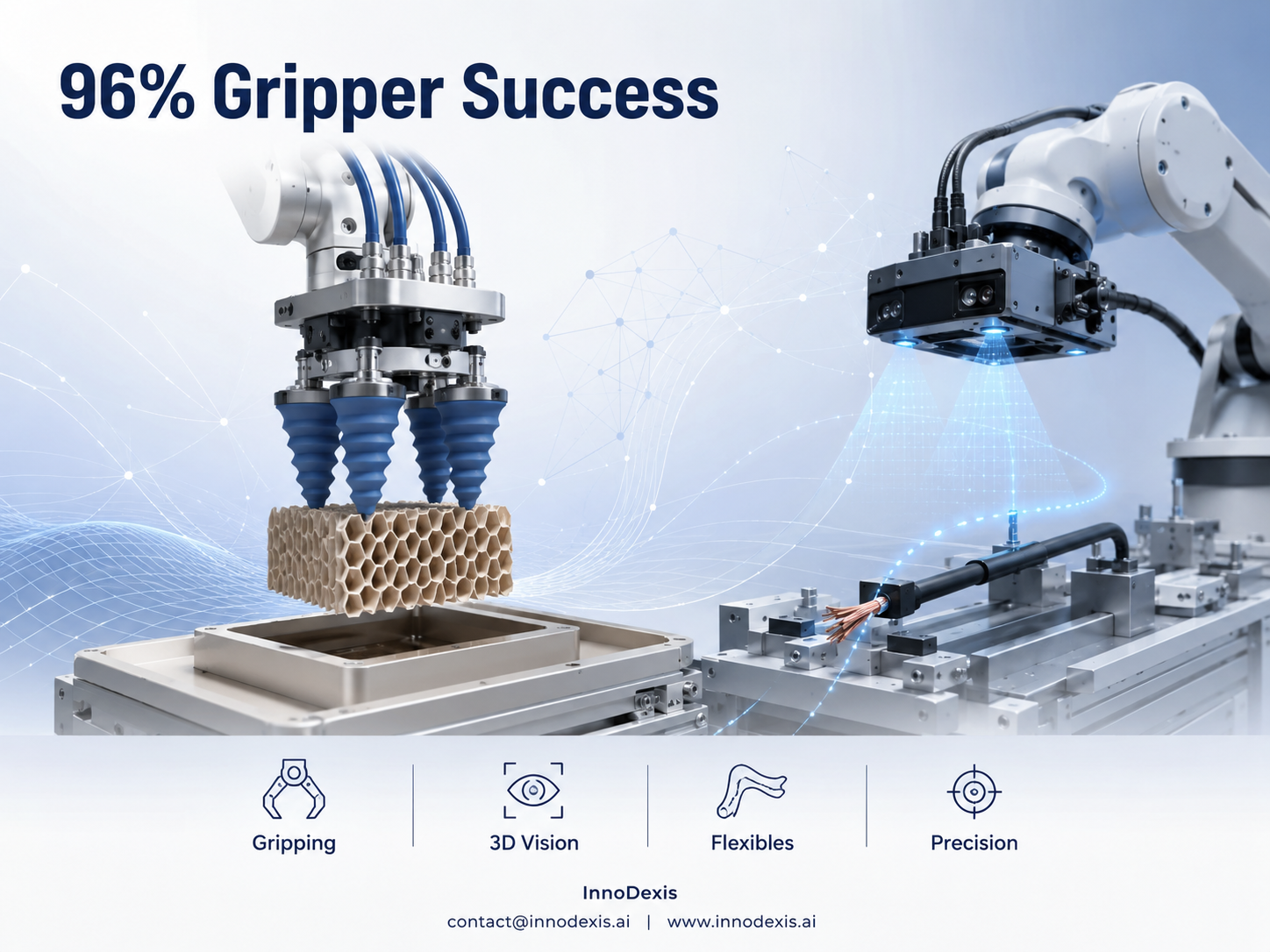
InnoDexis has published its latest Innovation Intelligence Report covering industrial robotics and manufacturing automation, analyzing two robotic prototypes developed in Portugal through a collaboration between INESC TEC's Industry and Innovation Laboratory and the University of Porto. The report reveals that researcher-designed pneumatic gripping and one-shot visual alignment systems — built around real production problems submitted by active industrial partners — achieved measurable automation of fragile and flexible material handling processes that have remained manual across furniture manufacturing and electrical equipment production sectors.
Key Findings
A pneumatic gripper developed specifically for fragile honeycomb cell insertion achieved a 96% success rate — a performance level reached on one of manufacturing's most persistent automation challenges. Honeycomb materials are compressible, fragile, and dimensionally variable, characteristics that have historically placed them outside the operating envelope of standard robotic gripping systems. The conical finger design compresses the paper honeycomb in a controlled manner, directly mimicking the mechanical behaviour of a human hand during the same task.
One-shot visual alignment was developed to address the challenge of flexible wire insertion — a task where wire geometry varies between individual components, making iterative adjustment-based approaches impractical at production speeds. The system uses 3D scanning to calculate the full trajectory correction required in a single pass before wire insertion begins, eliminating the iterative adjustment cycles that standard vision-guided systems rely on. This represents a meaningful methodological advance for automation of geometrically variable components.
Both prototypes were developed in direct response to manufacturing challenges submitted by active industrial partners rather than hypothetical use cases. This origin is significant: the performance specifications targeted by the research were drawn from real production environments, meaning the 96% success rate and single-pass trajectory correction were validated against actual industrial requirements rather than laboratory-defined benchmarks.
The two solutions address distinct manufacturing sectors — furniture production for the honeycomb gripper and electrical equipment production for the wire insertion system. The underlying design principles — pneumatic compliance for fragile materials and single-pass vision correction for flexible components — are not sector-specific, suggesting applicability across other manufacturing domains where standard automation systems encounter similar material-handling constraints.
Both prototypes were developed by master's-level researchers, demonstrating that the academic-industry collaboration model — tasking graduate researchers with precisely scoped real production problems — is capable of reaching automation challenges that established industrial robotics systems have not resolved.
Strategic Insight and Trend Analysis
The dominant trend emerging from this dataset is the strategic value of narrow, problem-specific automation design over generalised robotic system deployment. The manufacturing automation gap for fragile and deformable materials has persisted not because the problem is unknown but because standard robotic architectures optimise for repeatability and rigidity — properties that work against the compliance and adaptability required for honeycomb, flexible wire, and similarly variable materials. The INESC TEC prototypes succeed precisely because they were designed around the specific mechanical behaviour of a single material class rather than adapted from general-purpose systems.
This specificity-first design approach has broader implications for how manufacturing automation gaps are identified and closed. The most persistent gaps in industrial automation are frequently the narrow tasks — the ones that represent a small fraction of a production line but require human intervention because no standard system handles them reliably. Addressing these gaps requires targeted research anchored in real production constraints, which is exactly the model demonstrated here.
The academic-industry collaboration structure is itself a finding of strategic significance. By routing real industrial problems directly to graduate researchers with focused design mandates, INESC TEC's Industry and Innovation Laboratory produced two viable prototypes for problem classes that active industrial partners had not resolved through standard procurement channels. This suggests that the academic-industry model — when structured around specific production challenges rather than broad research themes — represents an underutilised pathway for closing persistent automation gaps.
The transferability of the underlying methods across sectors strengthens the strategic case further. Pneumatic compliance design for fragile materials and single-pass vision correction for variable geometry components are not inherently furniture or electrical equipment solutions — they are approaches applicable wherever material unpredictability has blocked standard automation.
Global and Industry Implications
For corporates and R&D teams in manufacturing, the findings identify two validated design approaches — pneumatic compliance gripping and one-shot visual trajectory correction — that are candidates for evaluation in any production environment where fragile, deformable, or geometrically variable materials are currently handled manually. The 96% success rate on honeycomb insertion and the single-pass wire alignment capability provide concrete performance benchmarks against which internal automation assessments can be measured.
For investors and capital allocators, the dataset signals continued momentum in materials-specific industrial robotics — a segment where the automation gap is well-documented and the addressable market spans furniture, electrical equipment, packaging, and other sectors handling compliant or variable materials. The academic-industry model demonstrated here also points toward graduate research programmes and technology transfer offices at institutions like INESC TEC as early-stage sources of robotics IP worth monitoring.
For policymakers and national innovation bodies, the Portugal-based collaboration illustrates the productivity of structured academic-industry partnerships where graduate researchers are assigned real production problems from active industrial partners. This model generates applied research output with direct commercial relevance while building graduate-level engineering capability in advanced manufacturing automation.
InnoDexis Statement
"The INESC TEC prototypes demonstrate that the most persistent automation gaps in manufacturing are best closed through targeted, material-specific design anchored in real industrial problems — a finding with direct implications for how industry and academia structure collaborative research mandates," noted InnoDexis in its latest intelligence report.
Conclusion
Fragile and flexible material handling represents one of manufacturing automation's most enduring open problems. The pneumatic gripper and one-shot visual alignment systems developed at INESC TEC and the University of Porto demonstrate that targeted academic-industry collaboration, scoped around specific production constraints, can produce viable automation solutions for material classes that standard robotic systems have not reliably addressed. As manufacturing sectors continue to seek automation coverage across their full production workflows, InnoDexis will monitor developments in compliance-based gripping, single-pass vision systems, and the academic-industry models generating them. The complete Industrial Robotics Innovation Intelligence Report is available to InnoDexis subscribers and enterprise clients.
About InnoDexis
InnoDexis is a global Innovation Intelligence platform that tracks, analyzes, and interprets breakthrough innovations, prototypes, and emerging technologies across industries and countries. Its intelligence helps corporates, investors, and policymakers understand the true structure and direction of global innovation. Learn more at innodexis.ai.