Photonic Quantum Skyrmions Survive Entanglement Loss in First Chip-Scale Implementation by Penn Engineering, Yale, Witwatersrand and NTU
Penn Engineering researchers fabricated a photonic chip whose skyrmion pattern persisted after background disturbances broke the photons’ entanglement, with quantum correlations still measurable through quantum discord.
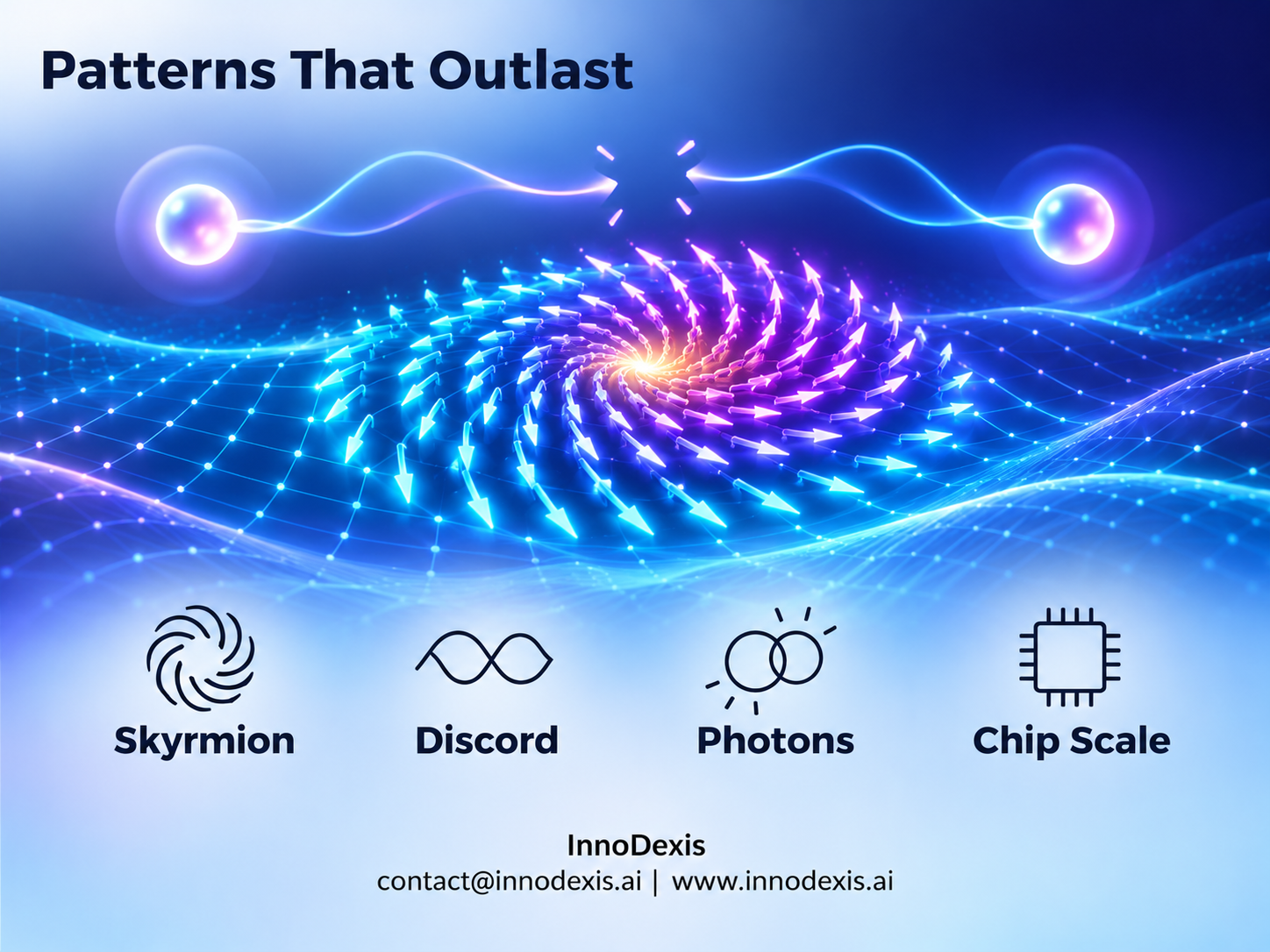
InnoDexis has published its latest Innovation Intelligence Report covering quantum photonics and resilient quantum networks, analyzing one innovation from the University of Pennsylvania’s School of Engineering and Applied Science, developed with partners across three countries and published on 30 October 2026. The report reveals that a photonic chip generated and manipulated quantum skyrmions, and that the topological pattern persisted after background disturbances broke the photons’ entanglement, retaining quantum correlations measured through quantum discord, in what is described as the first chip-mediated transfer of a single-photon skyrmion property to an entangled two-photon state.
Key Findings
A miniature photonic chip generates entangled photon pairs, engraves a topological skyrmion pattern onto a single photon, and transfers that pattern to the shared quantum state. This is the first chip-scale implementation of photonic quantum skyrmions and the first demonstration of chip-mediated manipulation, fabricated at the Singh Center for Nanotechnology using established nanophotonics methods.
The topological skyrmion pattern persisted even after background disturbances completely broke the photons’ entanglement. Quantum correlations remained measurable through quantum discord, which shows that topological properties can protect quantum information independently of entanglement. This points toward hardware with high structural robustness against environmental decoherence and background light disturbance.
The result changes the question for quantum communication resilience. Earlier work suggested these structures depended on entanglement, and this study shows the relationship is more complicated, moving attention toward broader quantum correlations preserved through topological patterns.
The integrated chip offers a scalable, miniature platform compared with bulky free-space optics. One part of the chip generates entangled photons, another directs them and a third creates the skyrmion pattern, and getting these parts to work together took nearly five years of refining chip techniques.
The work remains at an early stage. It was tested in a laboratory environment as a photonic chip prototype at TRL 3, with low commercial readiness and 5 to 10 years estimated before operational quantum network hardware integration.
Strategic Insight and Trend Analysis
The dominant trend in this research is a shift in how resilience is built into quantum networks, from protecting fragile entanglement toward encoding information in topological patterns that outlast it. The skyrmion pattern survived the complete destruction of entanglement, and the focus moves to quantum discord and the broader correlations it measures. Growth in quantum networking infrastructure investment raises the stakes for hardware that tolerates noise in transit. If it holds up, the approach could displace conventional entanglement protection schemes with topologically protected state encoding, increasing the reliability of long-distance quantum networks.
The hardware route reinforces the point. The field is moving from free-space optics toward integrated quantum photonics, and a chip that generates, routes and sculpts photons is compatible with long-term industrial semiconductor manufacturing, since the platform uses established nanophotonics methods and existing semiconductor fabrication lines could support scalable production.
The limits are equally clear. Validation is laboratory-only, and each node requires complex multi-stage photonic integration. Open risks include loss of topological stability under noise beyond the tested threshold, fabrication yields and insertion losses in multi-component chips, and the possibility that competing topological or error-correction approaches mature first. How quantum discord maintains topological memory after entanglement is lost is still an open scientific question.
The implication is that topological photonics should be read as an alternative or complementary path to classical quantum error correction in communication networks, with its next test being whether the pattern holds across real fiber links rather than in a laboratory chip.
Global and Industry Implications
For corporates and R&D teams, the technology could be absorbed by quantum communication vendors, telecommunications equipment manufacturers and specialized semiconductor foundries through IP licensing or joint development. Applications include fault-tolerant quantum key distribution and distributed quantum computing interconnects, and the commercial step requires moving from an academic cleanroom to standard foundry process design kits and testing over real-world optical fiber networks.
For investors and capital allocators, the finding is a reason to monitor topological photonics as an alternative or complementary route to classical quantum error correction. The risks are early development, high capital requirements for scaling nanofabrication to commercial photonic foundries, and slower-than-expected commercial deployment of quantum network infrastructure, within a 5 to 10 year horizon.
For policymakers and national innovation bodies, the work was supported by a National Science Foundation grant, the Penn Engineering Futures Fund and the Gordon and Betty Moore Foundation, and it is a research collaboration among Penn, Yale, the University of the Witwatersrand and Nanyang Technological University, spanning the United States, South Africa and Singapore. Applications in secure telecommunications and defense and cybersecurity are named, and export controls on advanced quantum photonic hardware are a stated risk.
InnoDexis Statement
“Resilience in quantum networks is shifting from protecting fragile entanglement to encoding information in topological patterns that outlast it, and the proof now needed is performance over real fiber networks,” noted InnoDexis in its latest intelligence report.
Conclusion
The next milestones to watch are extension of the photonic chip architecture to full data encoding and decoding, testing over deployed optical fiber loops to assess practical network resilience, and clarification of how quantum discord maintains topological memory after entanglement is lost. Performance limits under extreme perturbation and attenuation over distance remain to be defined. InnoDexis will continue to track topological photonics, integrated quantum photonics and resilient quantum network hardware as this field develops. The complete Photonic Quantum Skyrmions Innovation Intelligence Report is available to InnoDexis subscribers and enterprise clients.
About InnoDexis
InnoDexis is a real-time innovation intelligence platform connecting scientific discovery to commercial opportunity. Powered by InnoGraph, its proprietary innovation knowledge graph, the platform maps technologies across the entire lifecycle, from early-stage research (TRL 1) to market deployment (TRL 9), connecting researchers, institutions, startups, companies, products and emerging opportunities.
Covering 40+ specialised industry segments and 360 technology areas, InnoDexis delivers innovation tracking, research discovery, product and startup intelligence, investment insights, and AI-powered reports. Its mission is to bridge the gap between scientific discovery and real-world impact.
InnoDexis — From Lab to Market: Real-Time Innovation Intelligence.