Photocatalytic Coupling for DNA-Encoded Libraries Modifies 59-Unit DNA Fragments at Room Temperature in CiQUS and AstraZeneca Collaboration
CiQUS and AstraZeneca developed a light- and catalyst-driven reaction that couples carbonyls with double-bond molecules on DNA-encoded libraries at room temperature while preserving DNA readability and sequence integrity.
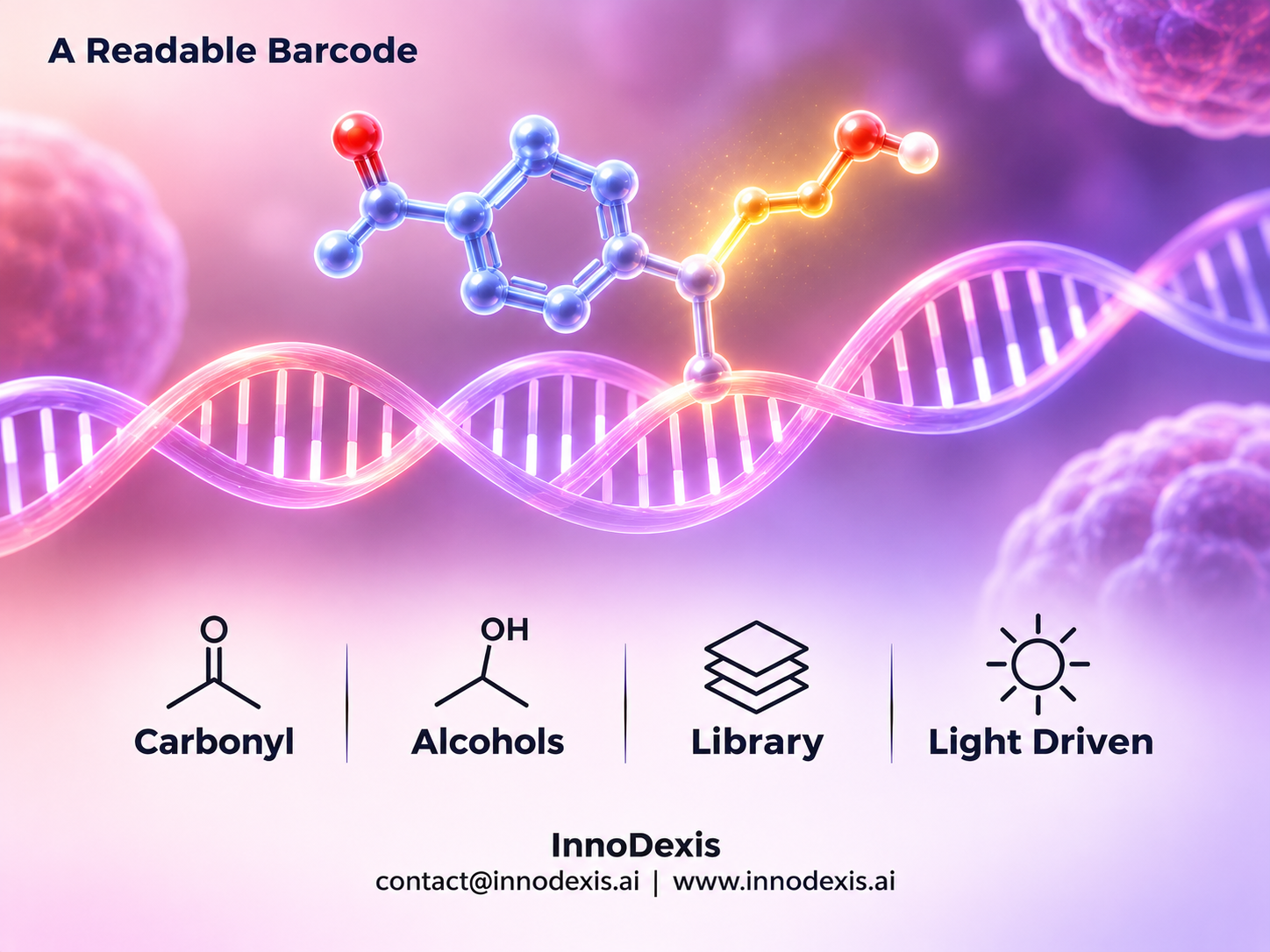
InnoDexis has published its latest Innovation Intelligence Report covering DNA-encoded library chemistry for drug discovery, analyzing one innovation from Spain, published on 27 October 2026. The report reveals that researchers at CiQUS, in collaboration with AstraZeneca, developed a light- and catalyst-driven reaction that links carbonyl compounds with molecules containing double bonds at room temperature, was demonstrated on 59-unit DNA fragments, and preserved DNA readability with very low levels of sequence change, broadening the range of chemistry available for building pharmaceutical screening libraries.
Key Findings
The reaction runs at room temperature without strongly reducing conditions. It couples carbonyl compounds such as aldehydes and ketones with molecules containing double bonds, generating aliphatic alcohols while preserving sensitive chemical structures, which matters because standard coupling methods rely on strongly reducing conditions that damage DNA. The scope is broad, incorporating versatile aliphatic alcohols.
The method was demonstrated on 59-unit DNA fragments, which were largely preserved and kept their readability, with very low levels of sequence change. Barcode DNA integrity is what allows a library to be read after screening, so this result is the central evidence that the chemistry is compatible with DNA-encoded libraries.
The strategy is described as first-of-kind: a reductive coupling of carbonyls through nucleophilic photoactivation that is compatible with DNA-encoded libraries. By broadening the range of DNA-compatible reactions, it lets pharmaceutical researchers build larger and more structurally diverse libraries for target screening.
AstraZeneca collaborated to assess the method’s suitability for drug-discovery applications and to test longer DNA fragments. Commercial readiness is rated low to medium, because the method has been verified in academic laboratory settings and collaborative bench trials but still needs wider adoption in automated screening pipelines.
Scalability for screening operations is rated high, since the protocol runs at room temperature with broad functional group tolerance. Adoption does require light-driven reactor equipment in standard chemical synthesis workflows, and integration into library synthesis platforms is estimated at 1 to 3 years.
Strategic Insight and Trend Analysis
The dominant trend in this research is the expansion of the chemistry available to DNA-encoded libraries. The DNA barcode has long limited which reactions can be used, because harsh conditions damage it. Replacing strongly reducing conditions with light and a catalyst at room temperature removes a constraint that has restricted library design, and it does so while keeping the barcode readable.
The significance is that library diversity drives what a screening campaign can find. Broadening the scope of DNA-compatible reactions allows pharmaceutical researchers to synthesize more structurally diverse libraries, and photocatalytic methods unlock chemical space that was previously inaccessible to screening collections. If adopted, the method could displace traditional harsh reductive coupling protocols used in combinatorial chemistry.
The evidence still has boundaries. Validation is limited to early lab-scale fragment testing, and long-term stability and scope across diverse macromolecular targets in industrial screening settings remain open. Ensuring zero sequence mutation across massive, ultra-diverse libraries is a stated challenge, and potential side reactions or trace mutations on non-standard DNA sequences are the main technical risk, although overall technical risk is low.
Competition and integration will shape the outcome. Established DNA-encoded library synthesis methods, competing hit-identification technologies, and alternative non-chemical DNA modification methods all remain in play, and market adoption depends on integration into existing drug-discovery workflows. Direct collaboration with AstraZeneca is described as strong proof of a lab-to-industry transition.
Global and Industry Implications
For corporates and R&D teams in pharmaceuticals and biotechnology, the method is directly transferable to pharmaceutical chemical synthesis and high-throughput drug screening laboratories. Broad adoption by contract research organizations and biotech screening platforms is the identified opportunity, and the practical requirement is adopting light-driven reactor equipment. Fine chemicals and agrochemicals are named as secondary markets, and applications include automated synthesis of specialized biomolecules and expanded fragment-based drug design.
For investors and capital allocators, and for pharma strategists, the guidance is to monitor photocatalytic DNA-encoded library methods because they unlock previously inaccessible chemical space for screening collections. Commercial licensing of library synthesis protocols to pharmaceutical screening partners is the identified route. Readiness is low to medium, integration is estimated at 1 to 3 years, and competition from established methods is the principal risk.
For policymakers and national innovation bodies, the work is an academic-industry collaboration supported by programmes that include the Galicia FEDER 2021–2027 Programme and the María de Maeztu Unit of Excellence accreditation. No regulatory approval is apparent for the chemistry itself, because regulatory standards apply primarily to downstream drug candidates rather than to chemistry tools.
InnoDexis Statement
“Replacing harsh reductive conditions with room-temperature photochemistry that leaves DNA barcodes readable turns library chemistry from a constraint into an expandable design space, and adoption in screening pipelines will decide its reach,” noted InnoDexis in its latest intelligence report.
Conclusion
The next milestones to watch are scale-up of synthetic library size and testing against functional biological target panels in high-throughput screening, evaluation on a wider spectrum of complex pharmaceutical targets, and scaling of reaction volumes for industrial library generation. Further evaluation with additional pharmaceutical drug-discovery platforms will show whether the early AstraZeneca results broaden into wider adoption. InnoDexis will continue to track photocatalysis in organic synthesis, DNA-encoded library expansion and high-throughput drug screening as this field develops. The complete DNA-Encoded Library Photocatalysis Innovation Intelligence Report is available to InnoDexis subscribers and enterprise clients.
About InnoDexis
InnoDexis is a real-time innovation intelligence platform connecting scientific discovery to commercial opportunity. Powered by InnoGraph, its proprietary innovation knowledge graph, the platform maps technologies across the entire lifecycle, from early-stage research (TRL 1) to market deployment (TRL 9), connecting researchers, institutions, startups, companies, products and emerging opportunities.
Covering 40+ specialised industry segments and 360 technology areas, InnoDexis delivers innovation tracking, research discovery, product and startup intelligence, investment insights, and AI-powered reports. Its mission is to bridge the gap between scientific discovery and real-world impact.
InnoDexis — From Lab to Market: Real-Time Innovation Intelligence.