PFAS Innovation Splits Four Ways at Near-Equal Weight as Zero of 112 Records Address Concentrate Disposal
A cross-stream analysis of 112 PFAS records finds destruction, capture, detection and substitution sitting within eight points of each other with no dominant approach, while capture is fully deployed at TRL 8–9 and produces a waste stream the corpus does not address at all.
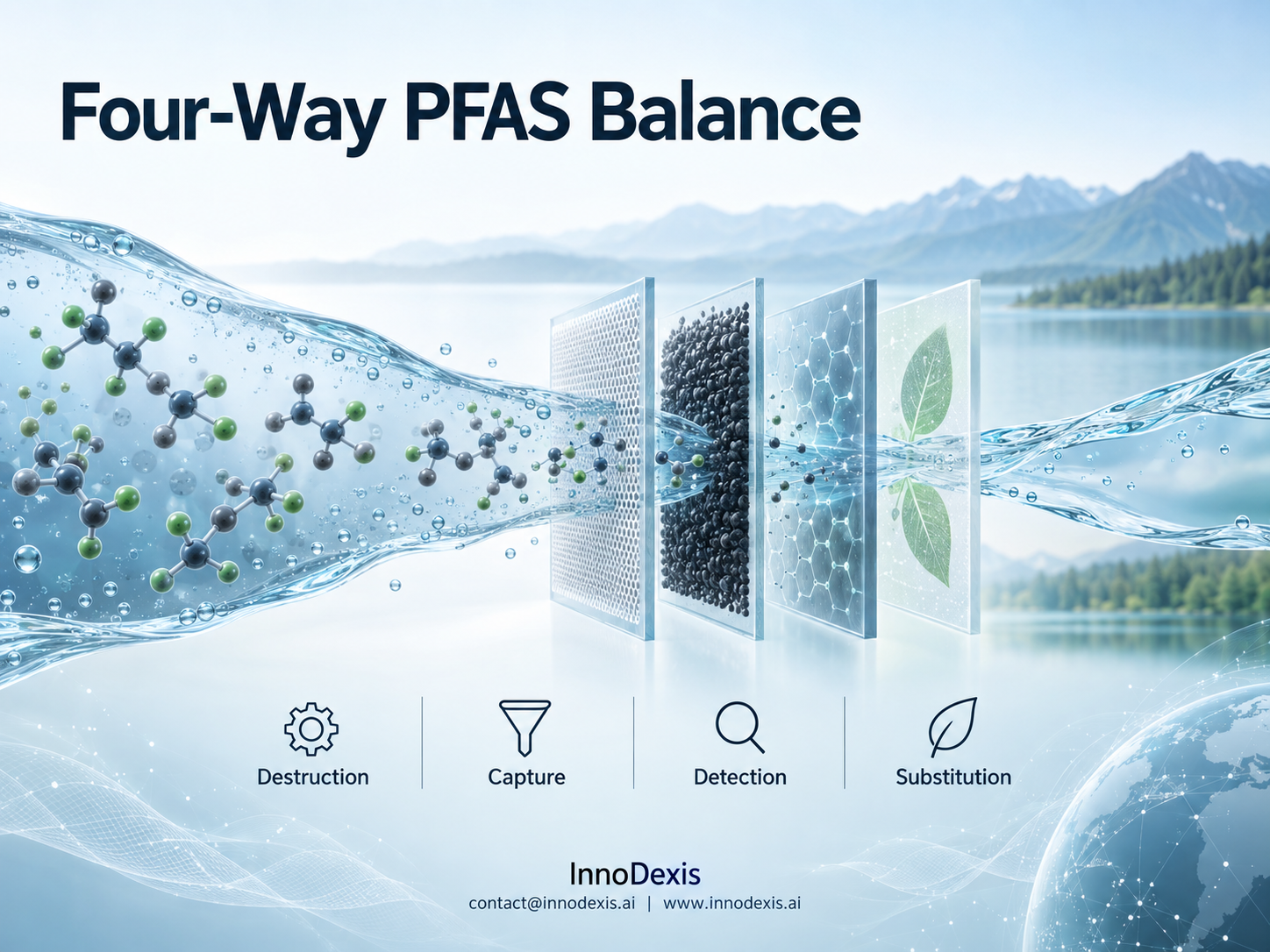
InnoDexis has published its latest Innovation Intelligence Report covering PFAS destruction, capture, detection and substitution, analyzing 112 screened records — 104 research records across the complete thirteen-month window and 8 corporate records from 11 May through 21 August 2026 — across 18 countries. The report reveals that four technical approaches sit at near-equal weight, with destruction at 26.8 percent, capture at 25.9 percent, detection at 22.3 percent and substitution at 18.8 percent, and that capture technology is fully deployed commercially while the concentrated PFAS waste it produces has no corresponding disposal category in either stream.
Key Findings
No approach dominates this corpus. Destruction and mineralisation leads narrowly at 30 records, followed by separation and capture at 29, detection and measurement at 25, and PFAS-free substitution at 21 — a spread InnoDexis has not observed in any comparably sized industrial sector analysed this year.
The corporate layer, though limited to eight records, is unusually informative: six of the eight sit at TRL 8 or 9, and their mean InnoDexis score of 6.75 is the highest recorded in any 2026 cross-stream edition. Four of the eight are capture or containment technologies — including an ion-exchange resin manufacturer expanding capacity and an in-situ groundwater barrier that won a national remediation award — while only two concern destruction and one concerns substitution.
The research-side maturity picture is early by contrast: where commercial readiness resolves, 12 records rate Low against 8 Medium and just 1 High. This produces a maturity barbell — a small number of technologies fully deployed, with almost nothing at intermediate stages behind them.
Destruction is arriving at first commercial scale rather than at volume. The first commercial-scale PFAS destruction facility in the United States is operating, and a second destruction platform is positioned explicitly on cost and performance — evidence that the technical question of whether destruction works has given way to whether it works economically.
No record in either stream addresses what happens to the concentrated PFAS that capture technologies produce. The waste, residuals and disposal category returned zero records from a possible 112, despite deployed capture technology generating a loaded resin, spent carbon or concentrated foam by design.
Strategic Insight and Trend Analysis
The defining structural fact of this corpus is that it has not converged where every other industrial sector InnoDexis analysed this year did. Crude oil concentrated in separation chemistry; critical minerals concentrated in separation and recovery; unmanned systems concentrated in counter-systems. PFAS innovation is spread almost evenly across four distinct approaches, and the corpus does not indicate whether this reflects deliberate segmentation by application or unresolved technical uncertainty that will eventually collapse toward one or two winners.
Underneath that spread sits a sequencing problem more urgent than the convergence question. Capture is commercially deployed — certified filtration systems, an award-winning groundwater barrier, resin capacity actively expanding, all at TRL 8 or 9. Destruction is arriving behind it, at first-commercial-scale rather than at volume. The step between them, disposing of the concentrate capture produces, is not merely underdeveloped; it does not exist as a category in either the research or corporate stream, meaning the sector is industrializing the half of the problem that creates a new waste stream faster than the half that would end it.
Substitution behaves differently here than in the critical minerals sector analysed in the same reporting period. There, substitution returned seven records and zero commercial presence; here it returns 21 records and a commercial product already at TRL 5. The distinction appears to be regulatory: PFAS substitution is being pulled forward by prohibition rather than by a price signal, and prohibition moves faster than economics alone would.
Global and Industry Implications
For corporates and R&D teams, the unoccupied position in this corpus is the handover between capture and destruction — moving concentrate from one to the other is a logistics and infrastructure question with no research or commercial activity addressing it, and it is being created by the sector's own deployment success rather than by neglect.
For investors and capital allocators, this corpus cannot support a capital-flow thesis at eight commercial records and funding fields resolving on only 3.1 percent of research records; the more reliable read is structural — demand is regulation-forced and dated rather than cyclical, deployed products are predominantly recurring-revenue materials and chemistry rather than one-time equipment, and destruction capacity should be treated as the scarce asset in the chain.
For policymakers and national innovation bodies, detection and measurement at 22.3 percent of the corpus reflects a regulatory regime enforcing limits at parts per trillion, and work on total organic fluorine and non-targeted analysis signals that regulation may shift from named compounds to total fluorinated load, which would expand liability and invalidate compliance strategies built around a fixed analyte list.
InnoDexis Statement
"Capture is being industrialized faster than destruction, and the concentrate it produces has nowhere documented to go — that is not a market waiting to be discovered, it is a liability being manufactured on a schedule," noted InnoDexis in its latest intelligence report.
Conclusion
As a research-led edition with a limited corporate sample, this report's findings on commercial distribution should be read directionally rather than statistically; the signals worth tracking are whether a second commercial-scale destruction facility is announced within twelve months, whether the foam fractionation sewage trial succeeds at municipal scale, whether regulation shifts toward total organic fluorine measurement, and whether any record addressing concentrate disposal appears in either stream. Each is a specific, observable test of whether this field's four-way split resolves toward convergence or permanent segmentation. The complete Four Ways Out: PFAS Innovation Landscape Report is available to InnoDexis subscribers and enterprise clients.
About InnoDexis
InnoDexis is a global Innovation Intelligence platform that tracks, analyzes, and interprets breakthrough innovations, prototypes, and emerging technologies across industries and countries. Its intelligence helps corporates, investors, and policymakers understand the true structure and direction of global innovation. Learn more at innodexis.ai.