Personalized Cancer Vaccine Platform Built on M13 Bacteriophage Shows Greater Tumor Protection at 35% Antigen Density Than 6% in MIT Mouse Models
MIT engineers genetically tuned antigen density on an M13 bacteriophage scaffold that activates TLR9 without external adjuvants, and higher-density formulations strengthened T cell responses and prevented melanoma and colon tumors in mice.
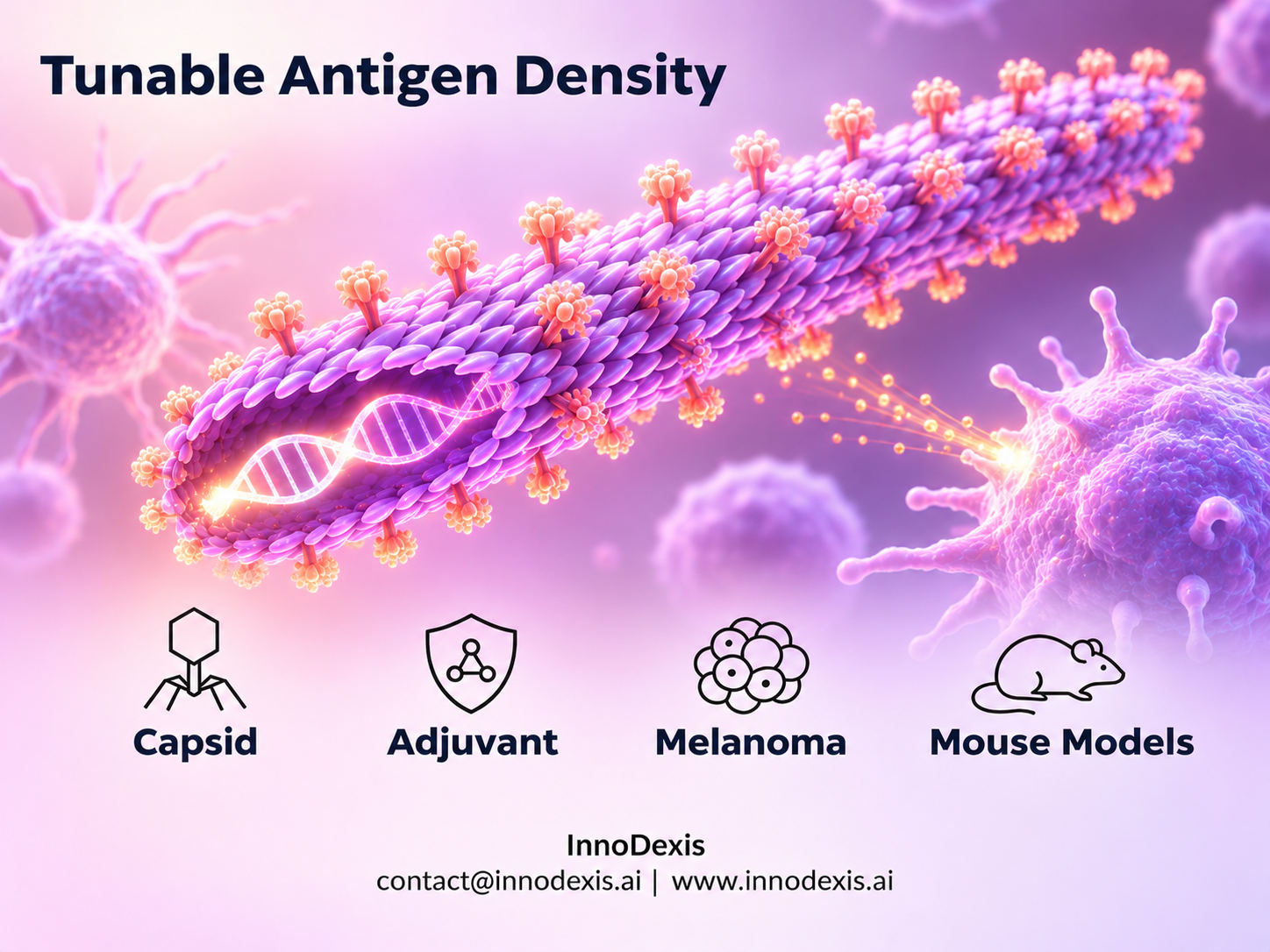
InnoDexis has published its latest Innovation Intelligence Report covering personalized cancer vaccine delivery, analyzing one innovation from the United States, published on 30 October 2026. The report reveals that engineers at the Massachusetts Institute of Technology (MIT) developed a customizable vaccine delivery vehicle based on an engineered M13 bacteriophage, with antigen densities from 6% to 70% set genetically, and that a 35% antigen density gave greater protection against tumor development than 6% while increasing T cell generation in mouse models of melanoma and colon cancer.
Key Findings
Antigen density on the vaccine vehicle can be set genetically. Modifying the viral capsid protein pVIII and adjusting DNA sequences produced antigen densities from 6% to 70%, which gives precise control over the density and pattern of antigens on the viral capsid. This control is the central design advantage of the platform.
A 35% antigen density gave greater protection against tumor development than 6% in mouse models. Higher-density formulations also increased T cell generation against the target antigen and increased uptake by dendritic cells, and they prevented the development of melanoma and colon tumors.
The vehicle is self-adjuvanting. The intrinsic single-stranded viral DNA engages the TLR9 pathway, which removes the need for external chemical adjuvants such as aluminum hydroxide and reduces formulation complexity compared with vaccines that rely on them.
The platform is modular. Target antigens can be swapped rapidly, which supports delivery of patient-specific neoantigens, and manufacturing relies on biological self-assembly of the engineered M13 bacteriophage, offering scalable fermentation production if regulatory standards for recombinant viral vectors are met.
The work is preclinical. Testing so far was in mouse models, commercial readiness is rated low, and the primary data show tumor prevention rather than regression of established tumors. Practical clinical use is estimated at 5 to 10 years away, building on more than 20 years of M13 bacteriophage work in the Belcher lab. The platform is positioned as a preclinical modular vehicle for targeted cancer vaccine delivery.
Strategic Insight and Trend Analysis
The dominant trend in this research is the treatment of antigen density as a tunable design variable inside a single genetically encoded vaccine vehicle. The engineered M13 bacteriophage carries the antigen, controls how densely it is displayed, and supplies its own adjuvant through single-stranded DNA that activates TLR9. Delivery, display and adjuvant function therefore sit in one self-assembling construct instead of separate formulation and adjuvanting steps.
This matters because the market is moving toward individualised immunotherapies that target patient-specific neoantigens. A platform that swaps antigens in a modular way and removes external adjuvants could shorten the formulation work behind personalized vaccines, and it is positioned as a possible replacement for complex multi-component chemical formulation.
The evidence also has clear limits. The mouse data show prevention of tumor development, and efficacy against large, established tumors and in human clinical settings is unproven. Expression efficiency may vary for larger or more complex human tumor antigens, and repeated dosing could trigger neutralising immune responses against the viral vector itself.
Competition is established, including mRNA and peptide-based personalized vaccine platforms and non-viral delivery systems such as lipid nanoparticles. The platform is currently moving from basic virus-scaffolding physics and engineering into early translational oncology research. Alberto Danielli of the University of Bologna says he looks forward to seeing whether the platform works against established tumors and displays additional antigens with comparable efficacy, and describes the work as improving the platform’s translational potential.
Global and Industry Implications
For corporates and R&D teams, the platform offers direct licensing or spinout potential for biotechnology firms specializing in personalized cancer vaccines and viral-vector platforms. The next steps are IND-enabling studies, scale-up manufacturing feasibility evaluation, and testing display capacity and immune response against a wider array of human neoantigens. Partnerships with biopharmaceutical companies developing personalized immunotherapies are identified as a route to clinical translation.
For investors and capital allocators, the profile is early and long-dated. The technology is preclinical, commercial readiness is low, practical clinical use is 5 to 10 years away, and translating preclinical nanomedicine concepts through clinical trials is costly. Its reduced formulation complexity makes it a candidate for strategic licensing, set against competition from mRNA, peptide and lipid nanoparticle platforms.
For policymakers and national innovation bodies, the regulatory path is the main constraint. FDA Investigational New Drug (IND) approval is required before human clinical testing, and customizable, patient-specific engineered viral vectors face complex approval hurdles. The MIT and University of Bologna collaboration shows how cross-institution research feeds early translational oncology.
InnoDexis Statement
“Treating antigen density as a genetically tunable design variable folds delivery, display and adjuvant function into one self-assembling vehicle, and evidence against established tumors will decide whether the platform moves beyond prevention,” noted InnoDexis in its latest intelligence report.
Conclusion
The next milestones to watch are IND-enabling studies, scale-up manufacturing feasibility evaluation, testing of display capacity and immune response against a wider array of human neoantigens, and evaluation of efficacy against established tumors in preclinical models. Practical clinical use is estimated at 5 to 10 years away, so progress on these steps will show whether the platform moves from tumor prevention in mice toward human translation. InnoDexis will continue to track cancer nanomedicine, personalized cancer vaccines and bacteriophage platforms as this field develops. The complete Personalized Cancer Vaccine Platform Innovation Intelligence Report is available to InnoDexis subscribers and enterprise clients.
About InnoDexis
InnoDexis is a real-time innovation intelligence platform connecting scientific discovery to commercial opportunity. Powered by InnoGraph, its proprietary innovation knowledge graph, the platform maps technologies across the entire lifecycle, from early-stage research (TRL 1) to market deployment (TRL 9), connecting researchers, institutions, startups, companies, products and emerging opportunities.
Covering 40+ specialised industry segments and 360 technology areas, InnoDexis delivers innovation tracking, research discovery, product and startup intelligence, investment insights, and AI-powered reports. Its mission is to bridge the gap between scientific discovery and real-world impact.
InnoDexis — From Lab to Market: Real-Time Innovation Intelligence.