Optogenetic Retuning of Brain Circuits Reduces Motor Symptoms in Huntington's Disease as Circuit Dysfunction Emerges as a Validated Intervention Target
Researchers from Germany and the United States used targeted light-pulse stimulation of VIP inhibitory interneurons to restore healthy corticostriatal circuit activity and markedly reduce motor impairments in a Huntington's disease model.
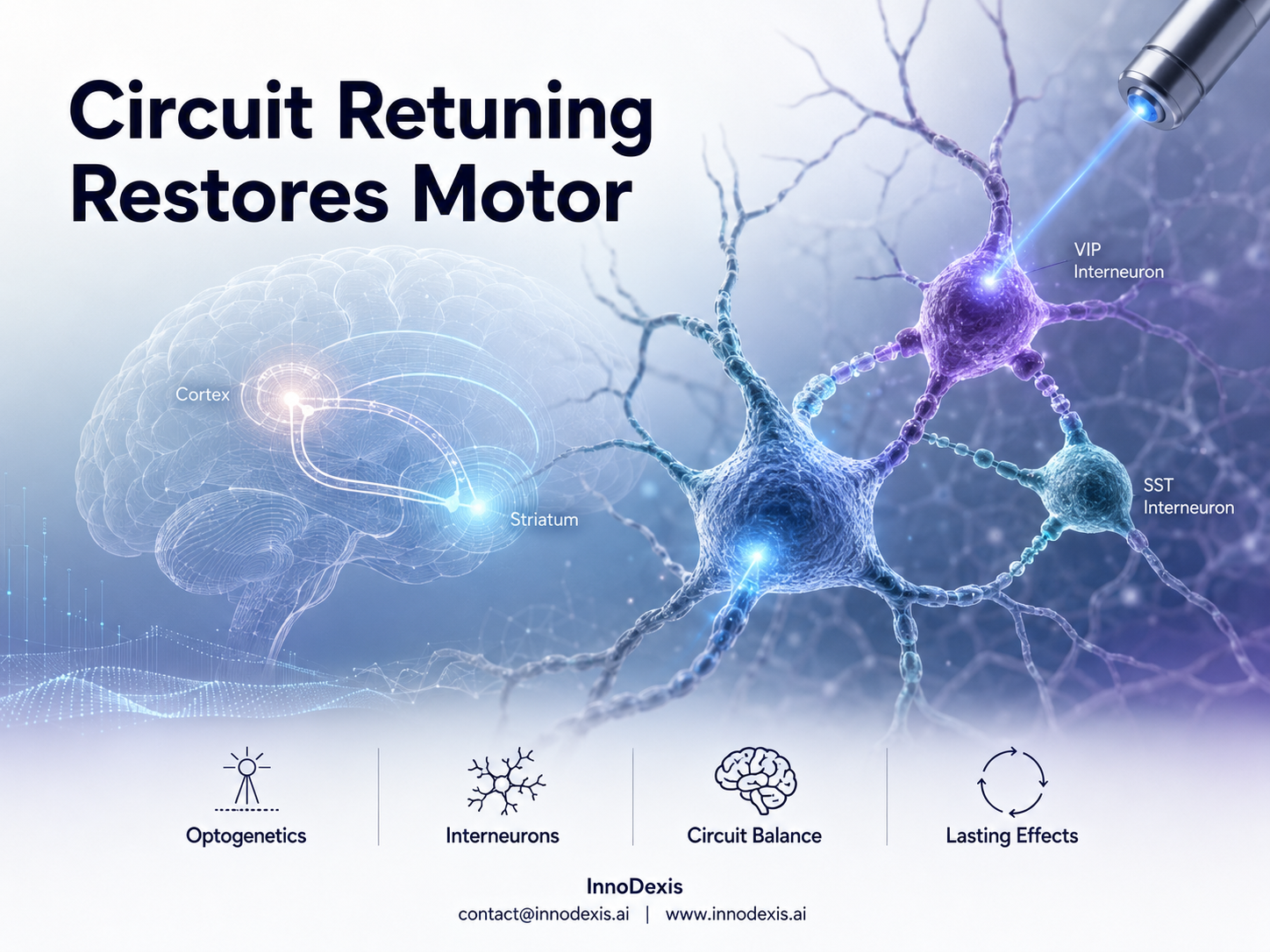
InnoDexis has published its latest Innovation Intelligence Report covering neuroscience and circuit-level intervention research, analyzing a high-significance innovation developed across institutions in Germany and the United States. The report reveals that researchers from the Max Planck Institute, Julius-Maximilians-Universität Würzburg, and UC San Diego have demonstrated that optogenetic stimulation of VIP inhibitory interneurons can restore healthy brain circuit activity and significantly reduce motor symptoms in Huntington's disease — establishing circuit dysfunction as a validated and targetable driver of motor impairment, distinct from and complementary to neurodegeneration-focused approaches.
Key Findings
Motor function improved significantly following targeted VIP interneuron stimulation, and disease-typical hindlimb dragging was markedly reduced after optogenetic intervention. These outcomes demonstrate that motor symptoms in Huntington's disease can be meaningfully addressed through circuit-level rebalancing, without requiring direct intervention at the level of neuronal cell death — the primary focus of most existing Huntington's disease research.
Corticostriatal neuron activity returned to healthy control levels following the optogenetic intervention. This finding is structurally significant because it confirms that the restoration of motor function observed behaviourally corresponds to a measurable normalisation of neural circuit activity — establishing a direct mechanistic link between interneuron stimulation, circuit rebalancing, and symptomatic improvement.
The research identified an over-inhibition cascade involving VIP, SST, and corticostriatal neurons as the key driver of motor dysfunction in the disease model studied. This cascade represents a previously undercharacterised mechanism by which circuit imbalance — rather than cell death alone — produces motor symptoms. Identifying the specific inhibitory pathway involved provides a defined mechanistic target for future therapeutic development.
The effects of the targeted stimulation lasted beyond the period of direct intervention. This durability signal is important for translational relevance: an intervention whose benefits do not persist would face significant limitations as a therapeutic strategy. The lasting effects suggest that targeted interneuron activation can reactivate mechanisms of learning and plasticity in the affected circuit, rather than producing only transient symptomatic relief.
Circuit dysfunction is now a validated intervention target in Huntington's disease based on these findings. Prior to this work, research in the field had concentrated predominantly on neurodegeneration as the primary driver of motor symptoms. The demonstration that rebalancing inhibitory interneuron activity reduces motor impairments independently of cell-death mechanisms expands the intervention landscape for the disease and potentially for other conditions driven by inhibitory imbalances.
Strategic Insight and Trend Analysis
The dominant strategic signal from this dataset is a validated shift in the mechanistic understanding of Huntington's disease — from neurodegeneration as the singular target to circuit dysfunction as a parallel, independently addressable driver of motor symptoms. This reframing has direct consequences for how the field approaches both research prioritisation and therapeutic development.
Huntington's disease has historically been approached as a cell-death problem, with therapeutic strategies focused on slowing or preventing the loss of neurons. This framework has defined the ceiling of intervention: once neurons are lost, the pathway to symptomatic improvement through cell-death-focused approaches narrows significantly. The circuit-retuning approach demonstrated here operates at a different layer of biology — one that remains accessible even in a disease state characterised by neurodegeneration, because the circuit dysfunction driving symptoms can be addressed through selective interneuron activation rather than neuroprotection alone.
The identification of the VIP–SST–CStr over-inhibition cascade as the key mechanistic driver provides a level of specificity that strengthens the translational case. Therapeutic strategies built on vague circuit concepts face significant development challenges; a defined inhibitory cascade with identified cellular components offers a more tractable pathway toward intervention design.
The durability of effects and the reactivation of plasticity mechanisms further distinguish this approach from symptomatic treatments that require continuous administration for maintained benefit. If the underlying plasticity signal proves robust in more complex biological contexts, it would meaningfully differentiate circuit-retuning strategies from existing symptomatic management approaches in neurodegenerative disease.
The potential extension of this strategy to other conditions driven by inhibitory imbalances — as noted in the dataset — represents a broader strategic implication for the field, contingent on validation in human models.
Global and Industry Implications
For corporates and R&D teams in biotechnology and pharmaceutical research, the findings introduce circuit dysfunction as a validated biological target in Huntington's disease alongside existing neurodegeneration-focused programmes. Organisations with active Huntington's pipelines should evaluate whether circuit-level intervention strategies — particularly those targeting inhibitory interneuron populations — represent a complementary or alternative development pathway to current approaches.
For investors and capital allocators, the research signals an expanding intervention landscape in Huntington's disease and potentially in neurodegenerative conditions more broadly. The translational timeline remains early-stage, as validation in human models has not yet been demonstrated. However, the mechanistic specificity of the VIP–SST–CStr cascade finding and the durability of observed effects represent positive indicators for the tractability of this approach as a development target.
For policymakers and national innovation bodies, the cross-institutional collaboration between Max Planck, Julius-Maximilians-Universität Würzburg, and UC San Diego illustrates the value of transnational research partnerships in advancing mechanistic neuroscience. Sustained public funding for circuit-level neuroscience research — which operates on longer timelines than translational programmes — is a prerequisite for discoveries of this type.
InnoDexis Statement
"The identification of a specific over-inhibition cascade as the driver of motor symptoms in Huntington's disease, and its successful correction through targeted interneuron stimulation, shifts the intervention framework for the condition from neurodegeneration alone to circuit-level rebalancing — a structurally distinct and complementary therapeutic direction," noted InnoDexis in its latest intelligence report.
Conclusion
As neuroscience research increasingly validates circuit dysfunction as an independent driver of symptoms in neurodegenerative disease, the therapeutic landscape for conditions like Huntington's disease is expanding beyond cell-death-focused approaches. The demonstration that optogenetic retuning of VIP inhibitory interneurons restores healthy circuit activity and reduces motor impairments with lasting effect positions circuit-level intervention as a credible and distinct research direction. InnoDexis will continue to monitor developments in optogenetics, inhibitory interneuron biology, and circuit-based therapeutic strategies across neurodegenerative disease. The complete Neuroscience Circuit Intervention Intelligence Report is available to InnoDexis subscribers and enterprise clients.
About InnoDexis
InnoDexis is a global Innovation Intelligence platform that tracks, analyzes, and interprets breakthrough innovations, prototypes, and emerging technologies across industries and countries. Its intelligence helps corporates, investors, and policymakers understand the true structure and direction of global innovation. Learn more at innodexis.ai.