Open Biological Infrastructure Expands as OpenBind Releases AI-Ready Protein–Drug Dataset and Predictive Model
The OpenBind initiative at Diamond Light Source is positioning experimental biological infrastructure as a foundational layer for AI-driven drug discovery.
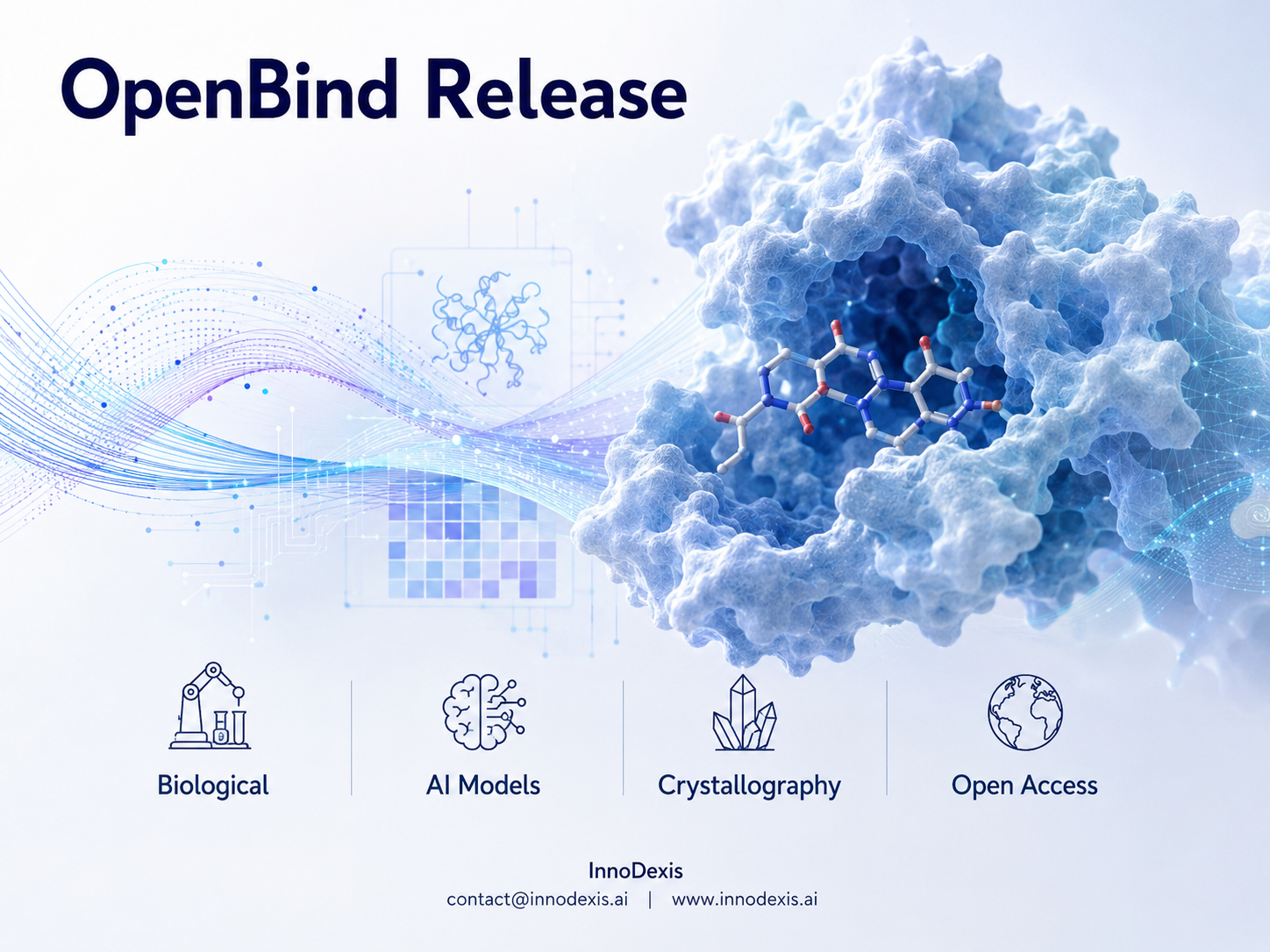
InnoDexis has published its latest Innovation Intelligence Report covering artificial intelligence-driven drug discovery and biological infrastructure. The report analyzes the first public release from the OpenBind initiative at Diamond Light Source, which combines automated chemistry, crystallography, and AI model training pipelines into a unified system. The findings reveal that large-scale, standardized experimental datasets may become a critical infrastructure layer for computational therapeutics, particularly as AI drug discovery systems increasingly depend on reliable biological training data.
Key Findings
The OpenBind initiative generated 800 high-quality protein–drug binding measurements within seven months. This level of experimental throughput indicates the growing capability to produce structured biological datasets at a scale suitable for AI training and validation.
The initiative also released a predictive AI model, OpenBindv1, alongside the experimental dataset. The simultaneous availability of both data and predictive systems reflects an integrated approach in which infrastructure development extends beyond data generation to include model deployment and benchmarking.
All datasets and models have been made publicly accessible to researchers worldwide. This open-access structure positions the initiative as part of a broader movement toward shared scientific infrastructure, where foundational biological resources are intended to support distributed innovation across academia, biotechnology, and pharmaceutical research.
The platform integrates automated chemistry workflows, crystallography systems, and AI training pipelines into a unified operational framework. This convergence reduces fragmentation between data generation, structural analysis, and computational modeling processes.
Researchers associated with the initiative describe the ambition as creating an equivalent of the Protein Data Bank for AI-era drug discovery. This framing suggests a long-term objective of establishing continuously updated, standardized biological infrastructure capable of supporting large-scale therapeutic model development.
Strategic Insight and Trend Analysis
The findings from the OpenBind initiative indicate that AI-driven drug discovery is increasingly constrained not only by algorithmic capability, but by the availability of reliable, standardized experimental data. As computational models become more advanced, the quality, consistency, and scalability of biological datasets are emerging as determining factors in model performance and reproducibility.
The release of both an experimental dataset and a predictive model reflects a transition from isolated AI applications toward infrastructure-centric therapeutic development. In this framework, the strategic advantage may shift from proprietary algorithms alone to the ability to continuously generate validated biological training data at industrial scale.
The integration of automated chemistry, crystallography, and AI pipelines further suggests that future drug discovery systems may operate as interconnected data-generation ecosystems rather than standalone computational tools. This reduces dependence on fragmented datasets and introduces a more continuous relationship between experimentation and model refinement.
The open-access nature of the initiative also signals a structural shift in scientific collaboration. By making datasets and models publicly available, the platform lowers barriers for researchers and organizations seeking to develop or validate therapeutic AI systems. This could accelerate distributed innovation while also increasing competitive pressure on organizations relying primarily on closed proprietary datasets.
Collectively, the data indicates that biological infrastructure may become as strategically significant as AI models themselves. The organizations capable of producing trusted, continuously updated experimental datasets could play a defining role in shaping the next phase of computational therapeutics.
Global and Industry Implications
For corporates and R&D teams, the findings highlight the growing importance of integrated biological infrastructure in AI-driven pharmaceutical development. Organizations may increasingly prioritize access to standardized experimental datasets and automated validation systems alongside computational capabilities.
For investors and capital allocators, the emergence of open biological infrastructure introduces a new category of strategic assets within AI therapeutics. Infrastructure platforms capable of generating scalable, high-quality biological data may become foundational components of long-term drug discovery ecosystems.
For policymakers and national innovation bodies, initiatives such as OpenBind demonstrate how open scientific infrastructure can support broader research participation and accelerate therapeutic development capacity. Supporting shared biological infrastructure may become a strategic priority for strengthening national and regional biotechnology competitiveness.
InnoDexis Statement
“The OpenBind initiative indicates that the next phase of AI-driven therapeutics may be shaped not only by advances in algorithms, but by the availability of scalable, trusted biological infrastructure capable of continuously generating high-quality experimental data,” noted InnoDexis in its latest intelligence report.
Conclusion
The OpenBind release from Diamond Light Source reflects a broader transition toward infrastructure-led AI drug discovery. As experimental datasets, predictive models, and automated laboratory systems become increasingly interconnected, the competitive landscape in computational therapeutics may depend on who controls the most reliable and scalable biological data ecosystems. Monitoring the evolution of open scientific infrastructure will likely be critical in understanding the future direction of AI-enabled pharmaceutical innovation. The complete AI Drug Discovery and Biological Infrastructure Intelligence Report is available to InnoDexis subscribers and enterprise clients.
About InnoDexis
InnoDexis is a global Innovation Intelligence platform that tracks, analyzes, and interprets breakthrough innovations, prototypes, and emerging technologies across industries and countries. Its intelligence helps corporates, investors, and policymakers understand the true structure and direction of global innovation. Learn more at innodexis.ai.