NUS Researchers Engineer Dual-Colour Light-Controlled Yeast to Replace Chemical Inducers in Multi-Pathway Biomanufacturing
A single yeast strain engineered to respond independently to red and blue light establishes a programmable, chemical-free platform for controlling multiple metabolic pathways simultaneously in biomanufacturing.
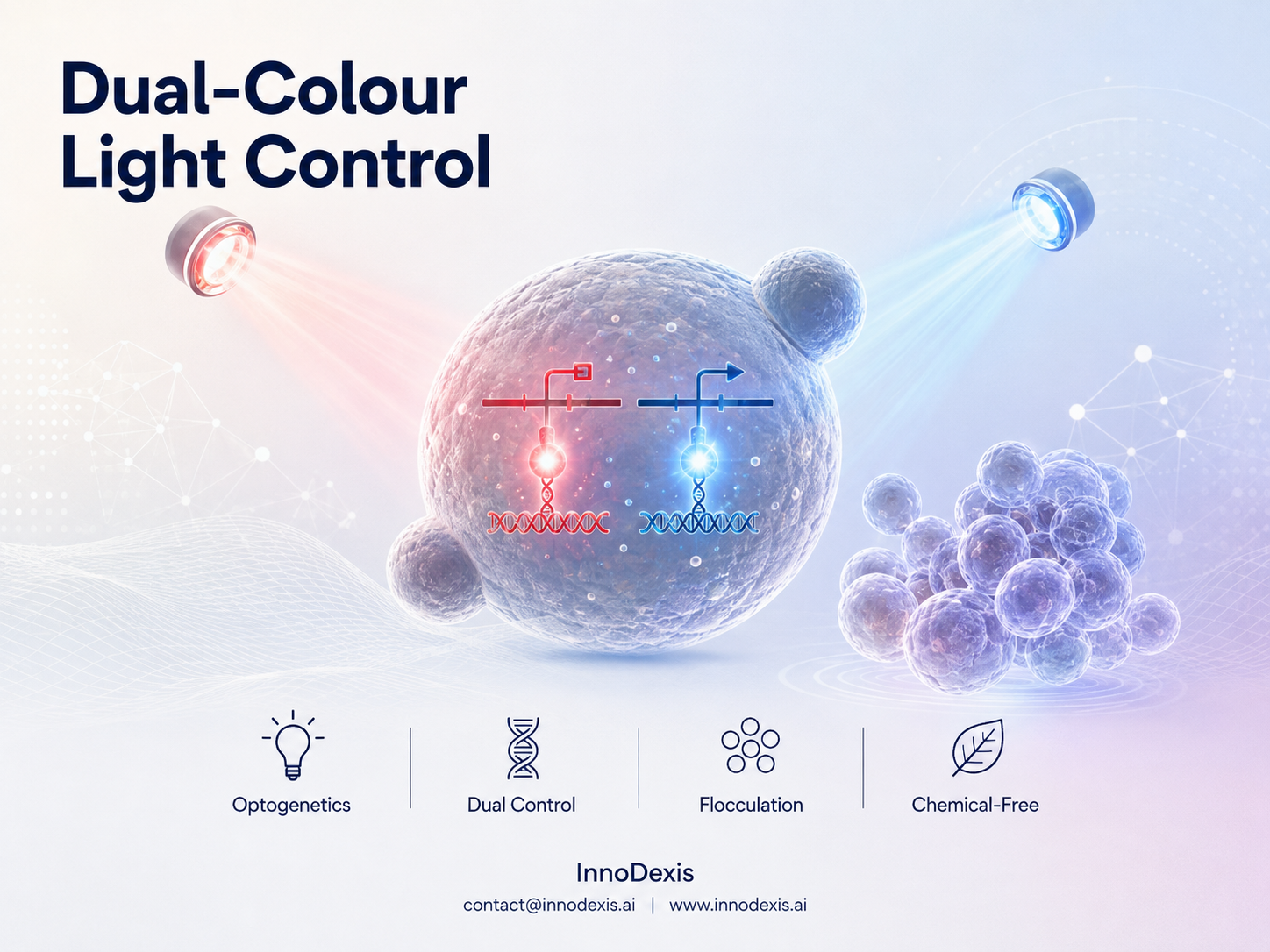
InnoDexis has published its latest Innovation Intelligence Report covering synthetic biology and optogenetics, analyzing a high-significance innovation from the National University of Singapore. The report reveals that researchers from NUS have engineered baker's yeast to independently respond to red and blue light using a system designated y-iLight, achieving dual-channel gene expression control in a single organism without cross-interference between the two light channels. The innovation eliminates dependence on chemical inducers for multi-pathway control and introduces light-triggered cell separation as a mechanism for reducing downstream purification costs in biomanufacturing.
Key Findings
A single yeast strain was engineered to respond independently to red and blue light without cross-interference between the two channels. This dual-channel control was achieved through modular protein engineering, which specifically eliminated the crosstalk that the blue-light system would otherwise exert on the red-light pathway. The absence of cross-interference is the foundational technical requirement for independent multi-pathway control in a single organism — without it, the two channels cannot be operated as genuinely separate inputs.
Blue-light crosstalk on the red-light system was eliminated through modular protein fusion, a design choice that reflects the precision achievable through protein engineering at the pathway architecture level. This approach establishes a replicable engineering logic for extending independent light-channel control beyond two colours, with implications for more complex multi-pathway systems in future iterations of the platform.
Red light-triggered flocculation via the FLO1 gene enables light-activated cell separation within the same engineered strain. Cell separation is a significant downstream processing cost in biomanufacturing, and the integration of a light-triggered separation mechanism directly into the production organism — without requiring additional chemical inputs — represents a consolidation of production and purification functions into a single controllable system.
The y-iLight system operates without added external cofactors beyond those naturally present in yeast. This is a practically significant constraint satisfaction: optogenetic systems in other organisms frequently require the addition of light-sensitive cofactors that are not natively synthesised, adding cost and complexity to bioprocess design. The native cofactor sufficiency of the yeast system removes this barrier for industrial deployment.
Chemical inducers — the conventional mechanism for controlling multiple metabolic pathways in yeast bioprocessing — introduce cost, contamination risk, and limited precision relative to light-based control. The y-iLight platform replaces chemical inducers with programmable colour signals that activate pathways independently, establishing a cleaner and more precisely controllable alternative for multi-step biomanufacturing processes.
Strategic Insight and Trend Analysis
The y-iLight platform represents a convergence of two structural trends in advanced biomanufacturing: the replacement of chemical process controls with physical signal-based alternatives, and the consolidation of multiple bioprocess functions — production, pathway regulation, and cell separation — into single engineered organisms.
Chemical inducers have been the standard mechanism for controlling gene expression in industrial fermentation for decades. Their limitations — cost, contamination risk, limited spatial and temporal precision — are well understood but have persisted because no sufficiently robust alternative existed for multi-pathway control in a single organism. The y-iLight system addresses this directly by demonstrating that two independent pathways can be controlled with colour-differentiated light signals in a single production strain, without cross-interference and without external cofactor addition.
The integration of light-triggered cell separation via FLO1 flocculation is strategically significant beyond its immediate functional utility. It demonstrates that optogenetic control can extend beyond gene expression regulation into physical bioprocess operations — a conceptual expansion that points toward future systems where light signals coordinate multiple stages of a bioprocess within a single organism.
The identified scaling constraint — light penetration through dense industrial cultures — is the primary threshold between laboratory demonstration and industrial deployment. This constraint is known and actively studied in the optogenetics field, and its explicit identification in the dataset signals that the NUS team is positioned within a realistic technology development timeline rather than presenting laboratory results without acknowledgement of deployment barriers.
For the synthetic biology field broadly, dual-channel independent light control in a well-characterised industrial organism such as baker's yeast establishes a platform with direct applicability to high-value compound production, where precise, contamination-free pathway control has the clearest economic justification.
Global and Industry Implications
For corporates and R&D teams in biotechnology and biopharmaceutical manufacturing, the y-iLight platform offers a technically validated alternative to chemical inducers for multi-pathway bioprocess control. Organisations producing high-value compounds — where contamination risk and process precision carry significant economic weight — have the clearest near-term interest in evaluating light-based control systems as the technology progresses toward industrial bioreactor compatibility.
For investors and capital allocators, the innovation signals continued maturation of optogenetics as a practical biomanufacturing tool rather than a purely academic research area. The native cofactor sufficiency and the integration of cell separation functionality within the same organism reduce two previously identified barriers to commercial deployment, strengthening the investment case for synthetic biology platforms built on light-based control architectures.
For policymakers and national innovation bodies, the NUS origin of this platform reinforces Singapore's position as a node of applied synthetic biology research with direct biomanufacturing relevance. National programmes supporting the translation of optogenetic platforms from laboratory to industrial scale — particularly addressing the light penetration constraint in large bioreactors — would accelerate the timeline to commercial deployment.
InnoDexis Statement
"The y-iLight platform reframes multi-pathway bioprocess control by replacing chemical inducers with independent colour-differentiated light signals in a single production organism — a structural shift with direct implications for precision, contamination management, and downstream processing in biomanufacturing," noted InnoDexis in its latest intelligence report.
Conclusion
As biomanufacturing moves toward greater process precision and reduced chemical dependency, optogenetic platforms capable of independent multi-pathway control in industrial organisms represent a structurally important development. The resolution of light penetration constraints in dense industrial cultures will determine the pace of transition from laboratory demonstration to commercial deployment. InnoDexis will continue to monitor advances in synthetic biology, optogenetic bioprocess control, and the translation of dual-channel light systems into industrial biomanufacturing applications. The complete Synthetic Biology Innovation Intelligence Report is available to InnoDexis subscribers and enterprise clients.
About InnoDexis
InnoDexis is a global Innovation Intelligence platform that tracks, analyzes, and interprets breakthrough innovations, prototypes, and emerging technologies across industries and countries. Its intelligence helps corporates, investors, and policymakers understand the true structure and direction of global innovation. Learn more at innodexis.ai.