NTU's Solar Artificial Leaf Converts Seawater to Hydrogen While Cutting Hydrazine to 0.5 ppb, 20x Below the EPA Limit
Researchers at Nanyang Technological University have developed a standalone solar device that generates clean hydrogen directly from contaminated seawater while simultaneously degrading toxic hydrazine, operating for over 72 hours without external power.
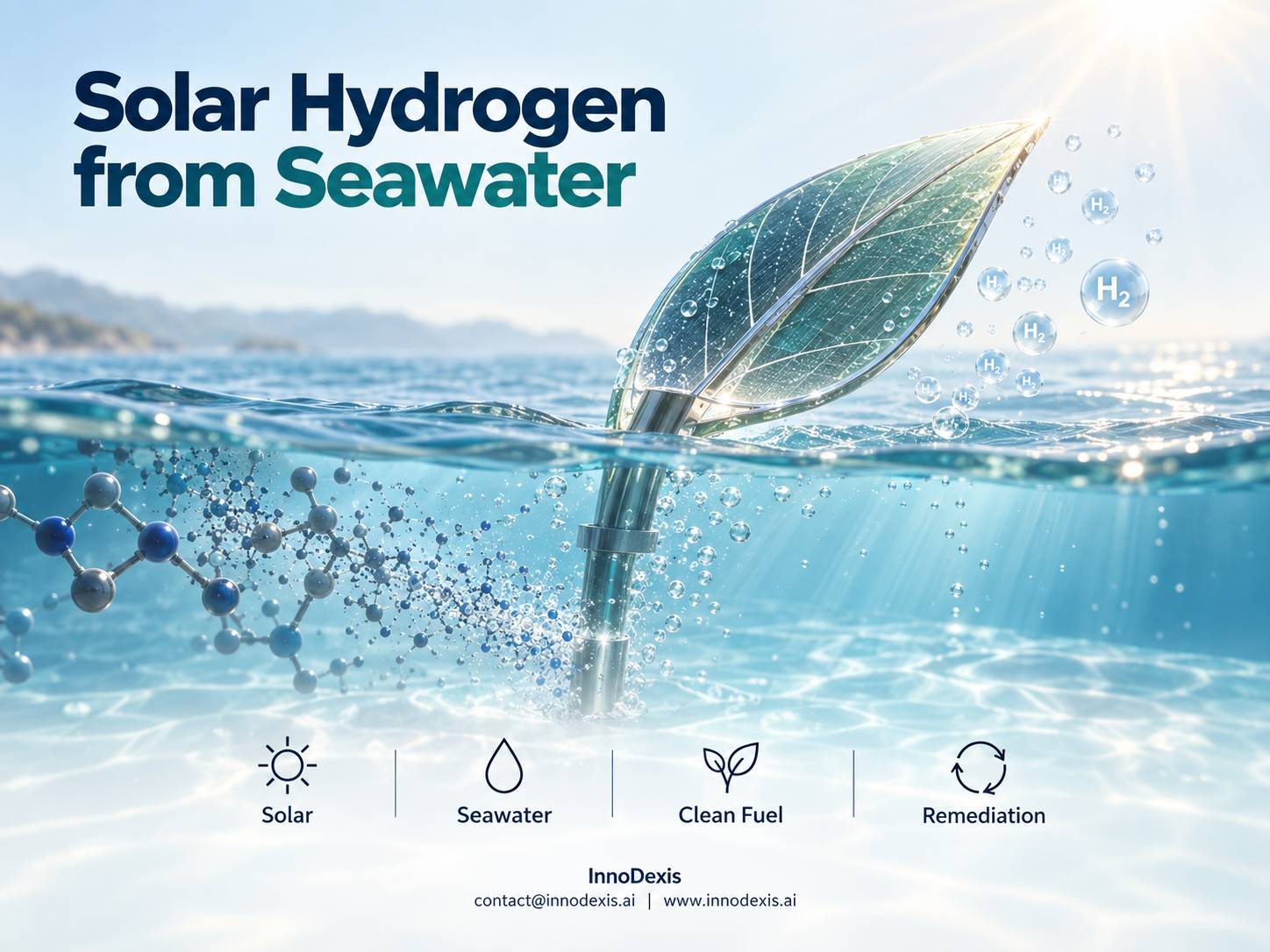
InnoDexis has published its latest Innovation Intelligence Report covering green hydrogen production and wastewater treatment technology, analyzing a single high-significance innovation developed by researchers at Nanyang Technological University. The report reveals that an artificial leaf device has been engineered to convert contaminated seawater into clean hydrogen fuel while degrading toxic hydrazine pollutant in the same reaction, eliminating the need for both freshwater input and external electricity that conventional water electrolysis systems require.
Key Findings
The device reduced hydrazine concentration to 0.5 parts per billion, more than 20 times below the US EPA's 10 ppb regulatory limit. This result demonstrates that the pollutant degradation process achieved by the device is not merely functional but substantially exceeds recognised regulatory thresholds for water safety.
The device maintained stable operation for over 72 hours without requiring external power. Sustained performance across this duration signals a result that extends beyond a short-term laboratory demonstration, indicating the underlying reaction mechanism is durable enough to warrant further scaled testing.
The system operates directly on seawater rather than requiring purified freshwater, removing one of the two major input constraints — freshwater availability — that conventional water electrolysis systems depend on. This directly addresses a structural limitation shared by most existing hydrogen production methods.
The device generates clean hydrogen and degrades a toxic pollutant simultaneously within a single standalone unit, rather than requiring separate treatment and production systems. According to the dataset, the pollutant degradation reaction itself supplies the electrons that drive hydrogen production, meaning the two outcomes are coupled within one reaction rather than achieved through two distinct energy-consuming processes.
As detailed in the accompanying commentary, most systems would treat the reaction generating hydrogen as waste to be managed rather than fuel to be captured; this device instead reverses that relationship, using what would otherwise be a byproduct as the driver of its core output. This reversal is described as the mechanism that makes the device self-sustaining rather than self-limiting.
Strategic Insight and Trend Analysis
The dominant trend emerging from this dataset is the structural convergence of two processes — environmental remediation and clean fuel production — that have historically been engineered, funded, and evaluated as entirely separate systems. Conventional approaches treat wastewater treatment as a cost centre and hydrogen production as a distinct energy-generation activity, each requiring its own infrastructure, power input, and operational budget. This device demonstrates that coupling the two within a single reaction converts what was previously a compliance expense into a fuel-generating process.
This convergence is significant not simply because it is novel, but because of what it removes: both external electricity and freshwater input, two constraints that have limited where and how conventional electrolysis-based hydrogen systems can be deployed. A device capable of operating directly on contaminated seawater, powered by sunlight, and stable for over 72 hours without external power addresses feasibility constraints that have historically confined hydrogen production to freshwater-rich, grid-connected locations.
The scientific reframing described in the dataset — treating what would typically be considered waste heat or a byproduct reaction as a capturable fuel source — represents a conceptual shift with implications beyond this specific device. If pollutant degradation reactions can be systematically redesigned to supply usable electrons for fuel production rather than being treated purely as a remediation cost, this principle could extend to other contaminant classes beyond hydrazine.
Collectively, these findings point toward a broader trend of energy-generating environmental remediation, where wastewater treatment infrastructure is redesigned around the possibility of energy capture rather than energy consumption alone.
Global and Industry Implications
For corporates and R&D teams in industrial wastewater management and clean energy sectors, this device demonstrates a viable pathway to convert regulatory compliance processes into fuel-generating operations, a reframing that could inform future infrastructure investment decisions in industries handling hydrazine or similar pollutants.
For investors and capital allocators, a device that operates on seawater without external power presents a lower operating-cost profile compared with conventional freshwater electrolysis systems, positioning decentralised, solar-driven hydrogen production as an area warranting closer evaluation, particularly for coastal and water-stressed deployment contexts.
For policymakers and national innovation bodies, the demonstrated ability to degrade hydrazine to levels 20 times below the EPA limit while simultaneously producing clean fuel offers a potential model for redesigning environmental compliance frameworks around combined remediation-and-energy outcomes, rather than treating pollutant control and energy production as separately regulated activities.
InnoDexis Statement
"By treating pollutant degradation as the electron source for hydrogen generation rather than a waste process to manage, this device reverses the conventional relationship between environmental remediation and energy production," noted InnoDexis in its latest intelligence report.
Conclusion
As water-stressed and coastal regions continue to face the dual challenge of wastewater management and energy access, devices capable of performing both functions within a single solar-driven system may offer a decentralised alternative to conventional, freshwater-dependent hydrogen infrastructure. Continued monitoring of scaled testing beyond the demonstrated 72-hour stability window will clarify the device's viability for broader deployment. InnoDexis will continue to track developments in solar-driven hydrogen production, pollutant-coupled energy systems, and decentralised clean fuel technologies. The complete Green Hydrogen and Wastewater Innovation Intelligence Report is available to InnoDexis subscribers and enterprise clients.
About InnoDexis
InnoDexis is a global Innovation Intelligence platform that tracks, analyzes, and interprets breakthrough innovations, prototypes, and emerging technologies across industries and countries. Its intelligence helps corporates, investors, and policymakers understand the true structure and direction of global innovation. Learn more at innodexis.ai.