North Carolina State University Develops Geometry-Driven Light-Powered Soft Robot That Jumps and Crawls Without Electronics or Manual Resetting
A single geometric angle parameter not code or electronics determines locomotion mode in a light-driven soft robot that resets autonomously under continuous infrared light, eliminating onboard batteries and mechanical actuators entirely.
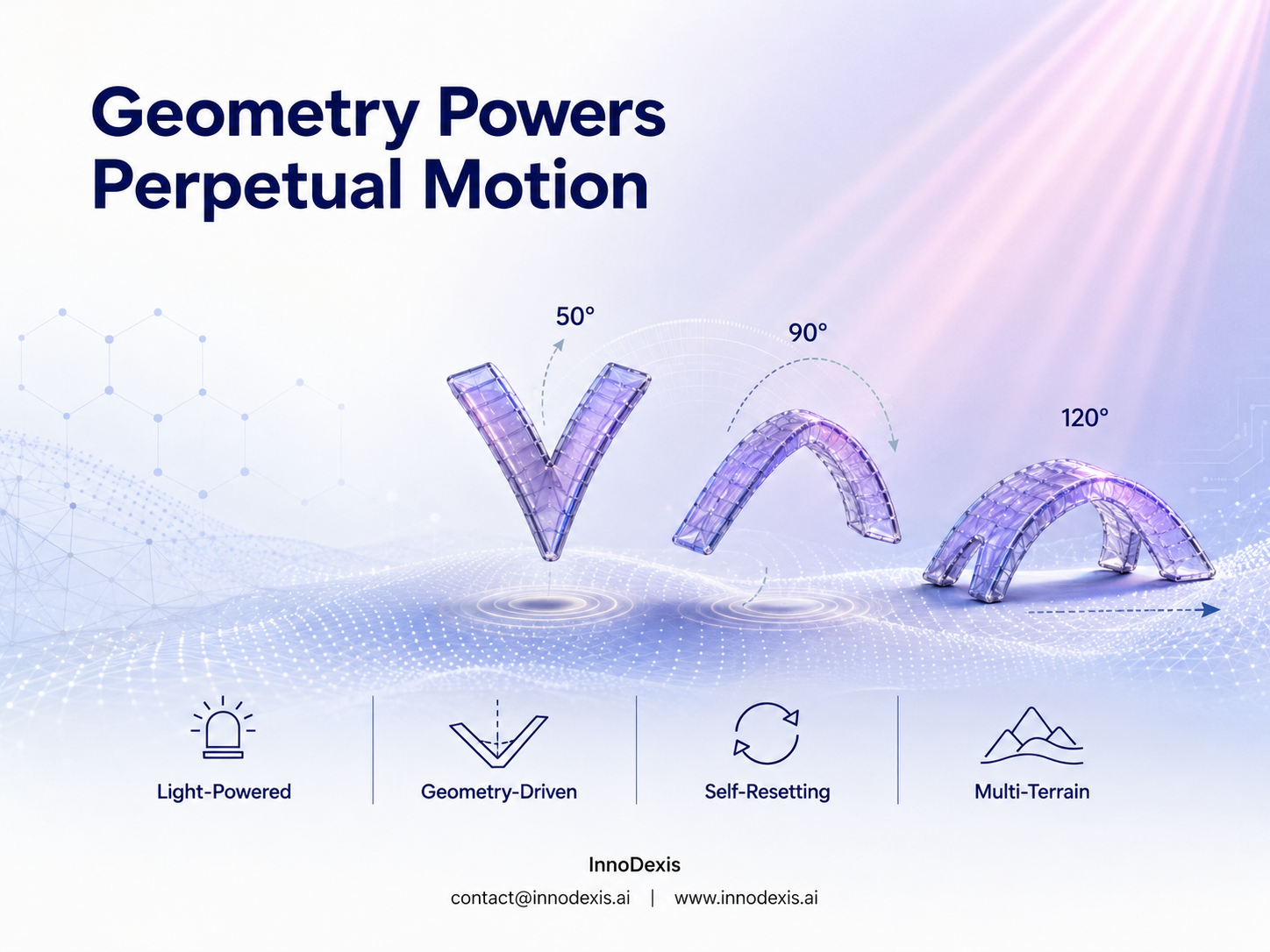
InnoDexis has published its latest Innovation Intelligence Report covering soft robotics and advanced materials, analyzing a high-significance innovation from the United States. The report reveals that researchers at North Carolina State University have developed a light-driven soft robot constructed from liquid crystal elastomers that continuously jumps or crawls under infrared light with no onboard electronics, batteries, or manual resetting required. Locomotion mode is determined entirely by a single geometric angle parameter, and the robot's self-resetting mechanism stores and releases torsional energy autonomously — enabling perpetual locomotion across varied terrain including grass, sand, rocks, mulch, slopes, and hurdles.
Key Findings
The locomotion mode of the soft robot is governed entirely by the V-angle of its geometry. A 50-degree V-angle produces vertical leaping, a 90-degree angle produces forward jumping, and a 120-degree angle produces crawling. This single physical parameter replaces the entire electronics stack conventionally required for soft robot actuation — eliminating onboard batteries, complex controllers, and mechanical actuators from the system entirely.
The self-resetting mechanism is the primary enabling breakthrough of the design. Most soft robots require manual intervention to reset between locomotion cycles, which has been a fundamental constraint on their operational autonomy. In this system, light-induced contraction stores torsional energy and releases it autonomously under continuous infrared light exposure, enabling perpetual locomotion without external intervention between cycles.
The robot demonstrated functional locomotion across six distinct terrain types — grass, sand, rocks, mulch, slopes, and hurdles — confirming that geometry-driven actuation is not confined to controlled laboratory surfaces. This multi-terrain performance is a critical step toward deployment viability in unstructured real-world environments where soft robots have historically faced significant operational limitations.
The elimination of onboard electronics has direct implications for miniaturisation at scales where electronic components cannot be reduced further. Because locomotion is governed by geometry and powered by ambient light rather than by an electronics stack, the design is viable at scales where conventional soft robot architectures face fundamental physical constraints. This makes the platform a credible candidate for micro-robot applications where size and weight are primary design boundaries.
The research identifies ambient light actuation and steering control as the remaining development steps toward battery-free swarm robotics applications. The current demonstration establishes autonomous locomotion and terrain traversal; the addition of directional steering would complete the functional requirements for deployment in environmental monitoring contexts using swarms of geometry-driven micro-robots.
Strategic Insight and Trend Analysis
The strategic significance of this innovation is the introduction of a new design language for soft robotics — one in which geometry replaces electronics as the primary determinant of robot behaviour. This is not an incremental improvement within the existing soft robotics paradigm but a structural departure from it. Conventional soft robot design assumes an electronics stack as a necessary component of the system; this research demonstrates that the stack can be eliminated entirely when the physical geometry of the material is engineered to encode locomotion behaviour directly.
The implications of this shift extend beyond the specific robot demonstrated. If a single geometric parameter can determine locomotion mode, and if ambient light can serve as the sole power source, then the design space for soft robots expands significantly into regimes where electronics-based approaches are not viable — specifically, at very small scales, in environments where electronics are unreliable, and in applications requiring large numbers of low-cost autonomous units operating simultaneously.
The self-resetting mechanism is the technical foundation that makes this expansion possible. Previous light-driven soft robots have demonstrated actuation but not sustained autonomous locomotion, because the absence of a reset mechanism required periodic human intervention. The torsional energy storage and release cycle demonstrated here resolves that constraint and converts a demonstration of actuation into a demonstration of operational autonomy — a distinction that is critical for real-world deployment.
The pathway toward battery-free swarm robotics in environmental monitoring is a logical and near-term extension of the current capability. Steering control is identified as the remaining requirement, and its addition would complete the transition from a single autonomous robot to a scalable swarm platform requiring no onboard power infrastructure.
Global and Industry Implications
For corporates and R&D teams, the geometry-driven locomotion architecture opens a new design pathway for soft robotics in applications where miniaturisation, weight constraints, or electronics reliability are primary limitations. Industries including environmental monitoring, search and rescue, and precision agriculture stand to benefit from autonomous micro-robots that require no onboard power source and can be produced at low cost through geometric parameter variation rather than complex electronic programming.
For investors and capital allocators, the elimination of the electronics stack from soft robot architecture has significant cost and scalability implications. Platforms that replace programmable electronics with engineered geometry reduce per-unit cost and complexity, enabling swarm deployment at scales that electronically controlled systems cannot reach economically. This positions geometry-driven soft robotics as a distinct and commercially relevant category within the broader robotics investment landscape.
For policymakers and national innovation bodies, the research demonstrates the strategic value of funding materials science and soft robotics at the intersection of locomotion and autonomous systems. Battery-free, electronics-free robotic platforms have clear relevance for environmental monitoring, disaster response, and infrastructure inspection — applications with direct public interest implications that justify sustained research investment.
InnoDexis Statement
"The geometry-driven locomotion model demonstrated at North Carolina State University reframes soft robot design by encoding behaviour into physical structure rather than electronics — a shift that expands the viable deployment envelope for autonomous micro-robots into regimes where conventional architectures cannot operate," noted InnoDexis in its latest intelligence report.
Conclusion
As soft robotics research advances toward autonomous, battery-free operation at micro scales, the geometry-driven light-powered platform developed at North Carolina State University represents a structurally significant step in that direction. The combination of autonomous resetting, multi-terrain locomotion, and electronics-free operation establishes a foundation for swarm robotics applications in environmental monitoring and beyond. InnoDexis will continue tracking developments in light-driven soft robotics, liquid crystal elastomer actuation, and the progression toward steerable battery-free swarm platforms. The complete Soft Robotics Innovation Intelligence Report is available to InnoDexis subscribers and enterprise clients.
About InnoDexis
InnoDexis is a global Innovation Intelligence platform that tracks, analyzes, and interprets breakthrough innovations, prototypes, and emerging technologies across industries and countries. Its intelligence helps corporates, investors, and policymakers understand the true structure and direction of global innovation. Learn more at innodexis.ai.