Noninvasive Brain-Computer Interface ChatBCI-Assist From Rutgers Reaches Nearly 3x Communication Speed Using a Locally Deployed Language Model
Rutgers engineers paired EEG-based P300 detection with a locally deployed, fine-tuned language model that suggests complete phrases, reaching nearly three times the baseline communication speed in tests with healthy participants.
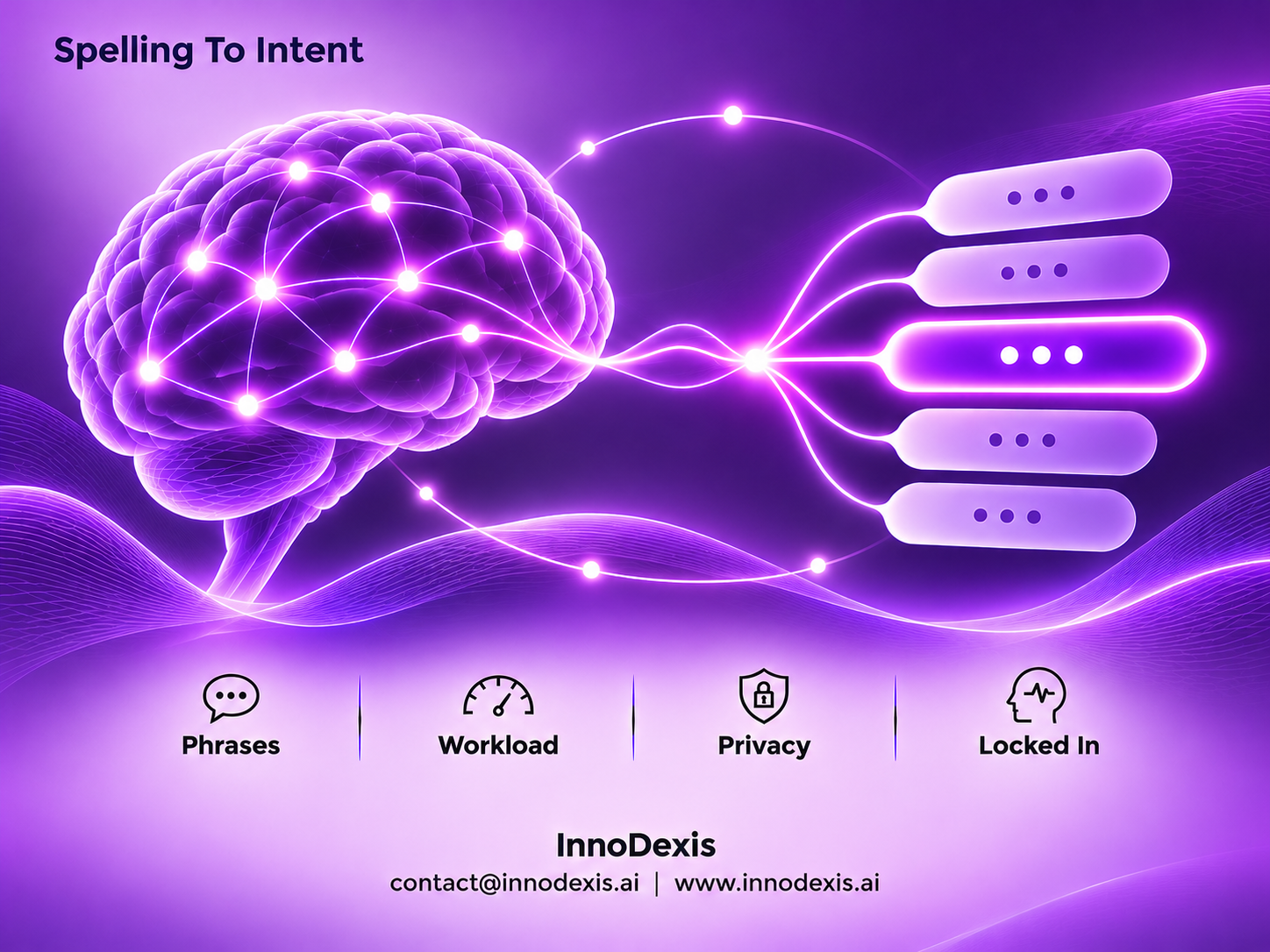
InnoDexis has published its latest Innovation Intelligence Report covering noninvasive brain-computer interfaces for assistive communication, analyzing one innovation from Rutgers University–New Brunswick in the United States, published on 20 November 2026. The report reveals that ChatBCI-Assist, which combines an EEG cap, P300 signal detection and a locally deployed, fine-tuned large language model, reached nearly twice the speed of a conventional dictionary-based predictive system in copy spelling and nearly three times the baseline speed in semantic spelling, with lower user workload and no surgical implantation.
Key Findings
ChatBCI-Assist reached nearly three times the communication speed of the baseline in a semantic spelling experiment. Instead of building words character by character, the system suggests complete, context-aware phrases and the user selects the intended one, which means fewer deliberate selections for each message.
In a copy spelling experiment, the system achieved nearly twice the communication speed of a conventional dictionary-based predictive system. Together with the semantic result, this shows a speed gain in both experiments rather than in a single test condition.
User workload was reduced and participants rated the system easier to use. This matters for the target users, people with advanced ALS and severe movement and speech impairments, because the design is linked to lower physical and cognitive fatigue for locked-in patients.
The language model runs locally, so the system works offline without an internet or cloud connection, which avoids the privacy risks of cloud-based AI in healthcare. The interface is noninvasive and needs no surgical implantation. It uses an EEG cap to detect P300 responses, which occur at a latency of about 300 ms when users focus on flashing screen stimuli.
The evidence is limited to laboratory settings with healthy participants. Commercial readiness is rated low, clinical trial protocols are in planning, and a provisional patent application has been filed through Rutgers Technology Transfer. Deployment is estimated at 3 to 5 years after patient trials and regulatory review.
Strategic Insight and Trend Analysis
The dominant trend in this research is a shift in brain-computer interface design from literal spelling to intent-based communication. Laleh Najafizadeh, who directs the Integrated Systems and NeuroImaging Laboratory, frames the change as moving away from reproducing every word a person wants to type toward systems that predict what users intend to communicate. For many people with advanced ALS, cognitive abilities remain largely preserved while progressive loss of motor control limits expression, so the bottleneck is the low bandwidth of the interface rather than the user's ideas.
A locally hosted language model addresses that bottleneck. It augments low-bandwidth P300 signals with predicted phrases, which raised communication speed while reducing workload, and it keeps processing on the device. Local processing also addresses HIPAA and patient privacy risks associated with cloud AI in healthcare, making it an attractive architecture for assistive device manufacturers.
The limits are specific. Testing involved healthy participants only, and the main open questions concern real patients: whether performance and comfort hold in ALS populations, whether P300 control stays reliable as neurodegenerative disease progresses, and whether low inference latency can be maintained on local edge hardware. Language model hallucination or misinterpretation of intent is a named technical risk.
Competition also matters. Invasive high-bandwidth neural interfaces are evolving rapidly, and ChatBCI-Assist competes on a different axis: no surgery, offline operation and privacy by design. The practical test is whether a laboratory result with healthy participants becomes a usable daily tool for people living with ALS.
Global and Industry Implications
For corporates and R&D teams, the work points to licensing opportunities with medical device manufacturers specializing in assistive communication and neurological rehabilitation. Commercial use needs standardized integration of commercial EEG caps with localized high-performance edge computing devices, and emerging applications include neuro-assistive devices for stroke or spinal cord injury recovery and hands-free noninvasive human-machine interfaces.
For investors and capital allocators, the case rests on a laboratory proof of concept with low commercial readiness. A provisional patent application has been filed and clinical trial partnerships have formed, but returns depend on trial results with ALS patients, FDA clearance, reimbursement approval for novel BCI software, and continuous funding for trials and scale-up, against competition from invasive interfaces.
For policymakers and national innovation bodies, the product needs FDA clearance as a medical device or assistive communication software, and regulatory complexity for AI medical software is a named threat. Local processing aligns with patient privacy requirements, and planned trials at Robert Wood Johnson University Hospital show how university engineering and clinical partners can move a noninvasive technology toward the people who need it.
InnoDexis Statement
"Reframing brain-computer communication from character-by-character spelling to intent prediction, with a locally run language model, ties speed gains to privacy, and clinical validation in ALS patients decides what comes next," noted InnoDexis in its latest intelligence report.
Conclusion
The next milestones to watch are the planned clinical trials with ALS patients at Robert Wood Johnson University Hospital, evidence that P300 signal tracking stays stable as disease progresses, and low inference latency on local edge hardware. Refinements to cap comfort and signal processing algorithms based on patient feedback will shape everyday usability, and FDA clearance remains the regulatory gate. InnoDexis will continue to track noninvasive brain-computer interfaces, edge AI and assistive communication technologies as this field develops. The complete Noninvasive Brain-Computer Interface Innovation Intelligence Report is available to InnoDexis subscribers and enterprise clients.
About InnoDexis
InnoDexis is a real-time innovation intelligence platform connecting scientific discovery to commercial opportunity. Powered by InnoGraph, its proprietary innovation knowledge graph, the platform maps technologies across the entire lifecycle, from early-stage research (TRL 1) to market deployment (TRL 9), connecting researchers, institutions, startups, companies, products and emerging opportunities.
Covering 40+ specialised industry segments and 360 technology areas, InnoDexis delivers innovation tracking, research discovery, product and startup intelligence, investment insights, and AI-powered reports. Its mission is to bridge the gap between scientific discovery and real-world impact.
InnoDexis — From Lab to Market: Real-Time Innovation Intelligence.