MitoSpace 4D Model Predicts Drug Mechanism With 75% Accuracy Versus 56% for 2D Imaging in UC San Diego Study
UC San Diego's unsupervised 4D microscopy models grouped drugs by mechanism from mitochondrial shape and movement alone, generalising to unseen drugs and cell types without retraining or human labeling.
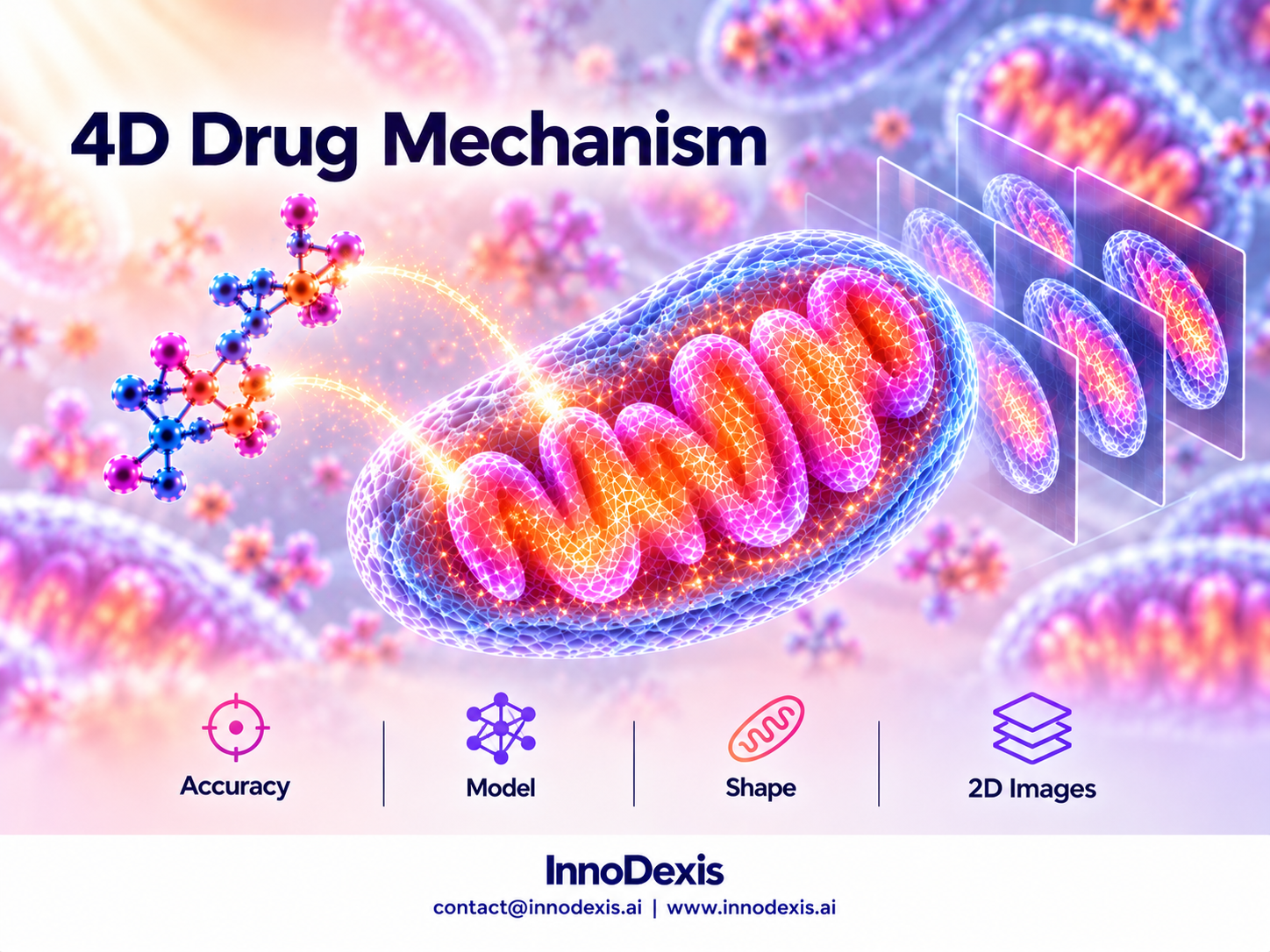
InnoDexis has published its latest Innovation Intelligence Report covering AI-driven virtual cell modelling in drug discovery, analyzing a research innovation developed at UC San Diego School of Medicine in the United States. The report reveals that researchers built two virtual cell approaches — a deep-learning model reading mitochondrial shape and a physics-based digital twin of real cellular movement — that grouped drugs by mechanism with 75% accuracy using 4D microscopy movies, substantially outperforming the 56% accuracy achieved using flat 2D images, without any human labeling involved.
Key Findings
Grouping drugs by mechanism using 4D movies achieved 75% accuracy, compared with 56% accuracy using flat 2D images. This 19-percentage-point gap between 2D and 4D approaches is large enough to change how screening pipelines are designed, indicating that temporal and structural movement data captures mechanism-relevant information that static snapshots miss entirely.
The models were trained on 40,000 single-cell 4D movies across 25 compound treatments. This scale of training data across a meaningful range of compound classes provides the foundation for the model's demonstrated ability to generalise beyond its original training set.
The physics-based digital twin represents the first instance of a physics-based virtual cell being compared directly against real 3D microscopy footage. This direct comparison against ground-truth footage distinguishes this approach from prior virtual cell models that lacked this validation step.
The MitoSpace model generalises to unseen drugs and cell types without retraining. This capability is significant because it indicates the model has learned mechanism-relevant patterns in mitochondrial shape and movement that extend beyond the specific compounds and cell types used during training, rather than simply memorising the training set.
UC San Diego has filed a patent and launched a spinout based on this research, moving the innovation from a laboratory result toward commercial application. This progression signals institutional confidence in the technology's translational potential beyond academic publication.
Strategic Insight and Trend Analysis
The dominant trend emerging from this dataset is a fundamental shift in the type of data considered sufficient for predicting drug mechanism. Drug discovery has historically depended on static 2D snapshots requiring manual labeling — an approach that captures a single moment in a cell's response to a compound rather than the dynamic process by which that response unfolds. The 19-percentage-point accuracy gap between 2D and 4D approaches demonstrates that movement and shape over time carry substantially more mechanism-relevant information than static imaging alone.
This shift also removes the labeling bottleneck that has constrained mechanism-based drug screening. Because MitoSpace groups drugs by mechanism from mitochondrial shape and movement with no human labeling involved, the approach eliminates a manual, time-intensive step that has historically limited the scale at which mechanism-based screening could be conducted.
The model's demonstrated ability to generalise to unseen drugs and cell types without retraining carries structural significance for how drug screening pipelines could be redesigned. A model that reliably predicts functional mechanism from structural dynamics, without requiring retraining for each new compound or cell type, could allow researchers to screen drug candidates computationally before physical lab testing begins — shifting a portion of the drug discovery process from wet-lab experimentation toward in silico screening.
The progression from laboratory result to filed patent and spinout company indicates that this shift is being pursued as a commercial pathway, not remaining confined to academic research. This trajectory suggests the technology is being positioned for integration into pharmaceutical screening workflows rather than existing purely as a research tool.
Global and Industry Implications
For corporates and R&D teams in pharmaceutical and biotechnology sectors, MitoSpace and the physics-based digital twin represent potential tools for reducing wet-lab screening burden by moving mechanism-of-action prediction earlier into the discovery pipeline, potentially accelerating candidate triage before costly physical testing begins.
For investors and capital allocators, the combination of a filed patent and an active spinout company signals a clear commercialisation pathway for this technology, positioning it as an identifiable near-term opportunity within the broader AI-in-biology and digital twin investment landscape.
For policymakers and national innovation bodies, this innovation illustrates the translational value of sustained academic research investment in AI-driven biological modelling, with direct implications for accelerating and reducing the cost of drug discovery pipelines at a national research infrastructure level.
InnoDexis Statement
"A 19-percentage-point accuracy gap between 4D and 2D imaging approaches demonstrates that movement, not just shape, carries mechanism-defining information that static drug-screening methods have been missing," noted InnoDexis in its latest intelligence report.
Conclusion
As the gap between static and dynamic imaging approaches becomes more clearly quantified, drug discovery pipelines may increasingly incorporate computational, mechanism-based screening ahead of physical lab testing. The progression of MitoSpace and its accompanying digital twin from academic research toward a patented, spun-out commercial technology will be an important indicator of how quickly virtual cell modelling moves into mainstream pharmaceutical screening workflows. InnoDexis will continue to track developments in AI-driven virtual cell modelling, digital twin technology, and their integration into drug discovery pipelines. The complete Virtual Cell Modelling Innovation Intelligence Report is available to InnoDexis subscribers and enterprise clients.
About InnoDexis
InnoDexis is a global Innovation Intelligence platform that tracks, analyzes, and interprets breakthrough innovations, prototypes, and emerging technologies across industries and countries. Its intelligence helps corporates, investors, and policymakers understand the true structure and direction of global innovation. Learn more at innodexis.ai.