MIT’s AI–Biomed Convergence Leads 529 Innovation Signals as Quantum and Space Technologies Advance Toward Commercial Scale
An analysis of 529 validated innovations reveals that artificial intelligence, biomedical translation, quantum infrastructure, and space technologies are defining MIT’s 2026 innovation agenda.
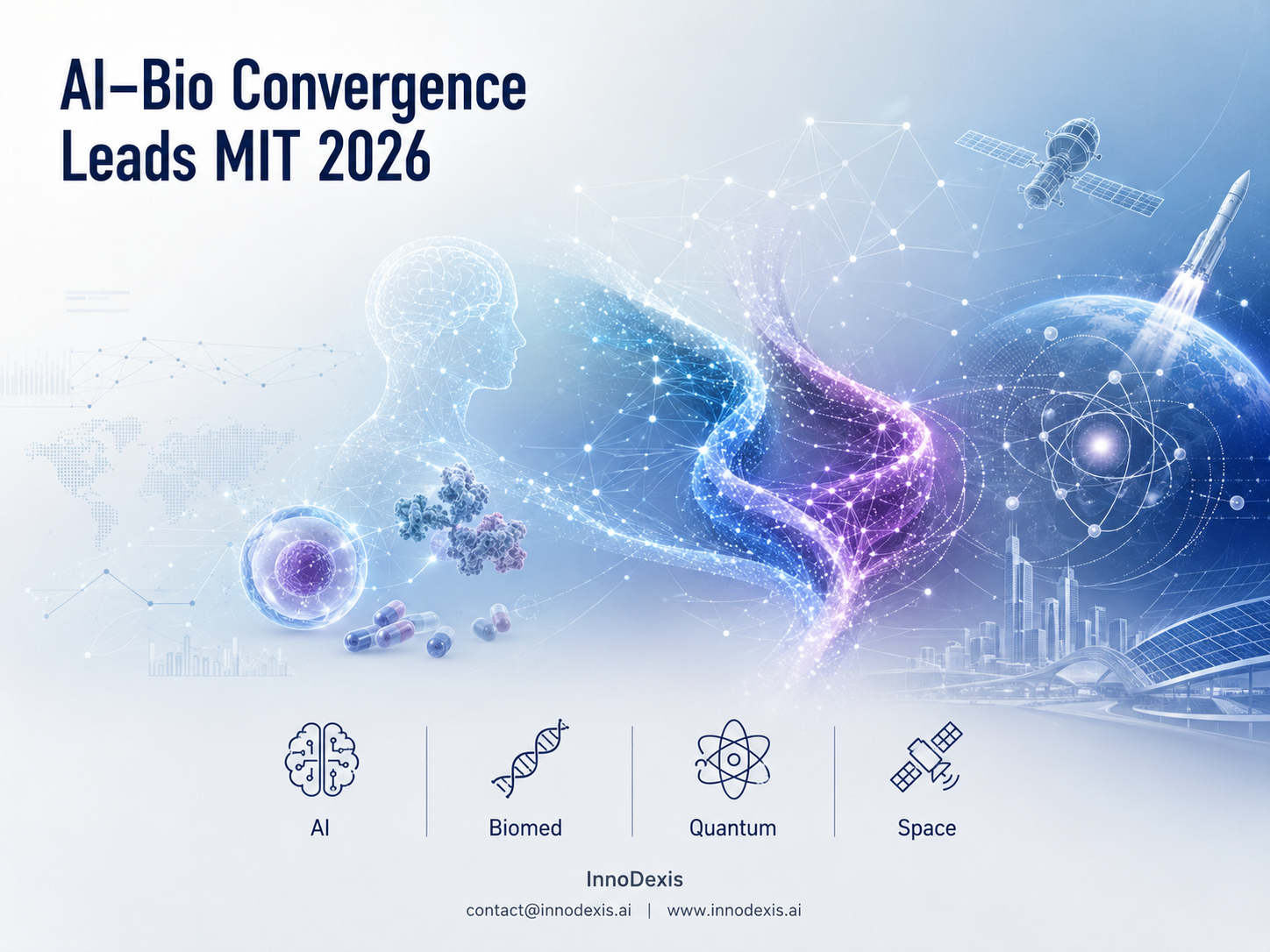
InnoDexis has published its latest Innovation Intelligence Report covering the Massachusetts Institute of Technology (MIT), analyzing 529 validated innovations across 12 technology sectors during the period from January to June 2026. The report reveals that MIT’s innovation strategy is increasingly centered on the convergence of artificial intelligence and biomedical science, while simultaneously accelerating advances in quantum infrastructure, space technologies, climate solutions, and advanced materials. The findings indicate that MIT continues to operate as both a research institution and a commercialization engine, producing a pipeline of technologies, startups, clinical programs, and scientific talent with global impact.
Key Findings
Artificial Intelligence & Machine Learning and BioMed & Pharma emerged as the two largest sectors within MIT’s innovation portfolio, generating 118 and 115 innovations respectively. Together, they account for approximately 44% of all validated innovation activity, highlighting a strategic focus on combining advanced computational capabilities with healthcare and life science applications.
Artificial intelligence has become a cross-disciplinary capability rather than a standalone research field. Approximately 77.5% of innovations include an AI component within their methodologies or applications, spanning drug discovery, clinical forecasting, quantum computing, advanced materials, urban systems, and space technologies.
Biomedical translation remains one of MIT’s strongest areas of commercial and societal impact. The report identified 29 active or recently completed clinical trial records, including programs in oncology, immunology, infectious disease, rare diseases, and novel drug delivery systems. This reflects a growing emphasis on converting laboratory discoveries into deployable healthcare solutions.
Quantum Computing continues to evolve as a strategic institutional priority. With 28 quantum-related innovations and significant infrastructure investments, MIT is positioning itself as a central node in a rapidly expanding quantum ecosystem. The establishment of a national quantum hub and strengthened industry partnerships indicate a transition from isolated research projects toward long-term innovation infrastructure.
Space & Aerospace emerged as the most commercially mature sector within the portfolio, achieving the highest average Technology Readiness Level among all sectors analyzed. Advances in propulsion systems, satellite technologies, and space infrastructure demonstrate a clear pathway from research to deployment.
Commercialization activity remains substantial across the institution. The report identified more than 45 startup mentions, over 23 spin-off formations, 160 innovations with corporate participation, and 233 government-funded records. This reflects a highly integrated ecosystem where research, funding, entrepreneurship, and industry collaboration operate in parallel.
Strategic Insight and Trend Analysis
The most important strategic signal emerging from the MIT 2026 dataset is not the strength of any individual technology domain but the increasing convergence between them. The institution’s innovation portfolio demonstrates a deliberate strategy of embedding computational intelligence into nearly every scientific discipline, creating new forms of interdisciplinary innovation.
Artificial intelligence serves as the clearest example of this convergence. Rather than functioning solely as a technology sector, AI has become an enabling layer that accelerates discovery across healthcare, materials science, physics, climate technologies, manufacturing, and space exploration. This transformation suggests that future competitive advantage will increasingly depend on the ability to integrate AI capabilities into domain-specific expertise rather than developing standalone AI systems.
The report also highlights a shift toward infrastructure-driven innovation. Quantum research is increasingly focused on building national-scale capabilities, while space technologies are moving toward commercially deployable systems. Similarly, advances in biomedical science increasingly emphasize translational pathways that connect research directly to clinical outcomes.
Another notable trend is the emergence of bioelectronics, soft materials, and body-machine interfaces as a growing frontier. These technologies combine advances in materials science, electronics, and medicine, creating new opportunities for healthcare diagnostics, monitoring, and therapeutic interventions.
Collectively, these patterns indicate that MIT’s innovation model is evolving from disciplinary excellence toward platform-based innovation, where advances in one field increasingly accelerate progress across multiple sectors simultaneously.
Global and Industry Implications
For corporates and R&D teams, the findings demonstrate the importance of identifying convergence opportunities between AI, healthcare, materials science, and advanced computing. Future growth is likely to emerge from technologies that bridge multiple domains rather than remain confined to a single industry.
For investors and capital allocators, the strongest long-term opportunities appear concentrated in quantum infrastructure, clinical-stage biomedical technologies, AI-enabled scientific discovery, advanced materials, and commercially mature space technologies. These areas combine strong research momentum with identifiable commercialization pathways.
For policymakers and national innovation bodies, the report reinforces the strategic value of integrated innovation ecosystems. The combination of public funding, research infrastructure, startup formation, and corporate partnerships provides a model for translating scientific excellence into economic and societal outcomes.
InnoDexis Statement
“The defining characteristic of MIT’s 2026 innovation landscape is convergence, where artificial intelligence, biomedical science, quantum technologies, and advanced engineering increasingly function as interconnected components of a broader innovation ecosystem,” noted InnoDexis in its latest intelligence report.
Conclusion
The MIT 2026 innovation landscape reflects an institution operating at the intersection of scientific discovery, commercialization, and technological infrastructure development. Across 529 validated innovations, the evidence points to a research ecosystem that is increasingly focused on translating foundational science into real-world impact.
As artificial intelligence becomes embedded across disciplines, quantum infrastructure expands, clinical programs mature, and space technologies advance toward deployment, MIT continues to shape multiple technology frontiers simultaneously. Monitoring these developments will remain critical for organizations seeking early visibility into the next generation of globally significant innovations.
The complete MIT 2026 Extended Innovation Intelligence Report is available to InnoDexis subscribers and enterprise clients.
About Innodexis
InnoDexis is a global Innovation Intelligence platform that tracks, analyzes, and interprets breakthrough innovations, prototypes, and emerging technologies across industries and countries. Its intelligence helps corporates, investors, and policymakers understand the true structure and direction of global innovation. Learn more at innodexis.ai.