Millennial-Scale Climate Cycles Observed Without Ice Sheets Challenge Established Climate Models
Geological evidence from the Late Cretaceous indicates that ~5,000-year climate oscillations can occur independently of ice sheets, driven by orbital dynamics.
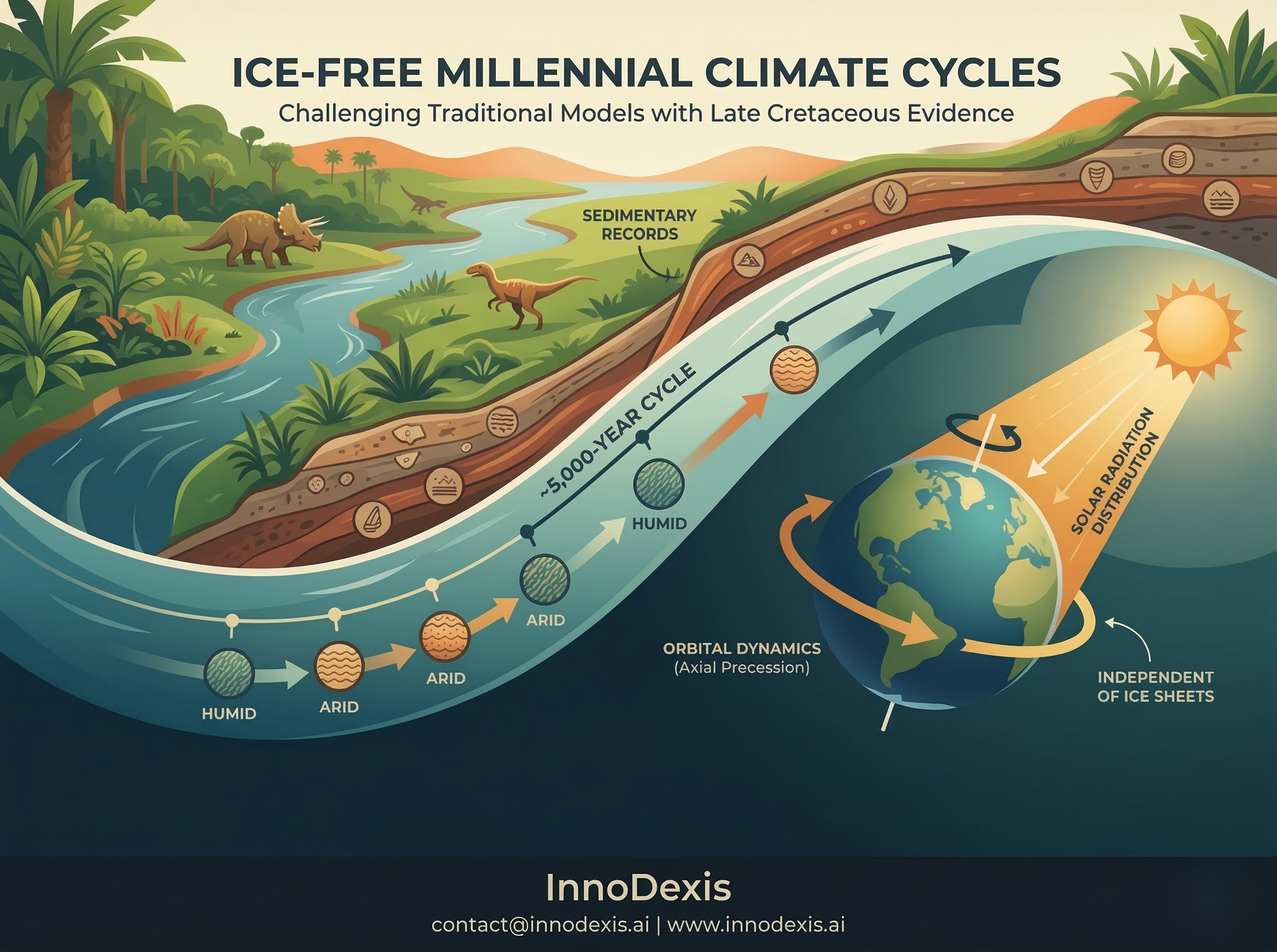
InnoDexis has published its latest Innovation Intelligence Report covering long-term climate variability and geological climate patterns, analyzing sedimentary evidence from the Late Cretaceous period under high atmospheric CO₂ conditions. The report reveals that Earth experienced recurring climate shifts approximately every 4,000–5,000 years despite the absence of major ice sheets. The findings suggest that millennial-scale climate variability may be driven by orbital factors such as axial precession rather than glacial dynamics, indicating that such cycles could persist or intensify in future high-CO₂ climate scenarios.
Key Findings
Geological analysis of sediment records from the Late Cretaceous period reveals consistent climate oscillations occurring at intervals of approximately 4,000–5,000 years. These oscillations were observed during a time characterized by elevated atmospheric CO₂ levels and the absence of large-scale ice sheets.
The findings challenge the conventional assumption that millennial-scale climate variability is primarily linked to the presence and dynamics of ice sheets. Instead, the observed patterns indicate that such variability can occur independently under greenhouse climate conditions.
The study identifies a strong correlation between these climate oscillations and Earth’s orbital dynamics, particularly axial precession. This wobble in Earth’s rotation alters the distribution of solar radiation across the planet, influencing regional and global climate patterns over time.
Evidence also indicates that these millennial-scale cycles interact with longer-term climate rhythms of approximately 100,000 years. This multi-scale interaction suggests that short-term variability may be embedded within broader climatic shifts.
The sedimentary record shows repeated transitions between humid and arid conditions, indicating that these oscillations had tangible environmental impacts. Such rapid shifts highlight the sensitivity of Earth’s climate system to relatively small changes in solar forcing.
Strategic Insight and Trend Analysis
The identification of millennial-scale climate variability independent of ice sheets represents a significant shift in how long-term climate dynamics may be understood. Traditional climate models have often linked such variability to glacial processes, assuming that ice sheets act as a primary driver of periodic climate fluctuations.
The Late Cretaceous evidence suggests that orbital forcing mechanisms, particularly axial precession, can independently generate structured and recurring climate variability. This implies that the Earth system possesses intrinsic cyclical behavior that does not rely on cryospheric feedback mechanisms.
The interaction between ~5,000-year oscillations and longer ~100,000-year cycles indicates a layered climate system in which multiple periodic drivers operate simultaneously. This multi-scale dynamic may introduce complexity into climate prediction models, particularly under conditions of sustained warming.
The findings also reinforce the importance of solar radiation distribution as a governing factor in climate variability. Changes in how solar energy is distributed geographically, rather than absolute energy levels alone, appear sufficient to trigger measurable environmental shifts.
From a modeling perspective, the research suggests that existing frameworks may need to account more explicitly for orbital-scale variability under non-glacial conditions. As contemporary climate systems move toward higher CO₂ concentrations, historical analogs such as the Late Cretaceous provide a reference for understanding potential future dynamics.
Global and Industry Implications
For corporates and R&D teams, particularly those operating in climate-sensitive sectors such as agriculture, water management, and energy systems, the findings indicate that climate variability may persist in structured cycles even in the absence of ice-sheet-driven dynamics. This may influence long-term planning and resilience strategies.
For investors and capital allocators, the presence of embedded climate variability under high-CO₂ conditions suggests potential implications for risk modeling in sectors exposed to environmental volatility. Understanding cyclical climate behavior may become increasingly relevant in long-term investment assessments.
For policymakers and national innovation bodies, the findings highlight the need to incorporate multi-scale climate variability into policy frameworks and predictive models. If millennial-scale cycles operate independently of ice sheets, climate adaptation strategies may need to account for recurring variability alongside long-term warming trends.
InnoDexis Statement
“The evidence indicates that Earth’s climate system contains intrinsic cyclical dynamics driven by orbital forcing, suggesting that variability may persist independently of ice-sheet processes under high-CO₂ conditions,” noted InnoDexis in its latest intelligence report.
Conclusion
The observation of recurring ~5,000-year climate cycles during a high-CO₂, ice-free period provides new insight into the structural behavior of Earth’s climate system. By identifying orbital dynamics as a primary driver of millennial-scale variability, the findings challenge established assumptions and introduce new considerations for climate modeling. As global temperatures continue to rise, understanding how these intrinsic cycles interact with anthropogenic warming may become increasingly important. The complete Climate Variability Intelligence Report is available to InnoDexis subscribers and enterprise clients.
About InnoDexis
InnoDexis is a global Innovation Intelligence platform that tracks, analyzes, and interprets breakthrough innovations, prototypes, and emerging technologies across industries and countries. Its intelligence helps corporates, investors, and policymakers understand the true structure and direction of global innovation. Learn more at innodexis.ai.