Microscale Surface Roughness Reduces Aerodynamic Drag by 43.6%, Overturning 80 Years of Smooth-Surface Design Assumption
Researchers from Tohoku University and Imperial College London have experimentally demonstrated that a passive microscale surface texture suppresses skin friction and cuts aerodynamic drag by up to 43.6%, challenging the foundational principle governing surface engineering since the 1940s.
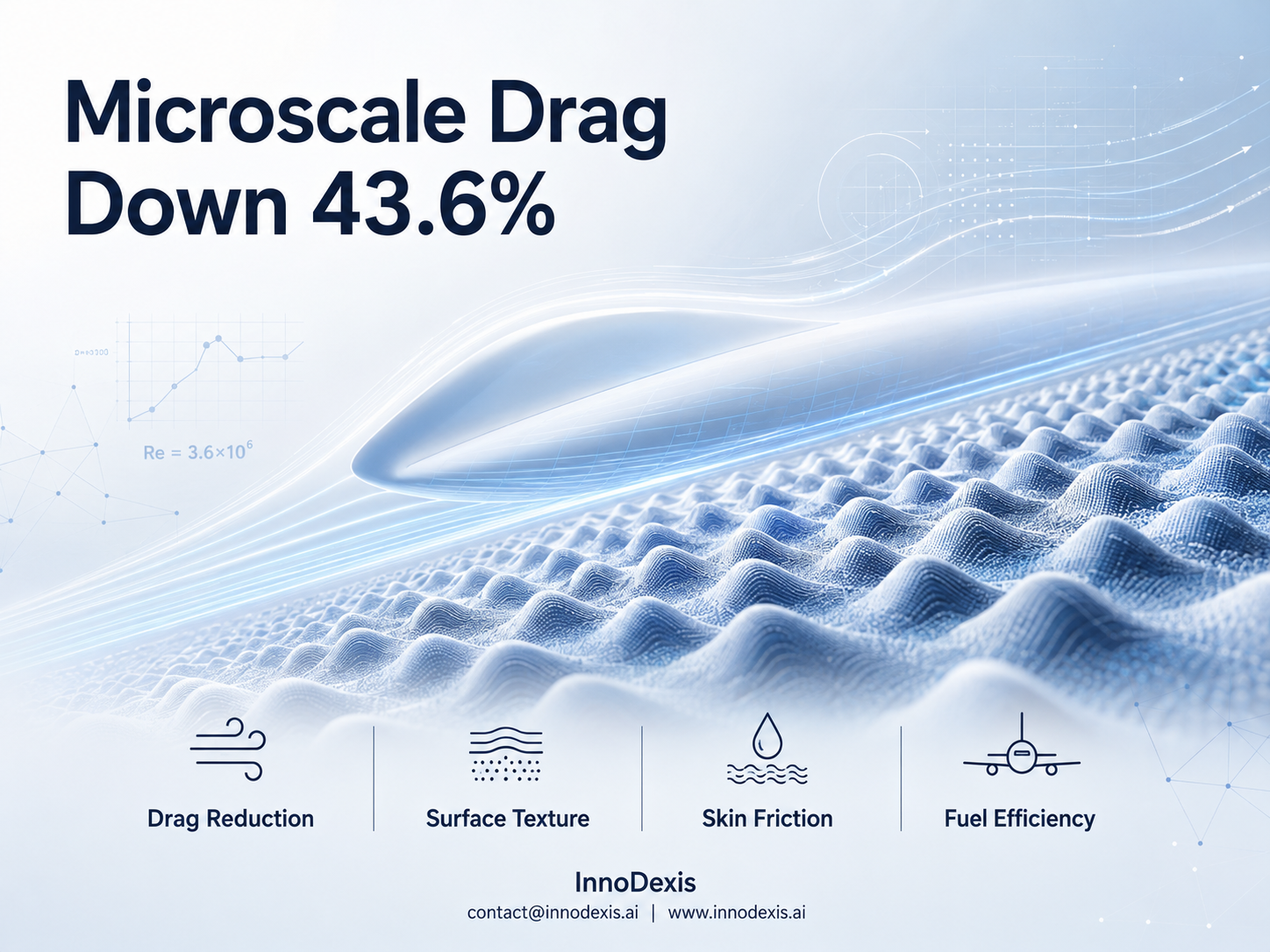
InnoDexis has published its latest Innovation Intelligence Report covering aerodynamic surface engineering, analyzing a high-significance innovation developed across Japan and the United Kingdom. The report reveals that researchers from Tohoku University and Imperial College London have demonstrated that microscale surface roughness — applied as a passive texture requiring no moving parts or power input — reduces aerodynamic drag by up to 43.6%. The finding directly overturns the 80-year engineering assumption that smooth surfaces minimise drag, and carries performance and emissions implications across automotive, aviation, marine, and rail transportation sectors.
Key Findings
A microscale surface texture designated DMR achieved up to 43.6% aerodynamic drag reduction in experimental conditions. This figure represents a passive engineering intervention — no moving components, no energy input, no active control system — making it directly applicable to existing vehicle and infrastructure design without the complexity or cost associated with active drag management systems.
The drag reduction effect was observed at a Reynolds number of Re = 3.6×10⁶, a parameter value that indicates real-world aerodynamic relevance rather than laboratory-only applicability. Reynolds number scaling is the primary test of whether fluid dynamics findings translate from controlled experimental settings to operational conditions across transportation and industrial systems, and this result clears that threshold.
DMR operates within k⁺ ≈ 1.2–1.7 viscous units, a range that is still classified as hydraulically smooth under standard fluid dynamics definitions. This is a technically significant finding because it means the drag-reducing surface texture does not introduce the roughness penalties typically associated with textured surfaces — it achieves friction suppression while remaining within the smooth regime by conventional measurement standards.
The mechanism through which DMR achieves drag reduction is skin-friction suppression, which is physically and mechanistically distinct from the dimple effect observed on golf balls. Golf ball dimples reduce drag by triggering turbulence that delays flow separation — a different physical process operating under different flow conditions. The DMR mechanism therefore represents a genuinely distinct aerodynamic phenomenon rather than an extension of previously understood roughness effects.
The 80-year assumption that smooth surfaces define the aerodynamic optimum for drag minimisation has been experimentally overturned by this research. Every major transportation sector — automotive, aviation, marine, and rail — was designed and engineered around this principle. The dataset identifies fluid-surface interaction as the common performance-governing factor across all of these sectors, meaning the finding opens a new design dimension wherever that interaction is the dominant performance variable.
Strategic Insight and Trend Analysis
The strategic weight of this finding derives from the breadth of its applicability rather than its depth in any single domain. Aerodynamic drag governs fuel consumption, range, and emissions performance across every major transportation mode. The engineering response to drag has been consistent for eight decades: make surfaces smoother. The DMR finding does not refine that principle — it inverts it under defined conditions, introducing microscale roughness as a drag-reduction mechanism that operates through a different physical pathway than anything previously considered in surface engineering practice.
The passive nature of the intervention is the most immediately significant commercial characteristic. Active drag reduction systems — including boundary layer suction, plasma actuators, and riblet films requiring periodic maintenance — carry implementation costs, operational complexity, and reliability constraints that limit deployment at scale. A passive surface texture that delivers 43.6% drag reduction requires none of these, and can in principle be applied during manufacturing or as a retrofit treatment across existing fleets and infrastructure.
The Reynolds number validation at Re = 3.6×10⁶ places the finding within the operating range of real transportation systems, which distinguishes this result from many fluid dynamics advances that demonstrate effects only at laboratory-scale flow conditions. This real-world relevance accelerates the pathway from research finding to engineering specification.
The involvement of Tohoku University and Imperial College London — two institutions with strong applied engineering and materials science capabilities — suggests the research infrastructure exists to advance DMR from experimental demonstration toward prototype integration and sector-specific testing. The next phase of development is likely to involve surface manufacturing scalability, durability under operational conditions, and sector-specific optimisation for automotive, aviation, and marine applications.
Global and Industry Implications
For corporates and R&D teams in automotive, aviation, marine, and rail, the DMR finding introduces a new variable into surface design specifications that has not previously been considered at the engineering level. Organisations with active fuel efficiency and emissions reduction programmes should evaluate DMR surface texture as a candidate intervention, particularly given its passive nature and the absence of moving parts or energy requirements. The manufacturing integration pathway and durability under operational conditions are the primary technical questions requiring resolution before sector-specific deployment.
For investors and capital allocators, the finding signals an emerging surface engineering technology with potential applicability across multiple high-value transportation sectors simultaneously. The passive, manufacturable nature of the intervention means the commercialisation pathway does not depend on complex systems integration — a characteristic that typically reduces go-to-market risk relative to active technology solutions. Early-stage investment opportunities are likely to emerge around DMR surface manufacturing, coating technologies, and sector-specific licensing.
For policymakers and national innovation bodies, the DMR finding has direct relevance to decarbonisation targets across transportation. A passive drag reduction of up to 43.6% applied across commercial aviation, shipping, or automotive fleets would contribute measurably to fuel efficiency and emissions reduction goals without requiring propulsion system redesign or infrastructure change.
InnoDexis Statement
"The DMR surface texture finding reframes the aerodynamic design problem by demonstrating that microscale roughness can suppress skin friction more effectively than smooth surfaces — a structural inversion of the engineering assumption that has governed transportation design for eight decades," noted InnoDexis in its latest intelligence report.
Conclusion
The overturning of the smooth-surface aerodynamic assumption introduces a new design dimension across every sector where fluid-surface interaction governs performance. As DMR surface texture moves from experimental validation toward manufacturing scalability and sector-specific prototype testing, the implications for fuel efficiency, emissions reduction, and transportation engineering standards will become progressively clearer. InnoDexis will continue to monitor developments in surface engineering, aerodynamic drag reduction, and the translation of fluid dynamics research into transportation applications. The complete Aerodynamic Surface Engineering Innovation Intelligence Report is available to InnoDexis subscribers and enterprise clients.
About InnoDexis
InnoDexis is a global Innovation Intelligence platform that tracks, analyzes, and interprets breakthrough innovations, prototypes, and emerging technologies across industries and countries. Its intelligence helps corporates, investors, and policymakers understand the true structure and direction of global innovation. Learn more at innodexis.ai.