MD Anderson Researchers Develop Dual Protein Degrader That Targets MYC in Preclinical Blood Cancer Models After Decades of Failed Drug Design Attempts
GT19630 simultaneously degrades MYC and GSPT1 through the cell's natural protein disposal system, prolonging survival by more than 300% in a preclinical blood cancer model and restoring sensitivity to venetoclax in resistant AML.
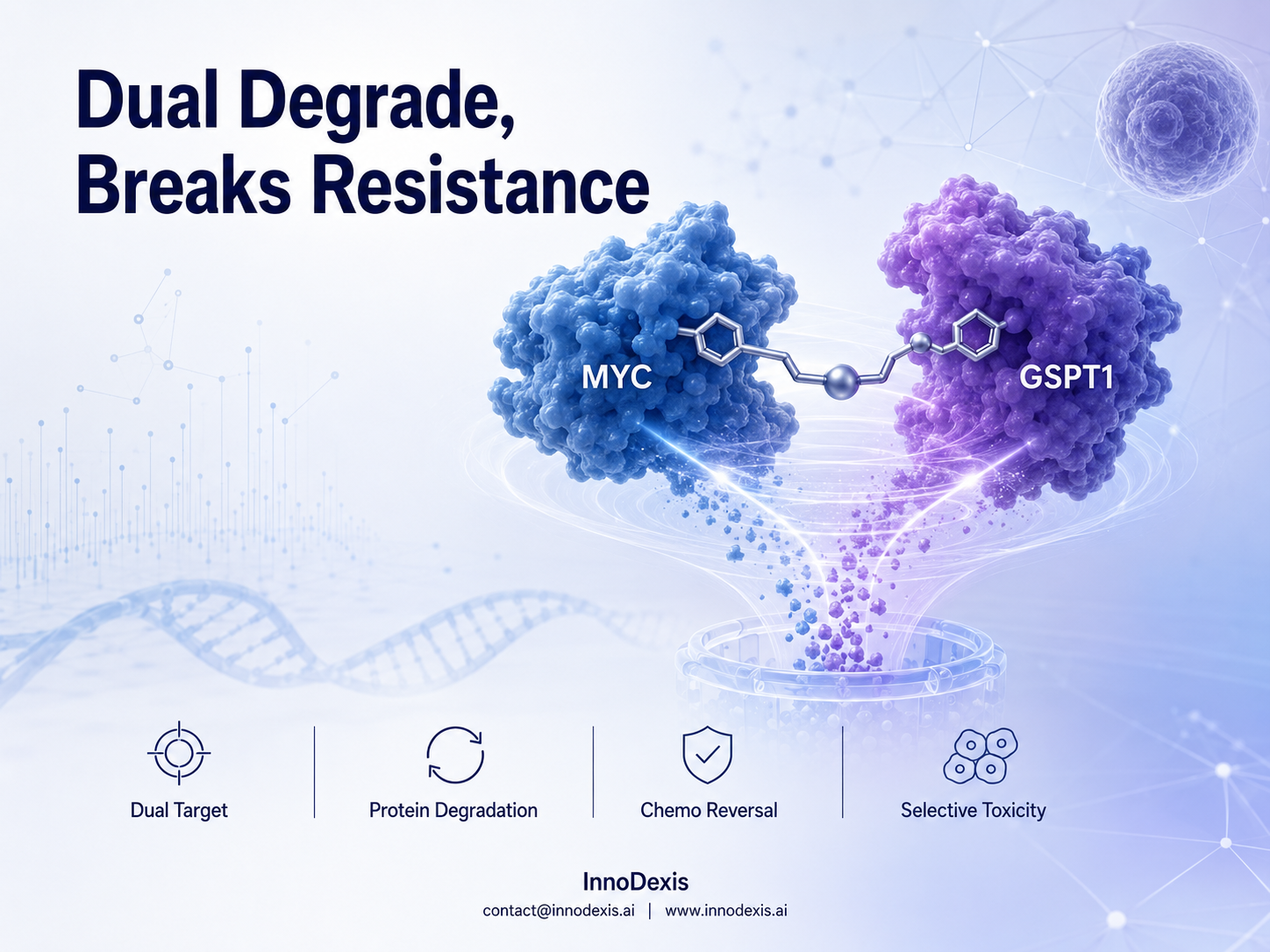
InnoDexis has published its latest Innovation Intelligence Report covering oncology drug discovery and protein degradation technology, analyzing a high-significance preclinical innovation from MD Anderson Cancer Center. The report reveals that researchers have developed GT19630 — a dual protein degrader that simultaneously eliminates MYC and GSPT1 using the cell's own natural disposal system — producing more than 300% survival prolongation in a preclinical blood cancer model and demonstrating selective toxicity toward resistant leukemia stem cells while sparing normal ones. The findings address one of oncology's most persistent unresolved challenges: the therapeutic targeting of MYC, which drives approximately 70% of human tumours and has resisted every prior drug design attempt.
Key Findings
GT19630 prolonged survival by more than 300% in a preclinical blood cancer model, establishing measurable efficacy at the in vivo level for a target that has historically been classified as undruggable. This survival outcome is the primary quantitative signal in the dataset and represents the most direct evidence of therapeutic potential generated by the dual degradation approach.
The degrader simultaneously eliminates both MYC and GSPT1 by exploiting the feedforward relationship between the two proteins through the cell's natural protein disposal system. This dual-target mechanism addresses a biological vulnerability that single-target approaches could not reach — the interdependence of MYC and GSPT1 creates a compounded degradation effect that neither protein alone would produce through independent targeting.
GT19630 restored sensitivity to venetoclax in resistant AML models. Venetoclax resistance represents one of the most clinically significant challenges in acute myeloid leukaemia treatment, and the ability to re-sensitise resistant cells positions GT19630 not only as a standalone therapeutic candidate but as a potential combination strategy within existing AML treatment frameworks.
Selective toxicity toward malignant leukemia stem cells — while sparing normal stem cells — was demonstrated in preclinical results. This selectivity finding carries direct relevance for therapeutic safety potential, as the capacity to discriminate between cancerous and healthy stem cells is a critical determinant of whether a cancer therapy can progress toward clinical application without unacceptable toxicity profiles.
Preclinical results demonstrated therapeutic safety potential distinct from single-target approaches. The dataset notes that the dual-degradation strategy produces a safety profile that differs from single-target degraders, suggesting that the simultaneous elimination of two proteins via a natural disposal mechanism may carry different tolerability characteristics than targeting either protein independently.
Strategic Insight and Trend Analysis
The strategic significance of GT19630 extends beyond its specific performance metrics. MYC's classification as undruggable has shaped oncology drug discovery strategy for decades — directing research away from direct MYC targeting and toward downstream pathway modulation as the primary mechanism for addressing MYC-driven cancers. The feedforward loop between MYC and GSPT1, now demonstrated as an actionable vulnerability, represents a conceptual reframing of how previously inaccessible cancer drivers might be approached.
The dual protein degradation strategy exploits a structural biological relationship rather than attempting to bind directly to MYC's historically intractable surface. By leveraging the cell's own natural disposal system to degrade both proteins simultaneously, GT19630 sidesteps the molecular design challenge that defeated prior approaches — not by solving the original problem, but by reframing it entirely through a different mechanism.
This reframing has implications beyond MYC and AML. The dataset raises the question directly: which other cancer drivers share a comparable feedforward vulnerability? If the GT19630 mechanism demonstrates that feedforward protein relationships can be exploited for simultaneous degradation, the drug discovery implications extend to any oncogenic driver that maintains a codependent protein relationship accessible through the same disposal pathway. The blueprint, if it translates clinically, could open a new class of targets that have been excluded from drug discovery pipelines based on assumptions formed before dual degradation approaches were available.
The restoration of venetoclax sensitivity in resistant AML models adds a further strategic dimension — combination therapy potential with an already-approved agent, which may provide a more direct regulatory and clinical development pathway than a fully novel standalone mechanism.
Global and Industry Implications
For corporates and R&D teams in oncology and drug discovery, GT19630 signals a viable mechanistic pathway for re-engaging targets previously excluded from pipelines on undruggability grounds. The feedforward loop exploitation strategy warrants systematic evaluation across other cancer drivers where codependent protein relationships have been characterised but not yet therapeutically leveraged.
For investors and capital allocators, the preclinical stage of GT19630 places this innovation at an early point in the translational timeline. However, the combination of a more than 300% survival prolongation signal, venetoclax re-sensitisation in resistant models, and a differentiated safety profile relative to single-target approaches constitutes a compelling preclinical package for a target of this strategic importance in oncology. The dual degradation mechanism also represents a platform with potential applicability beyond AML, which broadens the long-term commercial case.
For policymakers and national innovation bodies, the GT19630 findings reinforce the value of sustained investment in foundational cancer biology and novel therapeutic modality research. The capacity to convert a decades-long scientific impasse into a preclinical candidate reflects the compounding return on basic research investment in protein biology and degradation mechanisms.
InnoDexis Statement
"GT19630 reframes MYC targeting not as a solved problem but as a newly opened question — demonstrating that feedforward protein relationships can convert previously undruggable cancer drivers into actionable therapeutic vulnerabilities through dual degradation," noted InnoDexis in its latest intelligence report.
Conclusion
The GT19630 findings mark a meaningful inflection point in the long-standing challenge of targeting MYC-driven cancers. As the dual protein degradation strategy advances through further preclinical evaluation, the oncology field will be watching for evidence that the feedforward loop mechanism translates into clinical efficacy and whether the selective toxicity profile observed in preclinical models holds at scale. InnoDexis will continue to monitor developments in protein degradation technology, MYC-targeting strategies, and the broader application of feedforward vulnerability exploitation across oncology drug discovery. The complete Oncology Drug Discovery Innovation Intelligence Report is available to InnoDexis subscribers and enterprise clients.
About InnoDexis
InnoDexis is a global Innovation Intelligence platform that tracks, analyzes, and interprets breakthrough innovations, prototypes, and emerging technologies across industries and countries. Its intelligence helps corporates, investors, and policymakers understand the true structure and direction of global innovation. Learn more at innodexis.ai.