Manchester Researchers Confirm Electron Interactions as the Driver of Magic-Angle Graphene Superconductivity
A sub-nanometre screening device built by the University of Manchester has resolved a years-long debate by showing that superconductivity in twisted bilayer graphene is completely suppressed when electron interactions are screened, ruling out phonons as the driver.
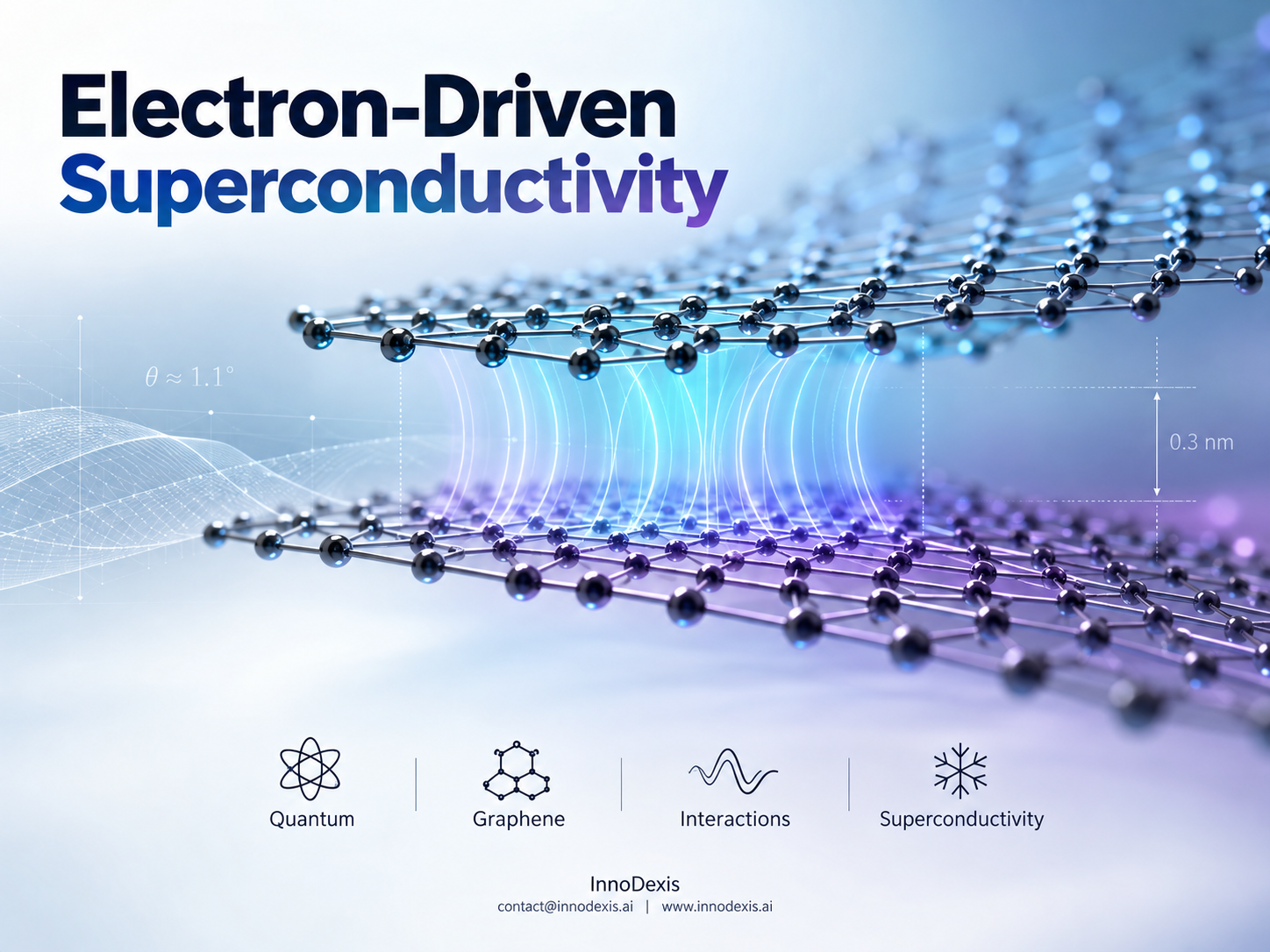
InnoDexis has published its latest Innovation Intelligence Report covering quantum materials and condensed matter physics, analyzing a high-significance innovation led by the University of Manchester in collaboration with researchers across Singapore, Belgium, Japan, and the United States. The report reveals that a graphene device capable of screening electron interactions at distances as short as 0.3 nanometres has provided direct experimental confirmation that electron interactions, rather than lattice vibrations, drive superconductivity in magic-angle twisted bilayer graphene — resolving a question that had shaped competing research directions in the field for years.
Key Findings
Superconductivity was completely suppressed when electron interactions were screened at a separation of just 0.3 nanometres. This complete suppression is the central experimental result of the study, providing direct evidence that rules out phonons — lattice vibrations — as the mechanism behind magic-angle graphene's superconducting behaviour.
The superconducting critical temperature was reduced by more than one order of magnitude under screening conditions. A reduction of this scale demonstrates that electron interactions are not a marginal contributor but the dominant factor governing the material's superconducting transition temperature.
The device architecture positioned two twisted graphene bilayers separated by less than one nanometre while keeping them electronically decoupled. This engineering achievement is significant in its own right, as maintaining electronic decoupling at sub-nanometre separation is what allowed the researchers to isolate and screen electron interactions without disrupting the broader device structure.
Correlated insulating states in the material also disappeared under the same screening conditions. This finding extends the significance of the result beyond superconductivity alone, indicating that electron interactions underpin multiple correlated quantum phenomena observed in magic-angle graphene, not superconductivity in isolation.
The study's method relies on direct experimental suppression rather than the indirect signatures — such as isotope effects or spectroscopic proxies — that prior studies in this field have used to infer the pairing mechanism. This distinction is significant because it shifts the evidentiary basis for the field from inference to direct causal demonstration.
Strategic Insight and Trend Analysis
The dominant trend emerging from this dataset is the resolution of a foundational mechanistic question that had constrained progress across an entire research area. For years, competing phonon-based and electron-interaction-based theories coexisted in the twisted bilayer graphene field, with research directions splitting depending on which mechanism a given group considered more likely. This device removes that ambiguity through direct experimental suppression rather than indirect inference, providing the field with a confirmed mechanism to build upon rather than a contested one.
This shift from contested theory to confirmed mechanism carries structural significance beyond graphene research specifically. The report places magic-angle graphene's superconductivity in the same mechanistic class as high-temperature cuprate superconductors, both of which are now understood to be driven by electron interactions rather than phonons. This classification matters strategically because it means insights and methodologies developed in one material system may now transfer more directly to the other, rather than researchers needing to separately resolve the pairing mechanism in each material class.
The sub-nanometre screening method itself represents a transferable experimental capability. Because the technique demonstrated the ability to isolate and suppress electron interactions at distances as short as 0.3 nanometres while maintaining electronic decoupling between graphene layers, it establishes a methodological approach that could be applied to probe unresolved pairing mechanisms in other correlated quantum materials beyond twisted bilayer graphene.
Resolving the pairing mechanism also has a direct bearing on the broader search for higher-temperature superconductors, as it tells researchers which theoretical and experimental directions are worth prioritising rather than continuing to explore mechanisms now experimentally ruled out.
Global and Industry Implications
For corporates and R&D teams in advanced materials and quantum technology sectors, the confirmed mechanism narrows the design space for future superconductor research, allowing R&D investment to concentrate on electron-interaction-driven approaches rather than dividing resources across competing theoretical frameworks.
For investors and capital allocators, the resolution of a long-contested mechanistic question reduces scientific uncertainty in a research area with long-term relevance to superconducting materials and quantum computing hardware, providing a firmer evidentiary basis for evaluating early-stage ventures in twistronics and correlated quantum materials.
For policymakers and national innovation bodies, the multinational research collaboration spanning the United Kingdom, Singapore, Belgium, Japan, and the United States illustrates the value of coordinated international investment in fundamental quantum materials research, where mechanistic breakthroughs of this kind require combined experimental and theoretical expertise across institutions.
InnoDexis Statement
"Direct experimental suppression of superconductivity through electron interaction screening resolves a mechanistic question that has divided the twisted bilayer graphene field for years, replacing indirect inference with confirmed causal evidence," noted InnoDexis in its latest intelligence report.
Conclusion
As the confirmed electron-interaction mechanism reshapes research priorities in twisted bilayer graphene, the sub-nanometre screening method developed by this collaboration may prove equally significant as a transferable tool for probing unresolved pairing mechanisms in other correlated quantum materials. InnoDexis will continue to monitor developments in quantum materials research, twistronics, and the search for higher-temperature superconductors as this confirmed mechanism informs the next phase of experimental and theoretical work. The complete Quantum Materials Innovation Intelligence Report is available to InnoDexis subscribers and enterprise clients.
About InnoDexis
InnoDexis is a global Innovation Intelligence platform that tracks, analyzes, and interprets breakthrough innovations, prototypes, and emerging technologies across industries and countries. Its intelligence helps corporates, investors, and policymakers understand the true structure and direction of global innovation. Learn more at innodexis.ai.