Machine Learning Accelerates Photocatalyst Discovery for Hydrogen Production — 16× Performance Increase Demonstrated in Japan
InnoDexis Analysis Shows Materials Informatics Can Rapidly Identify High-Performance Dopants for Next-Generation Photocatalysts
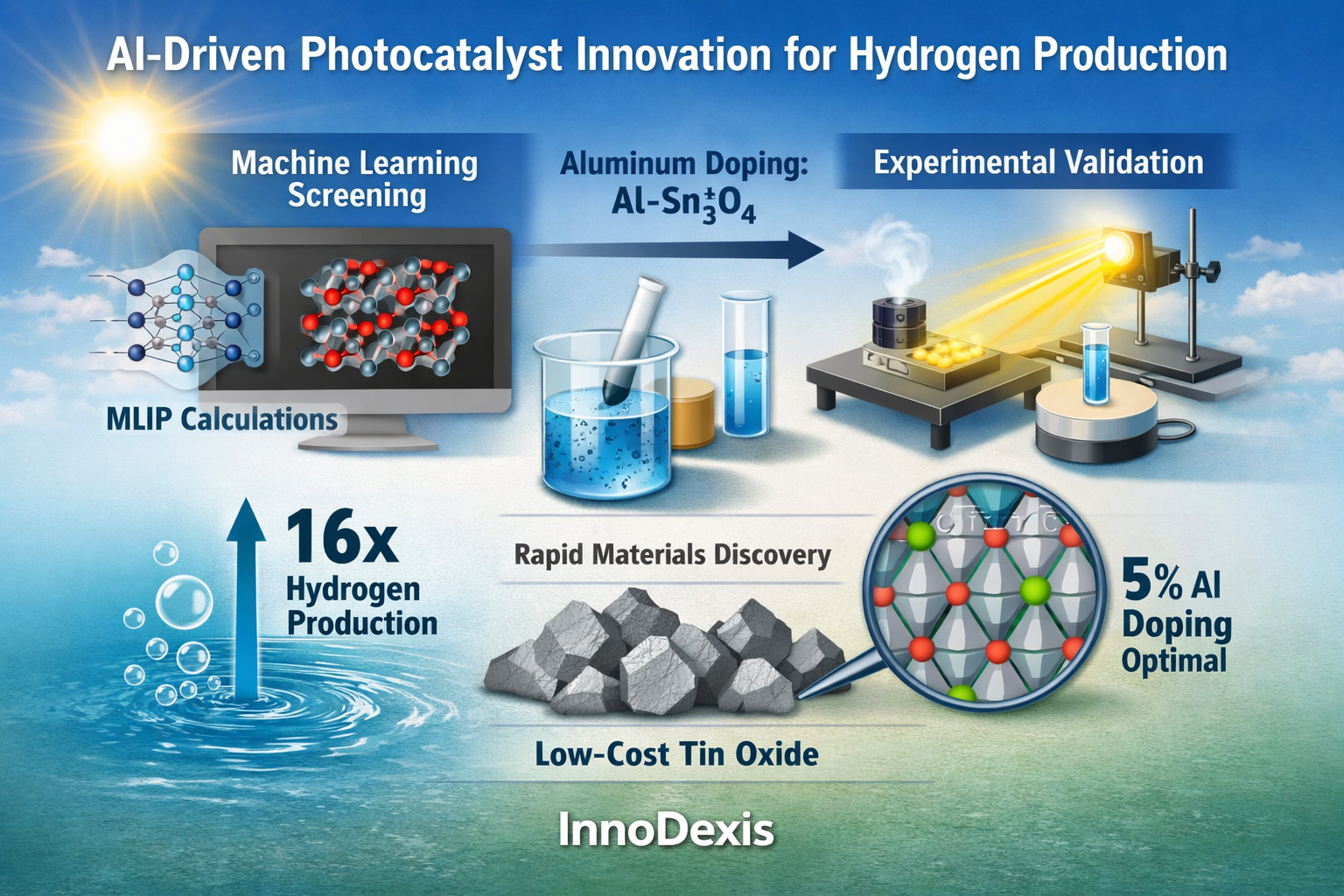
InnoDexis has published its latest Innovation Intelligence Report covering materials informatics applications in photocatalyst design for hydrogen production, analyzing a newly reported innovation from Japan developed through collaboration between Institute of Science Tokyo, the National Defense Academy of Japan, and Mitsubishi Materials Corporation during 2026. The report reveals that machine-learning-driven materials screening can dramatically accelerate photocatalyst development, with researchers experimentally validating aluminum-doped orthorhombic Sn₃O₄ that achieved 16 times greater hydrogen production under visible light compared with the undoped material. The work demonstrates how computational materials discovery can replace traditional trial-and-error experimentation in clean energy materials research.
KEY FINDINGS
A materials informatics strategy enabled researchers to identify effective dopants for a newly discovered photocatalyst material. Scientists used machine learning interatomic potential (MLIP) calculations to computationally screen potential dopants capable of stabilizing and enhancing the performance of orthorhombic Sn₃O₄, a newly studied photocatalyst candidate. This approach allowed the team to predict thermodynamically favorable dopants before conducting laboratory experiments, significantly narrowing the search space compared with traditional empirical experimentation.
The computational predictions led to the identification of aluminum as a highly effective dopant for the material. After screening potential candidates using MLIP simulations, researchers synthesized aluminum-doped samples through a hydrothermal synthesis method, allowing them to experimentally evaluate photocatalytic performance under visible light conditions. This integrated computational-experimental workflow enabled rapid validation of predicted material properties.
Experimental results demonstrated a 16-fold increase in hydrogen production when aluminum was incorporated into the material. The aluminum-doped orthorhombic Sn₃O₄ photocatalyst produced 16 times more hydrogen than the undoped version, representing a substantial performance improvement in water-splitting photocatalysis.
The study also identified an optimal doping concentration of approximately 5% aluminum, which delivered the strongest hydrogen generation performance among the tested samples. This finding highlights the importance of precisely tuned dopant concentrations when optimizing photocatalytic materials.
Beyond the specific material discovery, the research validated MLIP calculations as an effective method for screening dopants in newly discovered materials. The approach demonstrates that machine-learning-driven modeling can rapidly identify stable and high-performing chemical modifications that would otherwise require extensive experimental testing.
The base material used in the research—tin oxide-based compounds—is characterized by low cost and strong chemical stability, suggesting potential scalability for practical photocatalytic hydrogen production technologies.
STRATEGIC INSIGHT AND TREND ANALYSIS
The research highlights a broader transformation occurring in materials science: the integration of artificial intelligence-driven modeling with experimental materials engineering. Traditionally, the discovery of new functional materials has relied heavily on iterative experimentation—testing numerous chemical modifications through slow, resource-intensive trial-and-error processes. The materials informatics approach demonstrated in this study represents a structural shift away from that paradigm.
By applying machine learning interatomic potential calculations, researchers can simulate atomic interactions and thermodynamic stability across numerous candidate dopants before synthesizing any material in the laboratory. This capability significantly reduces the time required to identify promising compositions and accelerates the transition from theoretical materials design to validated functional materials.
In this case, the MLIP framework enabled the identification of aluminum as a stable and effective dopant for orthorhombic Sn₃O₄, allowing researchers to focus experimental work on the most promising candidate rather than exploring an extensive chemical search space. The resulting 16-fold performance improvement demonstrates how targeted computational predictions can translate directly into measurable performance gains.
The research also underscores the growing convergence between computational science, experimental materials engineering, and industrial collaboration. The project involved academic researchers from Institute of Science Tokyo, scientists from the National Defense Academy of Japan, and industry participation from Mitsubishi Materials Corporation. Such cross-sector collaboration is increasingly central to accelerating materials discovery pipelines.
More broadly, the study suggests that materials informatics methods such as MLIP simulations could become a foundational tool for identifying functional materials across multiple sectors. While the research focused on photocatalysts for hydrogen production, the same computational screening methodology could potentially be applied to other materials challenges, including catalysts, semiconductors, batteries, and structural materials.
GLOBAL AND INDUSTRY IMPLICATIONS
For corporates and industrial R&D teams, the findings highlight the potential for AI-driven materials discovery to significantly reduce development timelines for advanced materials. By integrating computational screening tools into research pipelines, companies may be able to identify promising material compositions more efficiently and reduce costly experimental exploration.
For investors and capital allocators, the work signals increasing momentum in technologies that combine artificial intelligence with materials science. As machine-learning-driven discovery tools mature, they may accelerate the commercialization timelines for next-generation energy materials and catalysis technologies.
For policymakers and national innovation systems, the research demonstrates the importance of supporting interdisciplinary collaboration between academic research institutions, defense-related research organizations, and industrial partners. Such collaborations are becoming central to advancing clean-energy technologies and strengthening national capabilities in strategic materials innovation.
INNODEXIS STATEMENT
“Integrating machine-learning-driven materials modeling with targeted experimental validation is emerging as a powerful pathway for accelerating clean-energy materials discovery,” noted InnoDexis in its latest intelligence report.
CONCLUSION
The development of aluminum-doped orthorhombic Sn₃O₄ illustrates how computational materials science can dramatically accelerate the discovery of high-performance photocatalysts for hydrogen production. By combining MLIP-based simulations with experimental validation, researchers demonstrated a method capable of rapidly identifying effective dopants for newly discovered materials.
As the global search for scalable clean-energy technologies intensifies, approaches that reduce the time and cost required to develop functional materials are likely to become increasingly important. Materials informatics strategies such as those demonstrated in this research may play a critical role in enabling faster innovation cycles across the energy and advanced materials sectors.
The complete Innovation Intelligence Report on AI-Driven Photocatalyst Discovery for Hydrogen Production is available to InnoDexis subscribers and enterprise clients.
ABOUT INNODEXIS
InnoDexis is a global Innovation Intelligence platform that tracks, analyzes, and interprets breakthrough innovations, prototypes, and emerging technologies across industries and countries. Its intelligence helps corporates, investors, and policymakers understand the true structure and direction of global innovation. Learn more at innodexis.ai.