Longitudinal Genomic Study Indicates Chronic Blood Cancers Can Be Detected Years Before Symptoms
A 25-year dataset reveals that certain blood cancers evolve gradually, leaving measurable genomic signals long before clinical diagnosis.
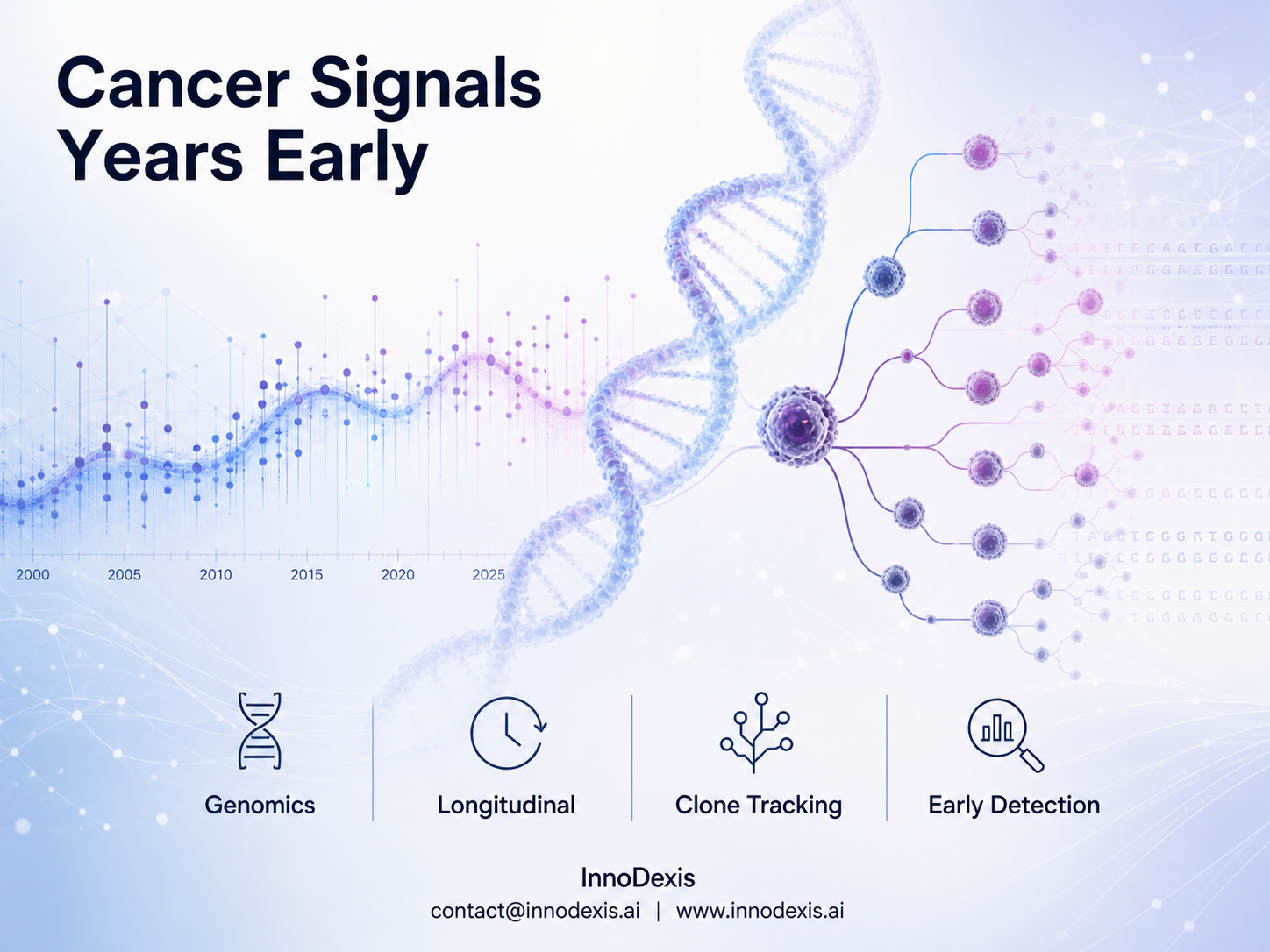
InnoDexis has published its latest Innovation Intelligence Report covering genomic oncology research, analyzing a 25-year longitudinal study conducted by the Wellcome Sanger Institute. The report reveals that some chronic blood cancers are not sudden-onset conditions but evolve over extended periods, leaving detectable traces in DNA years before symptoms appear. By combining genomic sequencing with long-term clinical data, the findings indicate that cancer progression may be observable as a measurable timeline rather than a single diagnostic event.
Key Findings
The study tracked 30 patients over a 25-year period, generating a longitudinal dataset that integrates more than 450 genomic samples with approximately 8,000 blood tests. This extended time horizon provides a detailed view of how cellular changes accumulate and evolve prior to clinical diagnosis.
Genomic sequencing enabled the construction of cellular “family trees,” allowing researchers to map how cancer-associated clones originate, expand, and interact over time. This approach provides a structural understanding of disease evolution rather than a snapshot at the point of detection.
The data identifies divergent disease trajectories between stable and progressive conditions. Some cellular populations remain relatively unchanged over time, while others acquire mutations that lead to increasingly aggressive forms of disease, indicating variability in progression pathways.
Specific mutation profiles offer diagnostic clarity. The absence of mutations such as JAK2, CALR, and MPL may correspond to normal biological aging processes rather than malignancy, providing a basis for distinguishing between benign and disease-related changes.
The combination of longitudinal monitoring and genomic analysis suggests that early-stage disease signals can be detected well before conventional diagnostic thresholds are reached. This enables the possibility of identifying risk patterns prior to symptom onset.
Strategic Insight and Trend Analysis
The findings from the Wellcome Sanger Institute indicate a shift in how cancer may be understood and managed, moving from a reactive diagnostic model to a predictive, timeline-based framework. Rather than identifying cancer at a fixed point, the data supports the concept that disease progression can be tracked as a continuous biological process.
The ability to reconstruct cellular lineage through genomic data introduces a new analytical layer in oncology. By observing how mutations accumulate and propagate, clinicians and researchers can gain insight into not only whether cancer is present, but how it is likely to evolve. This represents a transition from static diagnosis to dynamic disease modeling.
The distinction between stable and progressive disease trajectories further reinforces the importance of temporal analysis. Not all detected mutations lead to aggressive outcomes, and the ability to differentiate between these pathways may reduce unnecessary interventions while enabling earlier action in high-risk cases.
The absence of specific mutations as an indicator of normal aging also highlights the role of negative signals in diagnosis. This suggests that future diagnostic systems may rely as much on what is not present as on what is detected, refining the precision of clinical decision-making.
Overall, the study reflects a broader trend toward integrating genomics with longitudinal health data to create predictive frameworks. This approach positions cancer not as an isolated event, but as a process that can be monitored, interpreted, and potentially anticipated over time.
Global and Industry Implications
For corporates and R&D teams, the findings suggest opportunities in developing longitudinal genomic monitoring platforms that integrate sequencing, data analytics, and clinical interpretation. Technologies that enable continuous tracking of disease progression may become central to future oncology pipelines.
For investors and capital allocators, the shift toward predictive oncology indicates potential in companies focused on early detection, genomic data infrastructure, and longitudinal health analytics. The ability to identify disease risk years in advance may redefine value creation across healthcare innovation.
For policymakers and national health systems such as the National Health Service, the findings highlight the potential for early, data-driven interventions to reduce long-term treatment costs and patient burden. Integrating predictive diagnostics into screening frameworks may support more efficient resource allocation.
InnoDexis Statement
The longitudinal evidence indicates that cancer progression can be interpreted as a measurable timeline, suggesting that future oncology systems may shift toward forecasting disease trajectories rather than reacting at the point of diagnosis,” noted InnoDexis in its latest intelligence report.
Conclusion
The 25-year genomic study highlights a structural shift in oncology, where early biological signals may enable the anticipation of disease years before clinical manifestation. As genomic sequencing and longitudinal data integration continue to advance, healthcare systems may move toward monitoring disease trajectories rather than diagnosing endpoints. This transition has implications for screening, diagnosis, and treatment design across global healthcare ecosystems. The complete Genomic Oncology Innovation Intelligence Report is available to InnoDexis subscribers and enterprise clients.
About InnoDexis
InnoDexis is a global Innovation Intelligence platform that tracks, analyzes, and interprets breakthrough innovations, prototypes, and emerging technologies across industries and countries. Its intelligence helps corporates, investors, and policymakers understand the true structure and direction of global innovation. Learn more at innodexis.ai.